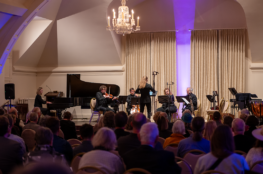
Navigating the mistiest Milwaukee September in memory, I park on Center Street, across from the Jazz Gallery Center for the Arts in Riverwest. Air that breathes like water in early autumn appears to be the ideal condition for a music festival called The Brain in the Cupboard, where electronic, world fusion and experimental audio awaits. New season, new sounds to be found for Milwaukee Music Notes.
Paul Maceri – the creator and purveyor of The Brain in the Cupboard, a Midwestern series of music festivals making its first stop in Milwaukee – curated a four-artist lineup that launched into orbit just after 7 p.m. I spoke to one of those acts: J. Sincock, a visual and sound artist of experimental soundscapes and field recordings working out of Racine. Here’s what he had to say:

If someone has inspired you through their service, leadership or dedication, the Unity Awards are your opportunity to recognize them!
What music or sounds got you excited when you were a little kid?
I think some of my earliest memories of music were in movies or TV shows. I also remember hearing a classical or opera album in grade school that was really dark and mysterious. The music that really opened my mind was when I found a John Cage album at the library, maybe in sixth or seventh grade. A weird find for a kid, but influential, I guess! Around that time, I was also really interested in “playing” the multiband radio my parents had, finding the noise rhythms and ghostly voices between the stations. I only recently realized that was a Cage influence when I found a reissue of Nova Musicha No.1 and saw he had a piece called “Radio Music” that used a radio in that way.
What inspired you to make your own sounds?
I’ve always liked to figure out new creative things, and experimental music seemed like something I might be able to do. In the mid-to-late ’80s, I was listening to stuff like Nurse with Wound, the Hafler Trio, Illusion of Safety, and seeing bands like Boy Dirt Car and F/i, and at some point thought I’d try my own music. It was probably around 1990 or so when I picked up a Casio CZ-101 synth and a cheap Radio Shack four-channel mixer and would just record live to tape with my solo work, and later to four-track with another friend I was making weird music with.
Has your brain ever before been in a cupboard?
Hmm. I’d say it has been tucked in a shoebox at the back of a shelf, but I hadn’t checked the cupboard!
Why is creating stuff so important for humans?
I think it is a way to share parts of ourselves that might be harder through regular communication. I also feel there is a meditative process to creating that can help you be more present and not dwell on things from daily life.
What’s good about the music scene in Milwaukee and in Wisconsin?
I had spent around 20 years living in Colorado, and it has really only been the past couple years that I’ve been reconnecting with parts of the Milwaukee music scene. When I first moved back so many of the venues I used to see music at in the ’80s and ’90s were gone and bulldozed, and I wasn’t really sure what the scene was like anymore. Illusion of Safety, Boy Dirt Car and others playing at the Jazz Gallery last year is probably what motivated me to start checking out the scene a bit more again. It is nice to see there is a thriving experimental scene and interesting small venues having shows.
Anything people should know about your work?
While I’ve been making music for about 35 years, my photography and art was always my main focus. Music was more a hobby that I never really tried to do much with or even shared with many people. In Colorado in the late ’90s, my friend Timmy Pitschka and I had a music project called Xerst, which was probably the one time I was more focused on the music, and shopped our music to some record labels in Europe, and considered playing live. For a long time, my workflow was using a Mac and Logic Pro and recording track by track, but that always felt more clinical for me. In 2024, I switched to the iPad for mixing and recording in more of a “live to cassette” method like I used to do in the past. The portability is so nice. I can record in the studio with hardware instruments or sit on the porch and use software instruments. The past year I’ve been posting a lot more of my music from over the years and decades, which feels good to finally put it out there.
The Brain in the Cupboard Review – Saturday, Sept. 19 at the Jazz Gallery Center for the Arts
J. Sincock
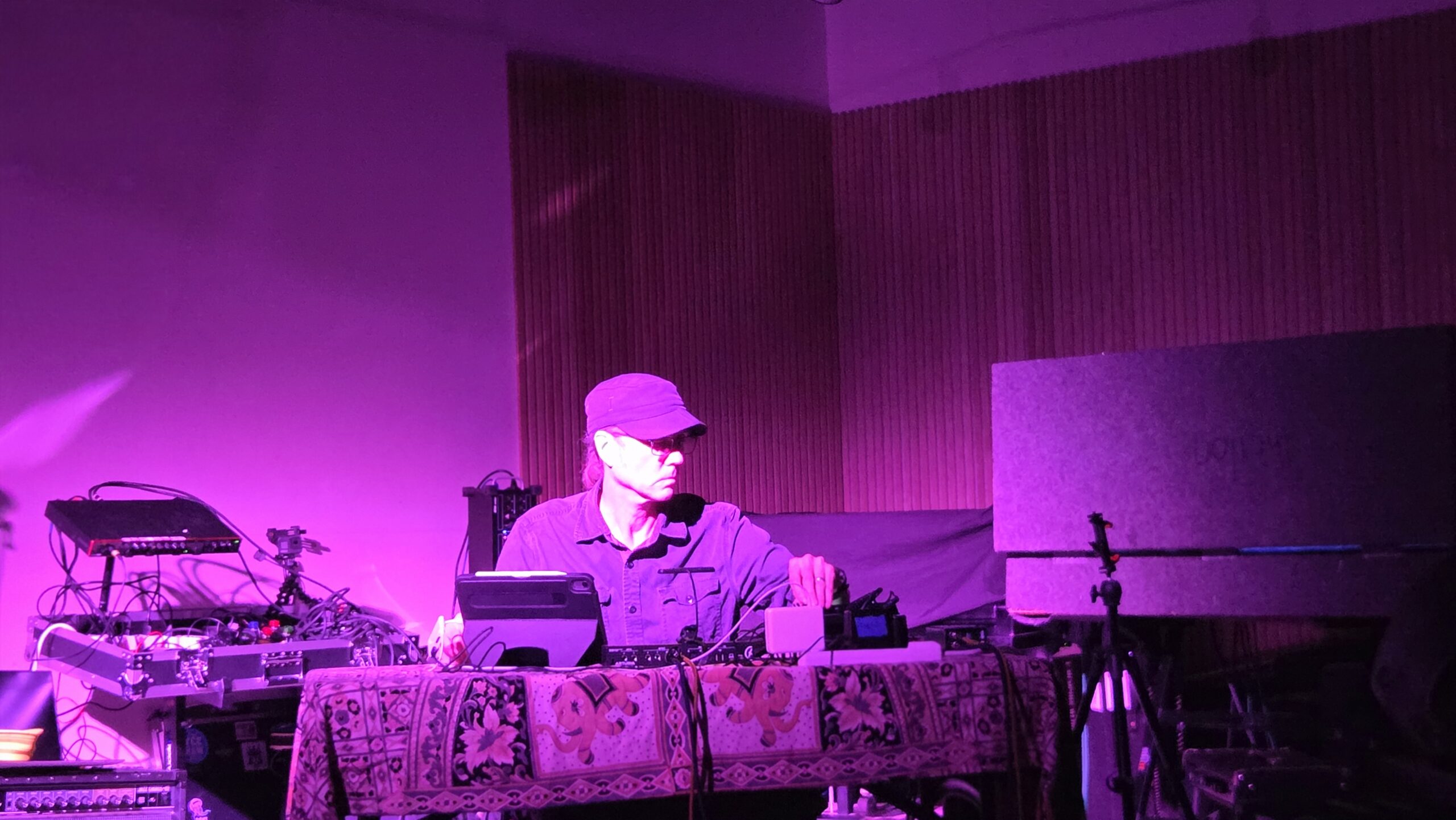
Racine’s own visual and sound artist J. Sincock leads off, plugging in various wires to various things, and I’m amid sounds one might not immediately recognize as music. We’re pulled forward and backward by audio spectacularly spaced out and quiet. The click of my pen is audible beneath the slow roar of ambient outgrowth. The gallery walls are talking, and I haven’t taken drugs since – oh, when was that? But this dose of frequency works better: It’s the highway of vibe, all exit. The tempo picks up and the machine hums helicopter lullabies hovering in pure violet, like dreaming at the highest possible velocity. Is he playing the industrial cicada? Does summer end? Must we scratch autumn’s itch? Suddenly meshing seamlessly with the watery traffic streaming past on Center Street, Sincock’s circumjacent symphony is over.
Ihcilon
Looming beyond a rectangular expanse of electronics, Illinois’ Ihcilon (the alias of festival creator Paul Maceri) unearths sounds I’d like to trademark as Boiler Room Gary Numan. What am I saying? The noise has great cyborgian gulps and coughs, layered in a fuzz of gurgling zen – frightening and inviting, like the best of Numan. Consider the mechanical riff of “Metal” played at various speeds and intensity: This, I dig. Emerging from the Korg-based sounds of inexplicable blue, I imagine this performance as the perfect tones to enjoy at an abandoned swimming pool party at the condemned high school dance.
Kelli Frances Corrado
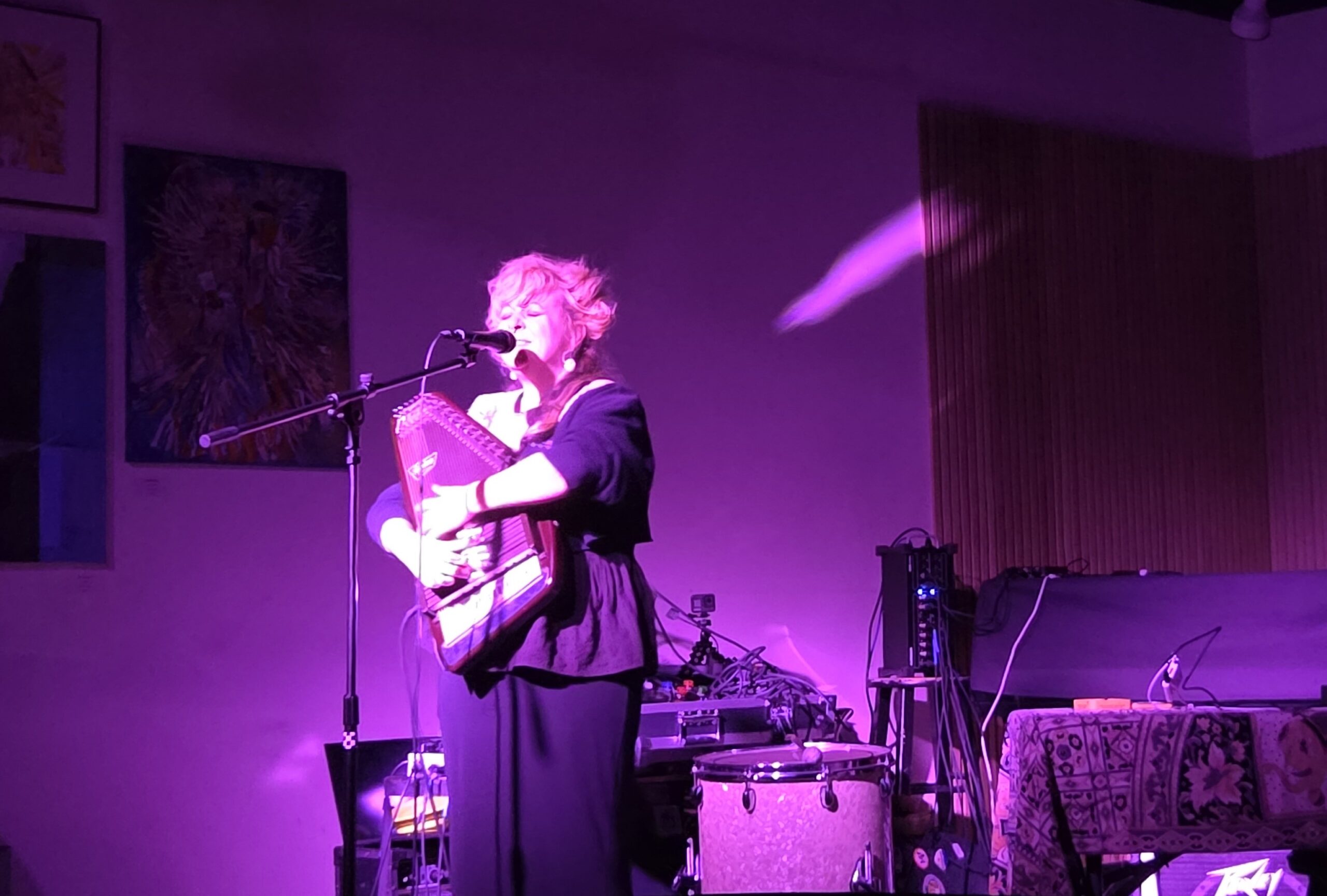
Touted by The Wire for her “haunted folk sensibilities which focus on presence and healing,” Chicago’s Corrado coaxes ethereal vibrations from an autoharp, along with looping surprises in songs of lunar pursuit. Someone scribbled “feral Portishead” in my Wexford memo book; I can only assume he meant to say the vocals came wild from a caldron steaming with jazz tradition and ionosphere. Corrado’s songs were incantations that demand repeat listen, spellbound for glory, her voice pure as moonbeam.
Bellysauce
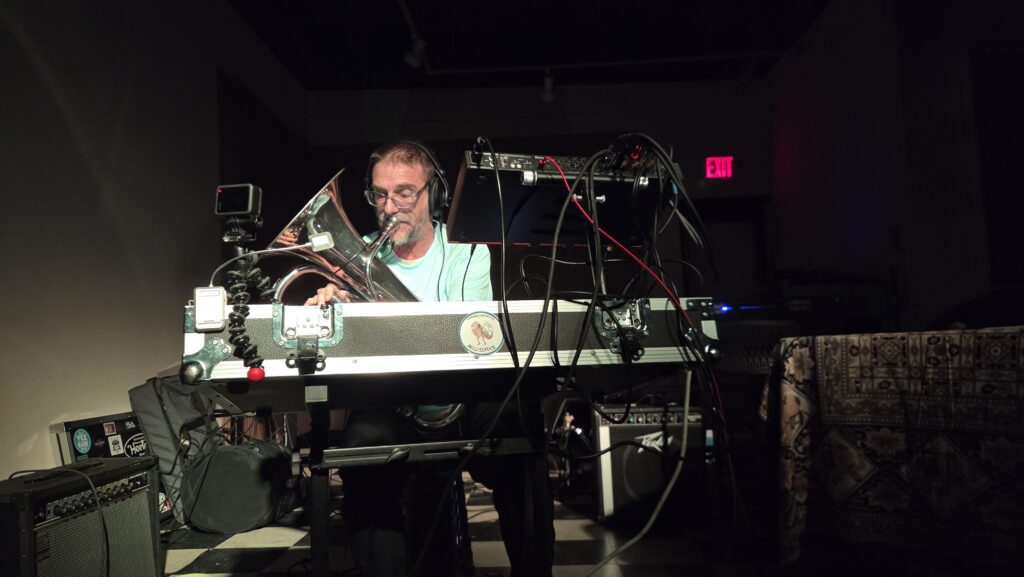
One knows they have reached the proper outer limits of music when the artist ambles on stage to plug his tuba into some sort of sound deck and commences to blow beautiful notes into our summer’s last Saturday. It sounds like a celebration of the unreal, conjuring a question unasked by Phillip Dick: Does a tuba dream of electric sheep? We ride the dark wave of Nashville’s Bellysauce through corridors of tuba trip-hop and the mournful emissions that belie the technological realities teeming before our worried eyes.
Reflections Upon Placing My Brain in the Cupboard
If AI learns to curate a show this unusual, this satisfyingly abnormal, I will throw my phone into Lake Michigan. Maybe I should do that regardless. The Brain in the Cupboard stocked us with sounds both cavemen and futuristic, time repeating itself in unpredictable order, here before, gone tomorrow. The beast or beast perceived persists, even if the song is over.