

It may have been F. Scott Fitzgerald’s Gatsby who said it first, but “Summer Days,” by Bob Dylan says it better:
She’s looking into my eyes, she’s holding my hand
She says, “You can’t repeat the past.” I say, “You can’t?
What do you mean, you can’t? Of course you can.”
Where do you come from? Where do you go?
For music lovers, we may not repeat the past, but we certainly repeat our favorite songs, year after year. Where we’ve come from goes hand in hand with where we go to next.
When we’re looking to feel a certain way, we go back to the musical memories of our youth. Sometimes I want the crackle of vinyl, other times the ca-chunk and rumble of a cassette tape. If you crave the specific artistry of your favorite band on cassette, you’re in luck.
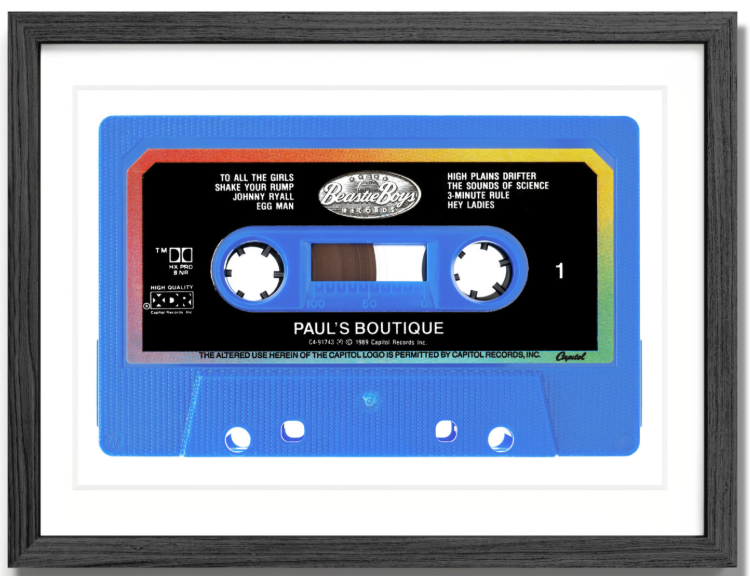
Milwaukee-area artist Jeff Delzer describes himself as a “cultural archaeologist with a specific focus – cassette tapes.” Delzer digs deep into the archives of musical formats for a medium many might not currently employ: Known for their distinctive sound quality and car-ready portability, the cassette tape ruled the 1980s, its heyday stretching through the early 90s, until compact discs took over. Delzer creates these prints under his business reWinder.

Gift An Issue For $1 Today!
The cassette tape case mirrored the album cover in rectangular miniature, losing some of the dramatic appeal, but the tape itself was a unique beast. Typically manufactured with the song titles on each side, along with album title and production label, tapes delivered a mixed bag of artistry, many of which are difficult to track down nowadays.
On a wave of a Gen-X-led revival in cassette tape interest, Delzer has found a way to generate greater appreciation for both the nostalgia and vibe in a simple, but elegant way: he’s making tapes big again. And by big, I mean 13″ x 19″ prints of the original tape, which Delzer creates by using actual tapes that he painstakingly cleans to pristine condition and professionally photographs, creating clean prints suitable for framing.
“My dedication to finding original music cassettes of all varieties from around the world – and putting them through the photo studio to take something smaller than our smartphones and turn it into a larger than life document of a time and place in music. All the detail, character, wear patterns, typos and mass produced aspects are on full display,” he said. “It’s an absolute blast as I see my effort as a cultural archaeologist with a specific focus – cassette tapes.”
Vibing over our mutual appreciation for Siamese Dream by Smashing Pumpkins, Nirvana and Metallica, leading him to explain another component to his creations: blowing up original ticket stubs to wall-art size.
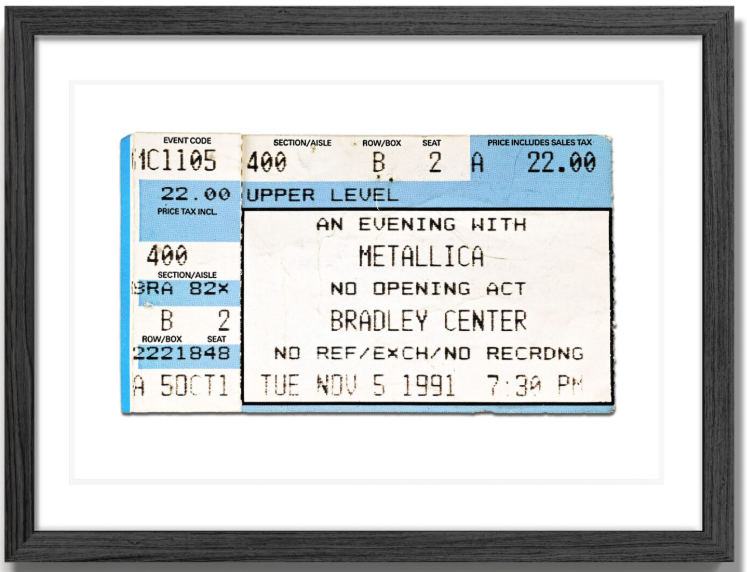
He especially pines for stubs that took place at venues no longer standing, “Metallica at the Bradley Center, Nirvana at the Mecca, those places aren’t even there anymore.”
I asked Delzer what bands inspired him as a young music lover, and the answer was not at all what I expected. “Alice Donut is one, and Drive Like Jehu, late 80s, early 90s San Diego, pretty hard punk,” he said. “The specificity is kind of where it’s at, if I dig it, there’s a chance others will dig it too.”
We chatted more about the thrill of the chase for elusive cassette tapes, many of which are getting harder to track down by the year. I asked if Delzer had a “white whale” tape, a cassette that appears to have disappeared from the musical landscape. His answer took me aback, as it just so happened to be one of my favorite albums of all time, released in 1999.
“The Soft Bulletin by The Flaming Lips, That’s the cassette I can’t get,” Delzer remarked. “That’s the perfect one, I have yet to find it.”
He also spoke on another hard to find tape, to complete a collection.
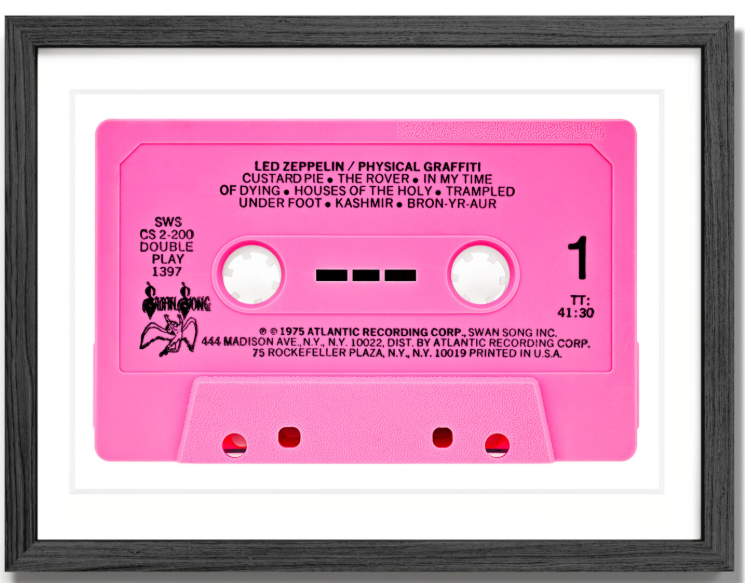
“I managed to find all the Led Zeppelin cassettes in this bubble gum pink; taking those tapes and blowing them up, they look like Andy Warhol screen prints,” said Delzer. “They’re gorgeous, but the only one I don’t have is, In Through The Out Door, I would love to find it.”
Delzer said he gets hundreds of requests, both for cassette tapes to blow up for wall art, and for ticket stubs.
“The Melvins, Fugazi, they need some love. People are like, what about U2, Black Sabbath, Depeche Mode, and my answer is always, not yet, but let’s do it,” he remarked. “If you have a cassette or a ticket stub that you want to see amplified, we can do it.
I asked if he’s willing to provide the service for homemade mixtapes, of which I still own quite a few. “Oh yes, anything’s on the table, that kind of stuff’s the best,” said Delzer. “There’s nothing more intimate than spending time selecting, sequencing songs and writing them up, that’s a treasure.”
Though I have been referred to as the “just above average Gatsby” on more than one occasion, I have no hopes to repeat the past. The joy in music has always been the act of discovery, or re-discovery. We can’t quarantine the past, but Delzer’s art does allow us to rediscover the joy of our favorite musical medium, in full color and fit for framing.
“The thing that’s most joyful about this is I feel like a conduit who connects some dots that maybe people haven’t,” said Delzer. “I want it to be exactly the way they remember it.”