
Ken Fitzsimmons, writer, performer and member of Milwaukee’s own Little Blue Crunchy Things has created a multimedia “rock and roll history show” called After The War: 1919, that presents incredibly uncommon and moving stories related to Wisconsin’s role during and immediately after WWI.
Beneath a blurring halo of streetlights, The Cooperage, with its old bones connecting to Milwaukee’s industrial apex made an ideal venue to house a show spotlighting our complex past. As the program to the show states, it was a time when “Americans fought a war ‘to make the world safe for democracy’ and now are fighting for democracy at home.”
To understand more and gain deeper context before the show, I connected with creator Ken Fitzsimmons, who through Mobilize The Poets, an organization that “brings history and music together in powerful multimedia productions” researched and wrote all the lyrics to After The War: 1919. Among other surprising Wisconsin connections, Fitzsimmons shares how a molasses explosion inspired Wisconsin kids to visit the library, how a Milwaukee woman sang to WWI veterans with PTSD and much, much more.
Celebrate this year’s winners of the Betty Awards!
How did this project come together & why doesn’t it happen more often?
I am a history nerd, it does more than just inform me, it gives me an insight into humanity. Especially when I can see people behaving in similar ways no matter the time period, so my goal is to focus on the way learning makes me feel, and conveying that feeling to others. It involves storytelling, imagery and music, which is my background. This show took me five years to write. That alone tells you why it probably doesn’t happen very often, it takes a lot of effort.
Why 1919 and why tell this story now?
It (WWI) fundamentally changed the world and we are still feeling its effects over 100 years later. In 1919, the year after it ended, those effects were being felt acutely around the globe. It is a tumultuous year in the history of the United States. Race riots, women’s rights (to vote and more), mass deportations without due process, undeclared wars, arrests for speech violations and more. Plus it’s all coming on the heels of a global pandemic. 1919 is a compression of the issues that this country has been dealing with since its inception.
What Wisconsin connections did you find in your research?
So many! Wisconsinites were part of the intervention force in Russia against the Bolsheviks during the Russian Civil War in 1919. Milwaukeean John Cudahy, was the hero of the Battle of Armistice Day in Northern Russia. The president of the Irish Congress Eamon De Valera traveled to northern Wisconsin where he is honored by the Lac Courte Oreilles band of Lake Superior Ojibwe. Milwaukee born Paul Lind Ayres led therapy circles to help veterans suffering from shell shock.
Many more Wisconsinites played their part in impacting events at home and around the globe during this chaotic time.
What about history in schools: how can we help children connect history to the arts and improve the world?
Connection is key. I don’t try to teach history, I try to build connections. Try explaining history without using the word “history.” It’s people. It’s a story. We love stories. Remove the need to make sense of it, just take it in and let it be what it is. There is so much nuance that even the history tellers don’t fully know. Let kids decide for themselves.
I played “Monster in the Tank,” a song I wrote about the Boston Molasses Flood of 1919 at a high school in Madison. Afterwards kids went to the library and looked up books about it! I didn’t ask them to remember the date, or how many people died, or tell them there would be a test. I just told a story and played a song.
Anything else about After The War: 1919 that you think folks should know?
These rock and roll history shows are like no other shows you’ve seen, many other people have said “Damn, if history had been this interesting in high school, I would’ve paid more attention!” These are concerts and story-telling sessions. They are a spectacle of larger than life images and light shows. Oh, and you might learn something too.
The Live Performance at The Cooperage
Imagine Ken Burns deciding to kick ass on electric bass as archival footage and photos blossom behind a full band rocking out about Wisconsinites braving the Bolsheviks and a negative 60 degree winter in a war they could not understand, and you might be watching After The War: 1919. Fitzsimmons fronted a top-notch assemblage of musicians as he led us back over one hundred years to an age that resembles much of our recent past and unbearable present. Behind Zevon-esque tales of increasingly visible invisible lines forming in the Midwest following WWI, Fitzsimmons delivered song after gutsy song reminding us that “there’s no coming back from a revolution of the mind.”
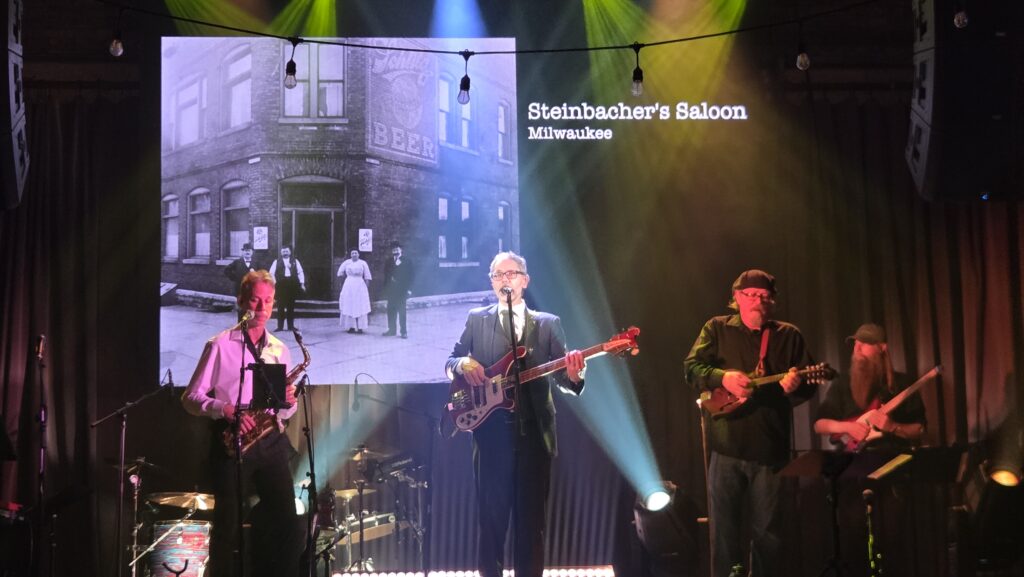
Behind the band loomed images of frozen Russia. A horse struggles valiantly to pull soldiers from a snowy crevasse, the century-old film a reminder of the unrelenting burden of our shared history. Relevant archive photos, film and news clippings punctuate the music and lyrics in a way our books could never match. Fitzsimmons’ compositions came alive with mandolin, keys and the saxophone and drum of Bryan Elliot and Bill Backes, respectively, lending a brothers-at-arms feel to the historical groove.
Songs specific to Milwaukee included the anti-German backlash of Prohibition of “No Beer” and the dramatic imagining of “The Driver”, which imagines the experience of Cream City’s Arthur Bozdeck who drove U.S. diplomat Henry White and witnessed the signing of the Treaty of Versailles. Fitzsimmons sings with soulful angularity and agility, adroitly accentuating the peaks of women’s suffrage in Wisconsin, the complexity of our First Amendment’s limitations and evolution and so much more that makes After The War: 1919 worth hearing and seeing in any context, live or on video.
As Elliot eclipses the evening fog with untouchably deep sax lines, the emotional peak of the evening emerges with “When the Darkness Comes,” a poignant reminder of the horrors brought home by soldiers after WWI. The show culminates with an historic confluence of physics, shell-shocked reality and celestial timing. The miracle of this performance is how Fitzsimmons illuminates the future by revealing the darkest corners of our past; if an eclipse can prove the abstract wonder of Einstein’s theory of general relativity, if war breaks even the best of men, and if the sky proves too dark for our own trembling hearts to travel, we should heed our singer’s song: “When the darkness comes…don’t look away.”