

Wisconsin native Glenway Wescott was a newly christened literary darling in 1928, when The New York Times reviewed his latest, a collection of short stories titled Goodbye, Wisconsin. “He has had his say concerning the people [and] the characteristics of the region of his birth,” the paper wrote, “and is ready for other things.” Nearly a century later, in an introduction to a new edition of the work published last month, author and native Minnesotan Patrick Nathan was more blunt. “Some of us,” he writes, “never get over being born in the Midwest.”
The reprint comes as part of Belt Publishing’s series reviving “unjustly forgotten” works from Midwestern authors. Wescott was born in 1901 in Washington County, and his family operated a pig farm near Kewaskum. Wescott described himself as “sickly and irritable,” of little help on the farm. He was just 12 years old when he convinced his parents to let him board in West Bend so he could attend high school. There, he became a voracious reader, published his first story, and had two impactful relationships – one with a male classmate that forced him to confront his sexuality, and another with a rebellious, cigarette-smoking girl who encouraged him to be himself.

Gift An Issue For $1 Today!
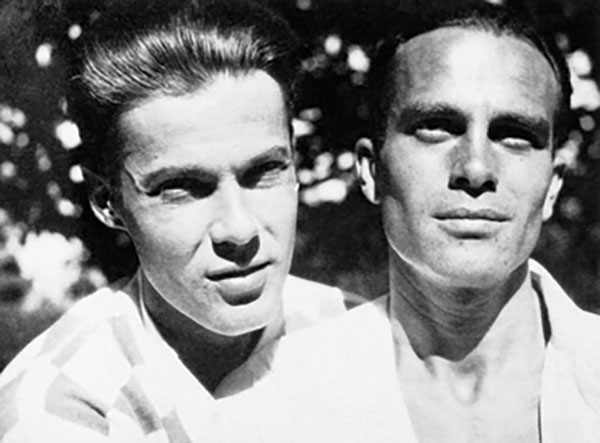
Wescott enrolled at the University of Chicago when he was just 16 and fell for the city and its literary crowd. In the spring of 1919, Wescott met 20-year-old Monroe Wheeler, a handsome young man who ran a poetry journal. Wheeler encouraged Wescott to live unapologetically as a gay man, and the two quickly fell in love.
Their relationship lasted nearly 70 years, including time spent in Europe during the 1920s where they socialized with F. Scott Fitzgerald, Ernest Hemingway and Gertrude Stein in a loose clique of American expat writers before returning to the U.S. in the ’30s. “Europe for the Midwesterner is no one else’s Europe,” Nathan tells Milwaukee Magazine. “[It is] an imagined way of life. It’s a desire that meshes perfectly with the project of fiction itself: the exploration of how one might have lived, who one might have loved.”
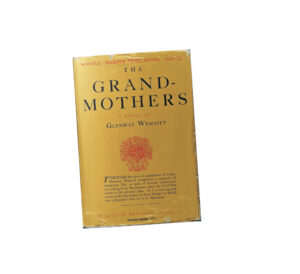
Much of Wescott’s fiction takes place in the Midwest, although in many cases he wrote it while in Europe. In 1927, he published his bestselling, most enduring novel, The Grandmothers, following a young farm boy traveling in Europe and haunted by the memories of family members long dead.
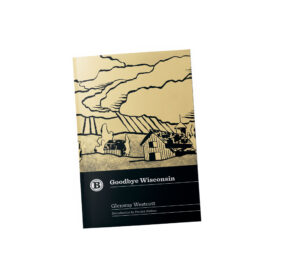
Goodbye, Wisconsin was his follow-up. The collection is all short fiction, save for the titular opening story, which details Wescott returning to the state for Christmas. “There is no Middle West,” he declares near the end of his visit. “It is a certain climate, a certain landscape; and beyond that, a state of mind of people born where they do not like to live.”
Wescott published only sporadically following Goodbye, Wisconsin and was an almost forgotten figure by the time he died in 1987, but his work remains relevant today, particularly within our region’s literary canon. “He nailed what it feels like to be ‘mis-born’ as the wrong person,” Nathan says. “In the wrong place, at the wrong time.” For many Midwesterners, a complex sense of “home” is unavoidable. For some, it’s a place to stay. For Wescott and others, it’s a place to escape in order to find yourself, elsewhere.