
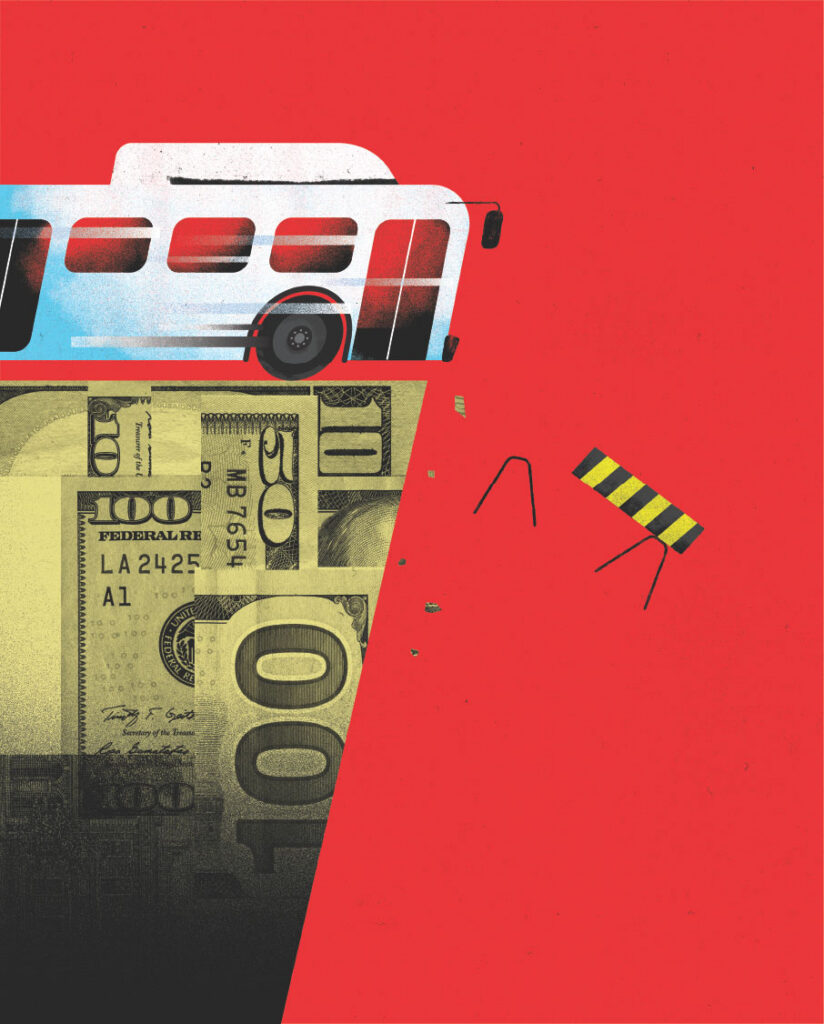
It’s a chase scene longer than anything out of Hollywood.
For much of the past 74 years, Milwaukee County buses have been racing to escape the treacherous forces of rising costs and falling ridership, with fiscal cliffs looming ahead.
And yet, somehow, each time the buses have managed to swerve away from the precipices at the last minute, avoiding catastrophic collisions thanks to surprise plot twists.
But soon the chase may be coming to an end. The fiscal cliffs are drawing ever closer, the bus drivers are almost out of maneuvers, and rescuers are nearly a year away – if they arrive at all.

Celebrate this year’s winners of the Betty Awards!
Transportation officials and outside experts agree the situation is dire. But the Milwaukee County Transit System was born in dire circumstances. It has survived because county leaders believed it was too important to die. Now they must decide how far they will go to keep it alive.
Researchers summed up the transit system’s problems long ago.
“The recent history of transit in Milwaukee County is one marked by desperation and false hope,” the Public Policy Forum wrote in a 2008 paper. “Simply put, public funding sources have not kept pace with growth in operating costs. While warning about the consequences, transit officials have averted disaster – and perhaps inadvertently delayed a solution – by spending down reserves, deferring needed capital expenditures, and implementing gradual service cuts and fare increases.” Without dedicated funding and steady revenue growth, the think tank wrote, county leaders faced “a stark choice” between “a transit system that is a shell of its former self” and a major change in funding.
Recalling that prophecy 15 years later, the organization’s successor Wisconsin Policy Forum explained, “Remarkably … that day of reckoning has largely been delayed – the result of a combination of good fortune, shrewd management and the imposition of a $30 vehicle registration fee in 2017.”
The “good fortune” included a massive infusion of federal aid during the COVID-19 pandemic. However, the pandemic that brought that $192 million also triggered a retaliatory cut in state aid to county buses, along with increased telecommuting and falling ridership for transit systems nationwide.
Now the federal aid is spent, ridership has not fully recovered and all the old problems remain: stagnant state funding, inflating costs and a county with few revenue options and many other needs. And after decades of running one of the nation’s most cost-efficient transit systems, the county has no fat to cut. “The crisis is upon us,” county transportation director Joe Lamers says.
Elected officials have already ended all Freeway Flyers, trimmed other service and raised the base fare 38%, from $2 to $2.75. That’s the highest regular adult fare of any big-city Midwestern bus system, although discounts, passes and fare caps soften the impact for many riders.
Yet unless something changes, the county projects a $15.7 million shortfall between revenue and expenses for 2027 – nearly 10% of this year’s $161 million transit budget – with inflation widening the gap by about $5 million a year in the future, Lamers says.
But a long-term change in the funding structure would require action from the state Legislature, where majority Republicans have long been unsympathetic to transit and have adjourned for this year. Lamers says county officials are staking their hopes on the 2027-29 state budget, which will be crafted by the governor and lawmakers elected in November.
That leaves the county on its own to keep the transit system together through 2027. Transit management has proposed slashing service 25% in the budget that County Executive David Crowley will introduce in late September.
Other choices were also unattractive. The 2026 budget already appropriates $28.9 million in property taxes – nearly one-tenth of the total county levy – to the transit system, after supervisors added $4.7 million to stave off deeper service cuts. And the County Board has repeatedly rejected previous recommendations to raise the wheel tax.
One major objection to the vehicle fee is that it’s regressive, meaning everyone pays the same regardless of their income, Policy Forum President Jason Stein says. However, service cuts are no less regressive, Stein argues, because they fall disproportionately on low-income residents who can’t afford cars and depend on buses.
To help put the choices in perspective, the county asked the Southeastern Wisconsin Regional Planning Commission to study the benefits of the bus system. Preliminary results show buses are saving the region at least $345 million a year – more than twice the transit budget – just by reducing the traffic jams, crashes and air pollution that would result if bus riders were driving instead. That doesn’t even count other benefits, such as how much bus riders save by not owning cars and transit jobs’ contributions to the local economy. The full study was to be completed by late summer or early fall.
Compared with most similar Midwestern bus agencies, the Milwaukee County Transit System:
… is more cost-efficient
Cost per bus passenger (2024)
Milwaukee $6.41
Detroit $10.10
Cincinnati $10.85
Cleveland $10.92
Twin Cities $11.43
St. Louis $12.43
Columbus $15.10
… is rebounding faster from the pandemic
Percentage of 2019 bus ridership (2025)
Cincinnati 99%
Milwaukee 86%
Cleveland 84%
Detroit 66%
Columbus 64%
Twin Cities 62%
St. Louis 50%
… and covers more of its costs with fares
Bus farebox recovery ratio (2024)
Milwaukee 19%
Cleveland 12%
Cincinnati 11%
Twin Cities 9%
Columbus 8%
Detroit 7%
St. Louis 7%
… but charges more to ride
Adult base bus fare (2026)
Milwaukee $2.75
Cleveland $2.50
Cincinnati $2.20*
Twin Cities $2*
Columbus $2
Detroit $2
St. Louis $1
* Higher for express routes
Sources: Federal Transit Administration, American Public Transportation Association, bus systems
Bill O’Donnell didn’t need a study to tell him what transit was worth. He rode buses from his home in the Merrill Park neighborhood to the courthouse, where he served on the County Board and eventually rose to chairman in 1975.
Those buses were run by the private Milwaukee & Suburban Transport Corp., which acquired the transit system in 1952, as streetcar lines were being phased out. The transit company completed the transition to buses in 1958 and introduced the popular Freeway Flyer express service in 1964. Yet it faced “a persistent decline in the number of passengers,” staying profitable only through fare hikes and service cuts, according to a 1978 Wisconsin Supreme Court ruling.
However, after two increases in four months in 1974 pushed the fare to a nationwide high of 60 cents ($3.86 in today’s dollars), the company was still projecting a $1.4 million loss for the following fiscal year, the court wrote. When the state Public Service Commission rejected a 1975 fare hike to 75 cents, the company prepared to go out of business.
That was when O’Donnell led a hostile takeover, guiding the county to seize the buses through condemnation and to create a nonprofit to manage the newly formed Milwaukee County Transit System. As a contractor, the nonprofit isn’t bound by civil service and other county rules, but still answers to the county, which owns the buses and sets routes and fares.
O’Donnell was elected county executive the next spring. Under O’Donnell and successor Dave Schulz, county investments over the next two decades helped boost ridership.
That didn’t last. Eventually the transit system fell back into its old cycle of declining ridership leading to fare increases and service cuts that further depressed ridership, leading to more fare increases and service cuts. The county either raised fares, cut service or both every year from 2000 through 2011. County Executive Chris Abele put an end to the fare increases – although not the service reductions – when he took office in 2011. After a 2007 increase to $2.25 and a 2023 cut to $2, the fare didn’t rise again until this year.
But by the time Abele was elected, Republicans had won control of state government, led by Abele’s predecessor, Scott Walker. In Walker’s first budget as governor, he and GOP lawmakers sliced state aid to the transit system by nearly $7 million a year, a 10% cut in the system’s largest revenue source. It didn’t rise much in later years, and this year’s $66.8 million remains below the 2011 level of $68.5 million. By contrast, if state aid had grown with inflation, starting in 2010, it would be nearly $101 million this year, Lamers says.
Although Abele followed Walker’s county budget practice of fighting tax increases for several years, he changed course to avoid major transit cuts. Abele broke his no-new-taxes pledge by proposing a $60-a-car wheel tax, shocking the supervisors who scaled it back to $30 before enacting it for 2017. Most of the revenue from the new tax went to the transit system, with a small portion going to other county transportation needs until this year, when the county devoted all $17 million to transit.
That arguably produced the dedicated transit revenue source that the county had long sought. But the wheel tax doesn’t grow with inflation, unlike the local sales taxes that fund many other U.S. transit systems, former Policy Forum President Rob Henken says. Although the county initially used wheel tax revenue to replace some of its property tax support for transit, tax levy funding exceeded 2016 levels by 2024. Between the wheel tax and the levy, county taxpayer support for transit has increased 106% since 2016, Lamers says.
Federal cash offered an escape route. But to use it, transit officials had to navigate through multiple funding programs after Congress phased out operating aid for big-city transit systems in the late 1990s. At the same time, a rule change allowed the county to fix old buses with federal dollars earmarked for bus purchases. The new rule helped the transit system balance its operating budget while deferring plans to buy new buses for an increasingly aging fleet.
Meanwhile, unexpected events kept breaking in the county’s favor. After the Great Recession, transit officials used federal stimulus money to buy new buses. The board had rejected Walker’s plan for express routes funded by a different stash of federal money, originally intended for light rail, and Abele spent that cash on new buses as well. And when GOP Assembly leader Robin Vos succeeded in his goal of killing a Kenosha-Racine-Milwaukee commuter rail plan, Abele used some of the federal money appropriated for those trains to start the color-coded routes originally branded as MetroEXpress.
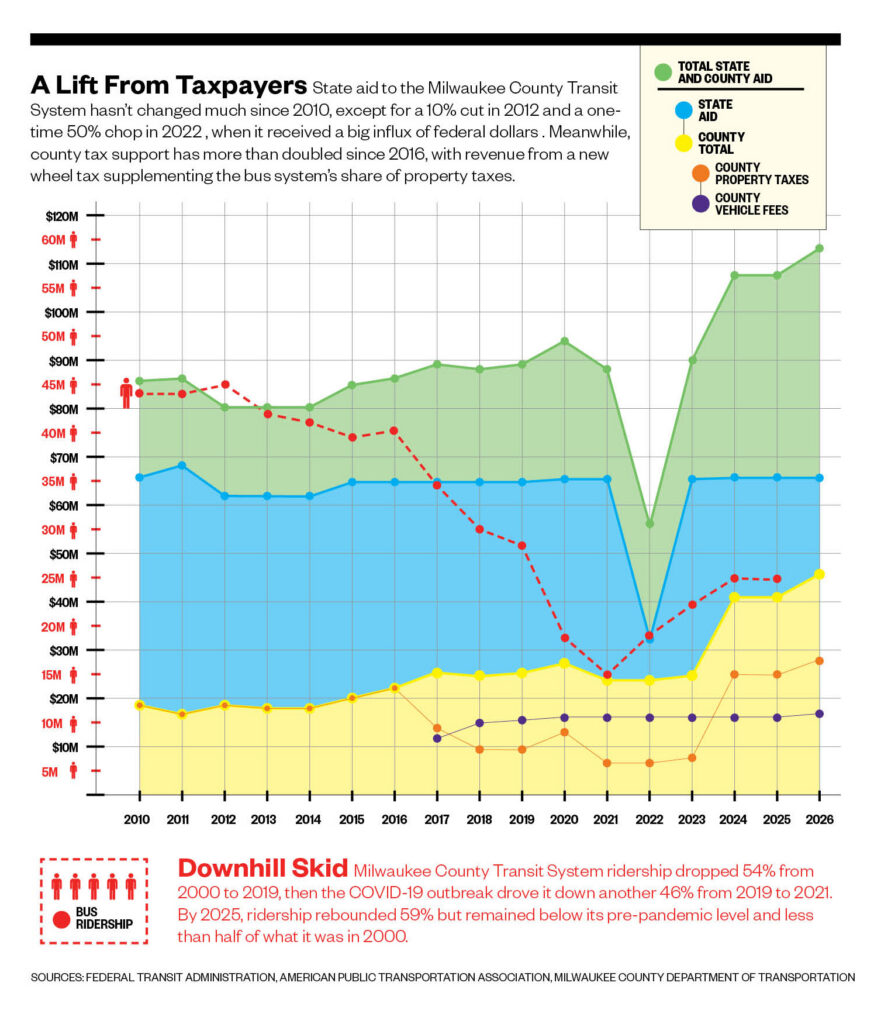
The pandemic was perhaps the transit system’s biggest break, as well as one of its greatest crises. With ridership tumbling 46% from 2019 to 2021, federal programs pumped tens of millions of dollars into keeping the county buses running. However, legislative Republicans ignored the congressional intent and treated the federal cash as an unnecessary windfall, slashing 2022 state aid in half to negate the impact of the first $32.7 million from Washington. Democratic Gov. Tony Evers made up part of the gap by giving the county more than $19 million of the state’s own pandemic aid. But Lamers said the GOP move inflicted long-term damage by forcing the transit system to dip into $13 million allocated for future years – money that could have largely averted next year’s shortfall.
Hairpin turns continued over the past year. Last summer, transit managers blindsided elected officials with news that rising expenses would lead to a 2025 deficit initially estimated at nearly $11 million. That was followed by the resignations of top transit system and county transportation leaders, with Crowley naming Lamers as transportation chief, before the County Board filled the hole by raising fares, trimming service and adding property tax dollars. This year, more cost-cutting by new transit management is expected to produce a surplus.
But as Crowley noted in announcing the surplus, the short-term gain won’t solve the long-term issues. And without a long-term solution, the road ahead will remain a hazardous drive.