

This was a race that changed faster than the speed of polling.
After a chaotically twisty primary, Milwaukee County Executive David Crowley won the Democratic nomination for governor in a stunning come-from-behind upset, just two weeks after Wisconsin’s most reliable poll found him trailing his chief rival by 31 percentage points.
With more than 99% of votes counted, The Associated Press reported that Crowley edged Madison’s Democratic Socialist state Rep. Francesca Hong by just half a point, 39.8% to 39.3%, to take on Republican U.S. Rep. Tom Tiffany in the November contest to succeed retiring Democratic Gov. Tony Evers.
The first-ever nomination of a Black candidate for governor was an unexpected finale to a wild, big-spending primary that drew extraordinarily high turnout, in a year when moderates and progressives are fighting a nationwide battle to lead Democrats into a midterm election where they hope Republican President Donald Trump’s unpopularity will produce a “blue wave.”

If someone has inspired you through their service, leadership or dedication, the Unity Awards are your opportunity to recognize them!
And it was the kind of white-knuckled finish that Wisconsin voters have come to expect in statewide general elections. However, no major-party primary for governor has been this close since 1942, Marquette University Law School fellow Craig Gilbert notes. This victory came from the guy who won his current office by the narrowest margin in county history and then earned a second term by the widest margin ever seen in the county.
Madison’s state Sen. Kelda Roys finished third in her second gubernatorial primary, although with 7.5% she was a more distant third than in the 2018 race that Evers won. Former state administration secretary Joel Brennan was next with 4.7%, barely ahead of other candidates who had dropped out after the seven-person ballot was finalized.
About 800,000 people voted in the primary, a number that Marquette political scientist Charles Franklin calls “just eye-popping” compared with recent Democratic fall primaries. He says that could signal high Democratic enthusiasm that could benefit the party if it continues into November.
The price tag was eye-popping, too, with candidates spending a combined total of $8 million through July 27. That was up from the $7.2 million spent through Aug. 31, 2018, on that year’s crowded Democratic primary, but well below the likely record of $23.9 million that Republicans spent through Aug. 31, 2022, on their brutal primary that year.
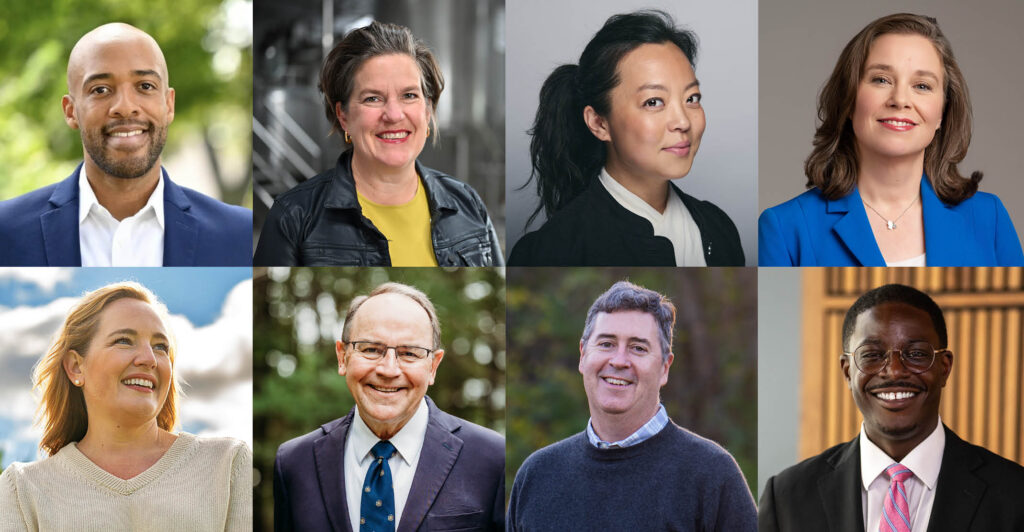
As of the most recent campaign finance reports, two of the three biggest spenders were candidates who had dropped out before the end of July: former Lt. Gov. Mandela Barnes, at $1.6 million, and current Lt. Gov. Sara Rodriguez, at $1.2 million. Crowley was in second place at $1.4 million. Following Rodriguez were Brennan and Roys, about $1.1 million each; Hong, $1 million; and another dropout, former state development chief Missy Hughes, $613,457.
Those figures would not include any final advertising pushes in the closing days, although Hong followed an unusual strategy of spending nothing on TV ads and relying instead on social media and in-person campaigning.
With Tuesday’s win, Crowley became the first person of color to win a major-party nomination for Wisconsin governor, on the same night that Republican primary voters snubbed their state party’s endorsed candidate for lieutenant governor, Black talk-radio host Will Martin of Racine. Instead, former Lancaster Mayor David Varnam will be Tiffany’s running-mate, while Secretary of State Sarah Godlewski was unopposed to join Crowley on the Democratic ticket.
Crowley is also the first Black county executive. Hong is the first Asian-American legislator and hoped to be the first Asian-American elected to statewide office. Former Weston Village Trustee Yee Leng Xiong, who won the Democratic nomination for state treasurer, still has a shot at that distinction if he can defeat GOP incumbent John Leiber. And Milwaukee Ald. JoCasta Zamarripa, who was unopposed in the Democratic primary to succeed Godlewski, would be both the first Hispanic and first openly bisexual statewide elected official if she wins in November against the Republican nominee, former Town of Menasha Supervisor Jay Schroeder, and the Green Party candidate, former Racine Ald. Peter Karas.
Tiffany would be the first sitting congressman to win the governor’s office, Gilbert notes.
Quirks in the Map and the Polls
Crowley carried nearly all southeastern and east-central counties, except Kenosha County, as well as many rural counties. Hong carried her home turf of Dane County and most other counties with large cities, including the three big Fox Valley counties.
Much of Hong’s support came from counties with college campuses that are home to younger and more progressive voters, although she didn’t dominate such areas to the same extent as Michigan Democrat Abdul el-Sayed, the progressive who won his U.S. Senate primary last week, Franklin says.
Crowley’s 1.5-point win in Milwaukee County wasn’t as large as Hong’s 7.3-point Dane County margin. In fact, the Milwaukee County wards that Crowley carried Tuesday closely matched those that he won when he defeated another progressive, state Sen. Chris Larson, by just 0.6 percentage points in the 2020 county exec race, according to figures compiled by Marquette research fellow John D. Johnson.
That was a “seemingly contradictory set of places,” Johnson said. Crowley’s coalition included predominantly Black urban neighborhoods, majority-white areas on the city’s northwest and southwest sides, conservative southwestern suburbs and most North Shore suburbs. Hong, like Larson, carried such liberal strongholds as Shorewood, the east side and Riverwest, as well as blue-collar areas like the south side and South Shore suburbs.
The geography wasn’t the only oddity. While Marquette’s gold-standard poll was quite close in predicting Hong’s final vote share, it was far off on Crowley’s results.
One factor may have been the race’s bizarre lineup changes, with four candidates dropping out and Crowley getting back in, says Franklin, the poll director.
Also contributing was the large number of undecided poll respondents. The last of Marquette’s polls showed 34% of Democratic primary voters still had not made up their minds in late July. Crowley may have won over most of them, Franklin says.
That’s not normally how it works. In other races, undecided voters usually cast ballots more or less in proportion to those who have made up their minds. For example, in the 10-way Democratic primary in 2018, Evers led the final Marquette poll with 31%, while all his opponents were in single digits and 38% were undecided. Evers won with 42%, to 16% for firefighter union leader Mahlon Mitchell and 13% for Roys.
This time, however, many of the undecideds were older voters who might have been more likely to oppose Hong, and who typically vote at higher rates than her base of more progressive young voters, Franklin says.
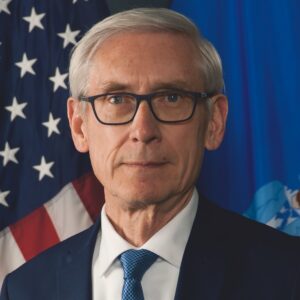
And although most poll respondents said Evers’ endorsement wouldn’t affect their vote, 36% said it made them more likely to back Crowley, adds Franklin. Evers had an 89% job approval rating from Democrats in the poll.
Bends in the Campaign Trail
It was clear from the start that this wouldn’t be an average election year. Evers’ decision not to seek a third term triggered a wide-open contest for the state’s highest office, for only the third time in the past quarter-century.
That attracted a large and diverse field of potential candidates, including a significant number from the Milwaukee area. At one point, the total number of hopefuls in the Democratic primary looked like it might equal or exceed the record 10 in the 2018 primary that Evers won, with four on the Republican side. By the time the ballot was finalized, Democrats still had a crowd of seven, while Tiffany faced only token opposition from political unknown Andy Manske in the GOP contest.
Two early Marquette polls showed massive indecision among Democratic voters, with only Hong and Barnes topping 10% and the rest mired in single digits. As party leaders fretted over whether the democratic socialist Hong could win a general election in this closely divided swing state, moderate support appeared to be coalescing around Rodriguez. Hughes and Crowley both suspended their campaigns and endorsed Rodriguez.
Then Rodriguez delivered the bombshell news that she had fired her campaign manager after discovering major discrepancies in her campaign finances. A week later, Rodriguez dropped out and Crowley jumped back in, with Evers’ endorsement. It was the first time since 1970 that a sitting Wisconsin governor had endorsed a candidate in his party’s primary to succeed him, Wisconsin Watch noted.
In what was supposed to be its final pre-primary poll, taken just before those developments, Marquette found Hong’s backing rose to 26%, followed by Barnes at 15%. Trying to compensate for the changes, Marquette conducted yet another poll, this one showing Hong surging to 38%, with Barnes barely budging at 16% and Crowley at just 7%.
Then Barnes exited, leaving a four-person field in practice but three others still on the ballot. All of those withdrawals came after absentee voting had started, and the state Elections Commission ruled voters couldn’t take back early ballots cast for candidates who quit the race. Johnson calculated that 39% of the 298,812 absentee votes were cast before the field stabilized, including 8.5% before Crowley withdrew, 13% while Crowley was out and Rodriguez was still in, and 17.7% after Rodriguez was out and Crowley was back in, but before Barnes quit.
The role of Evers and other party leaders in pulling Crowley back into the race drew jeers from the left, led by Barnes. They called Crowley the “establishment” candidate, a label that he argued was absurd — and even insulting — for a Black public school graduate from Milwaukee’s most impoverished zip code.
Crowley held a solidly liberal voting record when he served in the Assembly. In his current role, he has focused on such progressive priorities as improving health and social services, fighting homelessness and reducing racial disparities.
But Crowley has attracted the support of centrists like his predecessor, Chris Abele, and moderates like Evers, partly through his willingness to collaborate and compromise across ideological and party lines. Crowley enjoys a better relationship with the Milwaukee County Board than any prior county executive. He and Milwaukee Mayor Cavalier Johnson cut deals with Republican legislative leaders to shore up local finances with new sales tax powers and to renovate American Family Field to ensure the Brewers would stay there.
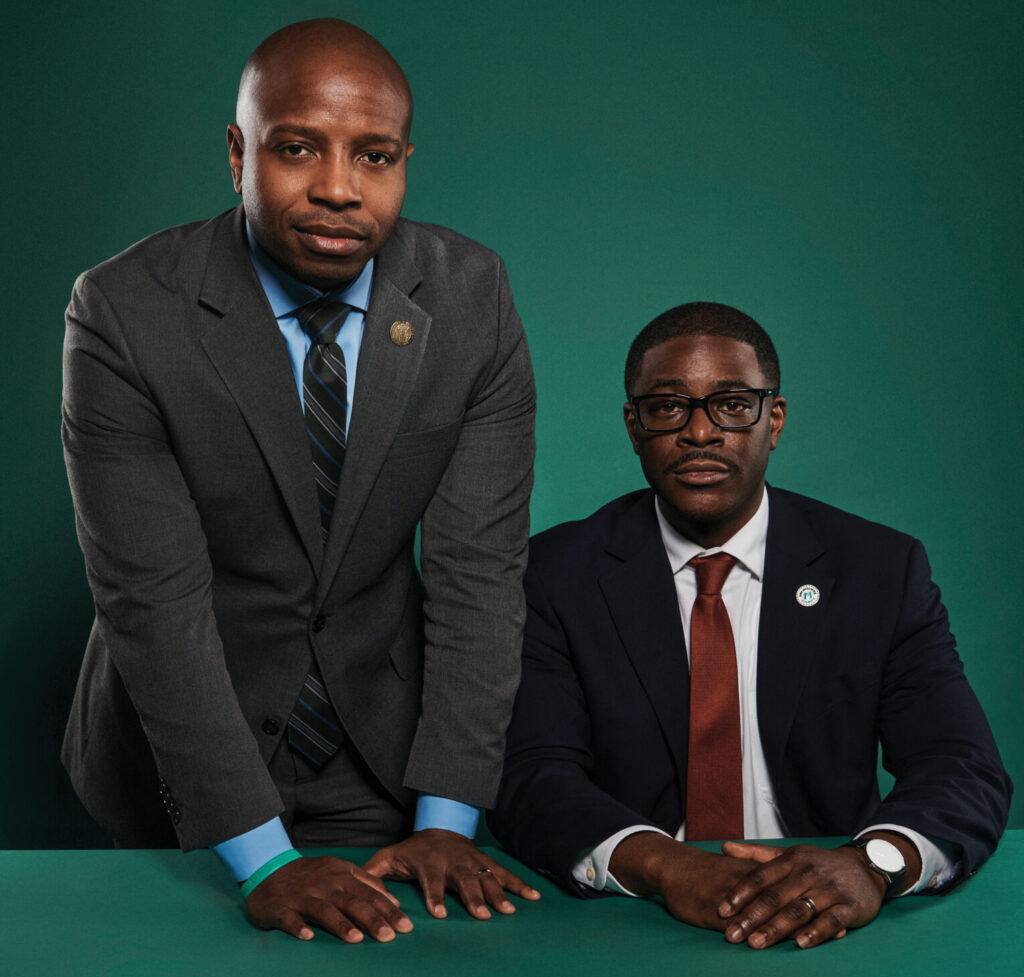
Yet that willingness to compromise was also controversial, as outgoing GOP Assembly Speaker Robin Vos insisted on concessions that forced police back into Milwaukee Public Schools, mandated minimum spending and staffing levels for public safety agencies and hampered streetcar expansion.
Hong appealed to left-wing voters who wanted more drastic change and less compromise. She fed into the restlessness of those who feel cheated by the status quo, frustrated by the slow pace of traditional government processes and angry at Democratic leaders who have been unable to block many of Trump’s actions. She embraced sweeping plans like phasing out school vouchers, raising the minimum wage to $20 and legalizing marijuana.
But the pugnacious progressivism that plays well in Hong’s Madison district was a tougher sell statewide. Under fire, she walked back her past comments about defunding police and abolishing prisons. On the stage of the primary’s lone debate, she distanced herself from national Democratic Socialists of America positions like abolishing the U.S. Senate and Supreme Court. Near the end of the campaign, she even had to retract old tweets denouncing Thanksgiving as a reminder of colonial oppression of indigenous peoples.
Tiffany and other Republicans had looked forward to hammering Hong on those positions during the general election campaign. Now, after their unruly primary, Democrats are trying to follow the lead of their Michigan counterparts and come together in a unified push to hold onto the governor’s office this fall.
This story has been updated to correct the nature of JoCasta Zamarripa’s potential milestone as the first openly bisexual statewide official and total campaign spending rankings.