


Ranked-choice voting could have overcome an invasion of “zombie votes” to give Milwaukee County Executive David Crowley a solid majority in Wisconsin’s recent Democratic primary for governor, or it could have sent state Rep. Francesca Hong, state Sen. Kelda Roys and maybe even former administration secretary Joel Brennan, into the November general election against both Crowley and Republican U.S. Rep. Tom Tiffany.
That difference would depend on whether Wisconsin adopts the more common form of ranked-choice voting used in Maine or the unique version used in Alaska. Lawmakers have separately proposed both ideas for at least some elections in this state, but neither one has gone anywhere so far.

Celebrate this year’s winners of the Betty Awards!
Crowley edged Hong by half a percentage point in the crowded and chaotic Aug. 11 primary, in which four of seven candidates dropped out and Crowley jumped back in, all after ballots were printed and absentee voting was under way. The race’s wild trajectory left some voters wondering how the campaign might have played out in a ranked-choice voting system.
Ranked-choice voting, or RCV, allows voters to pick more than one candidate for each office, ranking them first, second, and so on, up to whatever limit state or local law sets. If no candidate wins a majority of first-choice votes, the candidate with the fewest votes is eliminated and the second-choice votes of that candidate’s supporters are counted in the next round. The process continues until someone wins more than half of the total votes. If voters are filling multiple seats, such as on a school board, the total number of votes cast is divided by the number of seats at stake to calculate the threshold for victory.
Under the current system, you only get one vote. And in this state, if you cast an absentee ballot for a candidate who drops out, you can’t change your vote to someone who is still in the race.
RCV advocates at Fair Vote call those “zombie votes.” Lt. Gov. Sara Rodriguez, former Lt. Gov. Mandela Barnes and former state development chief Missy Hughes weren’t among the walking dead themselves, but their names remained undead on the Democratic primary ballot after they stopped running. Together they received more than 68,000 votes that could have gone to someone whose candidacy was still alive, in a race decided by less than 3,800 votes. With RCV, their supporters’ second or third choices could have counted toward the outcome.

Ranked-choice voting has been used in a variety of elections for more than a century, mostly for local offices, but also for some state and federal races as well. In local, state and congressional elections, it takes one of four main forms:
Consolidated RCV elections: All candidates run in a single RCV election, with no primaries or runoffs. This version is typically used in nonpartisan local races — including those in Minneapolis, St. Paul, San Francisco and Portland, Oregon — although Hawaii has authorized it for special elections to fill congressional vacancies. Since 2019, Wisconsin Democratic lawmakers have introduced three bills to let local governments and school districts decide whether to use this system, and two bills to require it for all nonpartisan elections, including for judges and state superintendent of public instruction. However, all that legislation died in committee.
RCV primaries and general elections: Each party holds a separate RCV primary, and then the party nominees and independents compete in an RCV general election. Maine uses this version for congressional races, and Washington, D.C., is using it for the first time this fall for local and congressional delegate contests. This system would have been required for all of Wisconsin’s partisan state, county and congressional elections under the same unsuccessful legislation that would have mandated consolidated RCV nonpartisan elections.
RCV primaries only: Each party holds a separate RCV primary, but the general election doesn’t use RCV. This version is used for local races in New York City and state contests in Maine. Wisconsin also used it for partisan primaries in 1912 and 1914.
Final four or five: All candidates run in a single primary, regardless of party and the top four or five advance to an RCV general election. Alaska uses a top four system for state and congressional races. A bipartisan group of legislators has twice introduced bills to require a final five system for Wisconsin’s U.S. House and Senate contests. Both bills received hearings but died in committee.
Some jurisdictions have tweaked the system to speed up counting. For example, Maine and D.C. don’t count first-choice votes for candidates who suspended their campaigns — a feature of particular interest to Wisconsin. Those jurisdictions immediately count the second choices of voters who supported the withdrawn candidates, or possibly those voters’ third choice if their second choice also dropped out.
Another variation, batch elimination, allows election officials to simultaneously eliminate multiple candidates who have no mathematical chance of winning, instead of eliminating them one at a time in successive rounds of counting. Minneapolis adopted batch elimination after 35 candidates qualified for the 2013 mayoral ballot, forcing 34 rounds of RCV counting. St. Paul, New York City and Maine also use batch elimination.
Looking at the results of this year’s primaries, we can imagine what would have happened under different forms of RCV. These are examples, not predictions, because RCV could have changed the lineup of candidates, their campaign strategies and voters’ behavior, says Barry Burden, director of the Elections Research Center at the University of Wisconsin-Madison.
The Maine Way
Under Maine’s rules, elections officials would have started by counting first-choice ballots for Crowley, Hong, Roys and Brennan, as well as second-choice ballots from voters who supported Barnes, Rodriguez and Hughes. Because those second-choice ballots wouldn’t have been enough to lift either Crowley or Hong above 50%, the next round would have eliminated Roys and Brennan, neither of whom could have won because Crowley and Hong together were the first choices of more than 79% of voters.
We don’t know for sure who the other candidates’ supporters would have listed as their second choices. The Marquette Law School Poll asked that question twice in July, while the field was still evolving, but the subsample of Democratic primary voters was too small for a complete candidate-by-candidate breakdown, says John D. Johnson, a research fellow at the law school. However, indications suggest “Crowley probably would have won by more,” Burden says.
Both Crowley and Hughes initially endorsed Rodriguez when they dropped out, and then Hughes urged Crowley to get back into the race after Rodriguez dropped out. As Rodriguez’s campaign was faltering, before Crowley reactivated his bid, Marquette pollsters found Brennan was the second choice of 29% of Rodriguez backers, followed by Barnes at 28%, Hong at 12% and Roys at 4%, with 26% undecided.
Although Hong had led in every poll, concerns grew among more moderate Democrats that her democratic socialist affiliation would be a liability in a purple-state general election. She also found herself defending and backpedaling on previous statements on everything from major policy issues to the existence of Thanksgiving.
By Election Day, “there were a lot of voters looking around for someone other than Hong,” and support was solidifying around Crowley, says Burden. Because Hong had attracted a devoted following by running to the left of everyone else, many of her supporters probably would have found other candidates unacceptable and voted only for her, while other candidates’ backers more likely would have listed someone other than her as second and third choices, Burden says.

With 39.8% of first-choice ballots, Crowley would have needed more than 10.2% for an outright majority. Hong had 39.3% and would have needed more than 10.7%. Rodriguez, Barnes and Hughes together received only 8.6%, ensuring the counting would go to a second round. At that point, the combined total of 12.1% from Roys and Brennan would have decided the race. Since Crowley or Hong would have needed votes from more than half of the other five candidates’ supporters and those voters seemed more comfortable with Crowley, he likely would have captured the majority.
Similar dynamics would have favored Democrat Tony Evers in the even more crowded 2018 primary, which he won with 41.8% on the way to the first of his two terms as governor. The first round would have eliminated two candidates who dropped out and together received 2% of the vote, while the next round would have eliminated Roys and five other candidates, with a combined 39.9% of the vote. Evers would have needed only
one-fifth of those second-choice votes to win. By contrast, the second-place finisher, firefighters’ union leader Mahlon Mitchell, had received 16.3% of the vote and would have needed more than eight of every 10 second-choice votes to overtake Evers.

It’s common for RCV elections to hand a majority to the same candidate who would have won with a plurality in a regular election. Since 2007, candidates with the most first-choice votes have won 29 of 41 RCV general elections and partisan primaries for big-city mayors and for governors and U.S. senators in Maine and Alaska, a Milwaukee Magazine analysis found. Unopposed candidates won another nine partisan primaries, and no Republicans qualified for this year’s D.C. mayoral primary.
The only come-from-behind RCV winners in those races were St. Paul Mayor Kaohly Her, who defeated then-incumbent Melvin Carter in 2025, and Maine gubernatorial candidate Hannah Pingree, who bested Wisconsin-born opponent Nirav Shah in this year’s Democratic primary.
One key difference in ranked-choice voting is that voters don’t have to think as strategically about their ballots, says Burden. In this year’s race, some voters might have preferred Roys or Brennan but marked their ballots for Crowley to ensure Hong didn’t win. With RCV, those voters could have listed their choices in order and “it would have all been worked out,” Burden says.
Up North To Alaska
The primary would have looked a lot different under Alaska’s rules. All Democratic candidates would have been running against Tiffany and his lone GOP opponent, political unknown Andy Manske, in August. If everyone received the same number of votes as they did in the separate party’s primaries, the top four — Tiffany, Crowley, Hong and Roys — would have moved on to the higher-turnout November election. (In a top five race, Brennan also would have advanced.)
In that scenario, most Republican voters would probably mark their ballots only for Tiffany, while many Democrats would list Crowley first, although Hong and Roys likely would capture some support as well, Burden says. Overall, that field would be so “loaded with Democrats” that the blue side would have the advantage.
But that would not have been the case when Democratic incumbents faced little or no serious opposition within their own party, Burden adds. In 2022, Evers could have been up against three Republicans: businessman Tim Michels, former Lt. Gov. Rebecca Kleefisch and election-denying legislator Tim Ramthun. Similarly, in 2018, U.S. Sen. Tammy Baldwin could have faced GOP lawmaker Leah Vukmir, businessman Kevin Nicholson and a third Republican.
That’s assuming each field of candidates was the same. A top four election probably would have changed candidates’ calculations about whether to run and whether to stay in, Burden says.
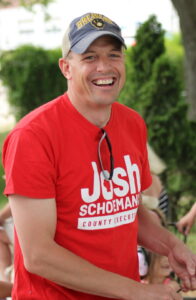
For example, Washington County Executive Josh Schoemann dropped out of this year’s GOP primary after President Donald Trump endorsed Tiffany. But in a top-four race, Schoemann might have chosen to stay in, betting that he could outpoll enough Democrats to reach the general election and perhaps receive more Republican support if the tide turned against Tiffany, says Burden.
An RCV system also could have attracted third-party and independent candidates, even if they didn’t break through to the final four, Burden says.
GOP vs. RCV
Ranked-choice voting doesn’t inherently help either party, Burden and Fair Vote say. But in recent years, Republicans have led opposition to RCV. Since 2023, 19 red states have banned RCV, with some exceptions for military and overseas voters casting absentee ballots. Wisconsin Republicans proposed a constitutional amendment to outlaw RCV, which reached a legislative hearing but died in committee in 2024.
Burden traces the GOP opposition to Alaska’s first top-four race, a 2022 special election for the state’s sole U.S. House seat. Democrat Mary Peltola defeated Republicans Sarah Palin and Nick Begich that summer, then won a rematch against them in the regular November election.
Palin, the state’s former governor and the 2008 GOP vice-presidential nominee, was a polarizing figure who might well have lost under the usual voting system, Burden says. Peltola led with the most first-choice votes in both the special and regular 2022 congressional elections. And Republican incumbents won top-four elections for both governor and U.S. senator the same year, while Begich unseated Peltola in 2024.
Nonetheless, Trump and his allies bashed RCV, claiming without evidence that the system was “rigged,” much as they have promoted many other baseless election-fraud conspiracy theories.
In this environment, ranked-choice voting is “very unlikely” to advance in Wisconsin if Tiffany wins and Republicans hold both houses of the Legislature, Burden says. By contrast, if Democrats win a trifecta, RCV legislation stands a better chance, but still is not guaranteed to pass, he says.
Perhaps the idea with the best prospects, Burden says, would be allowing RCV as an option for local elections, a bill most recently championed by Sen. Chris Larson (D-Milwaukee) and Rep. Amaad Rivera-Wagner (D-Green Bay). That’s because it would apply only to nonpartisan races and wouldn’t pose any risks for either party, Burden says.