
Editor’s Note: This article was written and edited before Lt. Gov. Sara Rodriguez withdrew from the Democratic gubernatorial primary; Milwaukee County Executive David Crowley revived his campaign, with the endorsement of Gov. Tony Evers; and former Lt. Gov. Mandela Barnes exited the race. It appears in our August issue.
Wisconsin Democrats will decide Aug. 11 on something that Republicans settled more than six months ago: their party’s nominee for governor.
The Democratic ballot will list seven candidates (five of whom were still running as of press time for this issue) – the second-largest field in Wisconsin’s 120 years of gubernatorial primaries, behind only the record 10 Democrats who ran for governor in 2018. But it’s the party’s third crowded statewide primary in eight years, counting the eight candidates who reached the ballot in the 2022 primary for U.S. senator.
By contrast, U.S. Rep. Tom Tiffany faces only a single minor opponent for this year’s Republican nomination for governor.
RELATED: THESE ARE THE CANDIDATES FOR WISCONSIN GOVERNOR
Politicians and scholars have long debated whether a nominee enters a general election campaign stronger after being tested in the heat of a contested primary or with the backing of an already-unified party.
They don’t have a definitive answer. Wisconsin’s recent history shows either theory could hold true – or both could be overshadowed by the midterm backlash against an unpopular president.

Celebrate this year’s winners of the Betty Awards!
In 21st-century races for governor and senator, we’ve seen nominees emerge from bruising primary battles and go on to triumph over opponents who faced little or no opposition in their own primaries. We’ve also seen candidates breeze through primaries to quickly gain a decisive advantage over opponents still struggling to rebuild their campaign war chests after a contested primary. We’ve even seen a primary where most of the major contenders dropped out late in the race in the interest of party unity, only for the nominee to lose the general election.
“It’s complicated,” says Anthony Chergosky, associate professor of political science at UW-La Crosse. “It cuts both ways.”
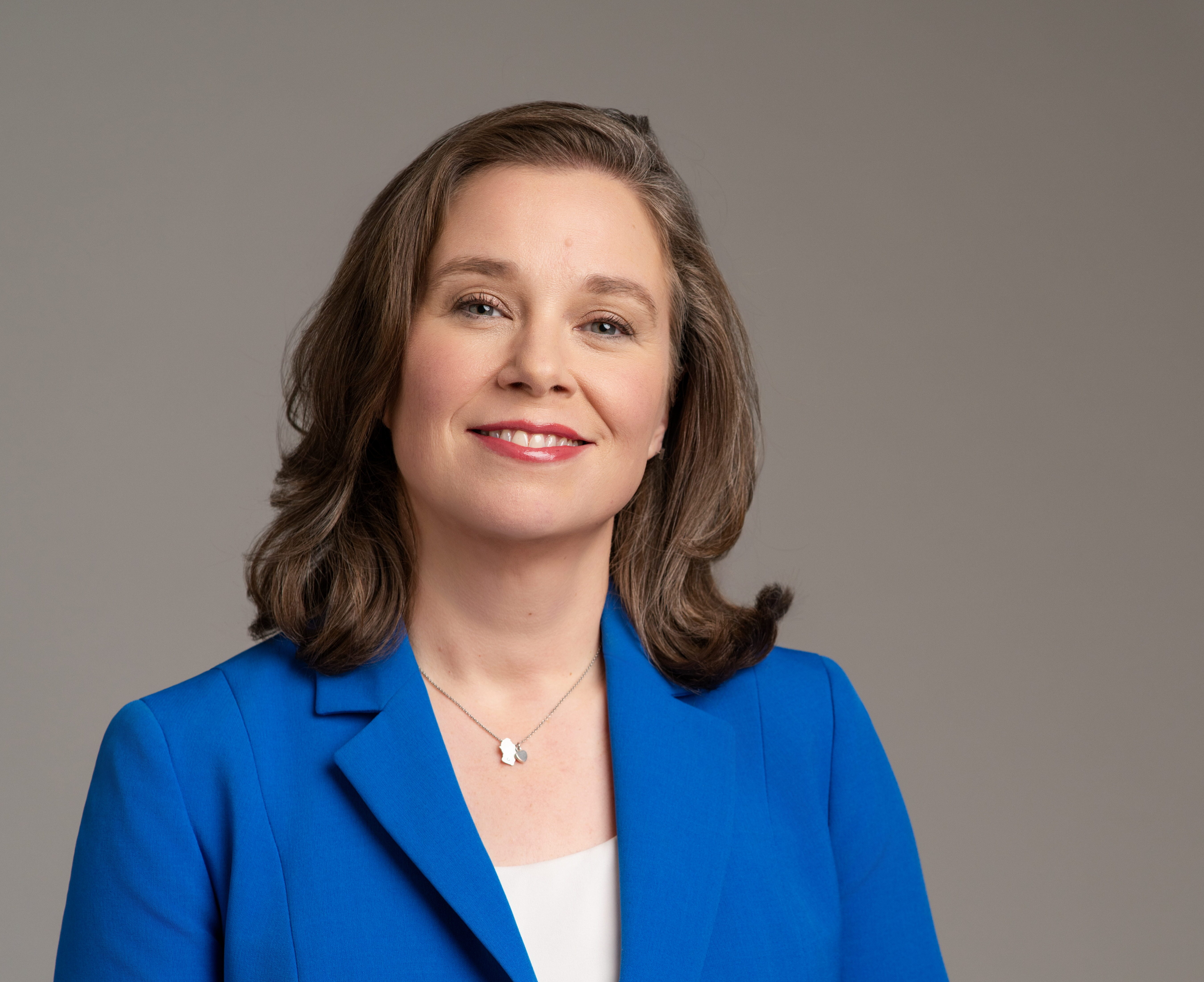
Democratic Gov. Tony Evers kicked off this year’s contest in July 2025, when he announced he wouldn’t seek a third term. That set up Wisconsin’s first wide-open race for governor in 16 years, and only the sixth in the past century, according to a 2025 analysis by University of Minnesota-Twin Cities researcher Eric Ostermeier for his blog, Smart Politics.
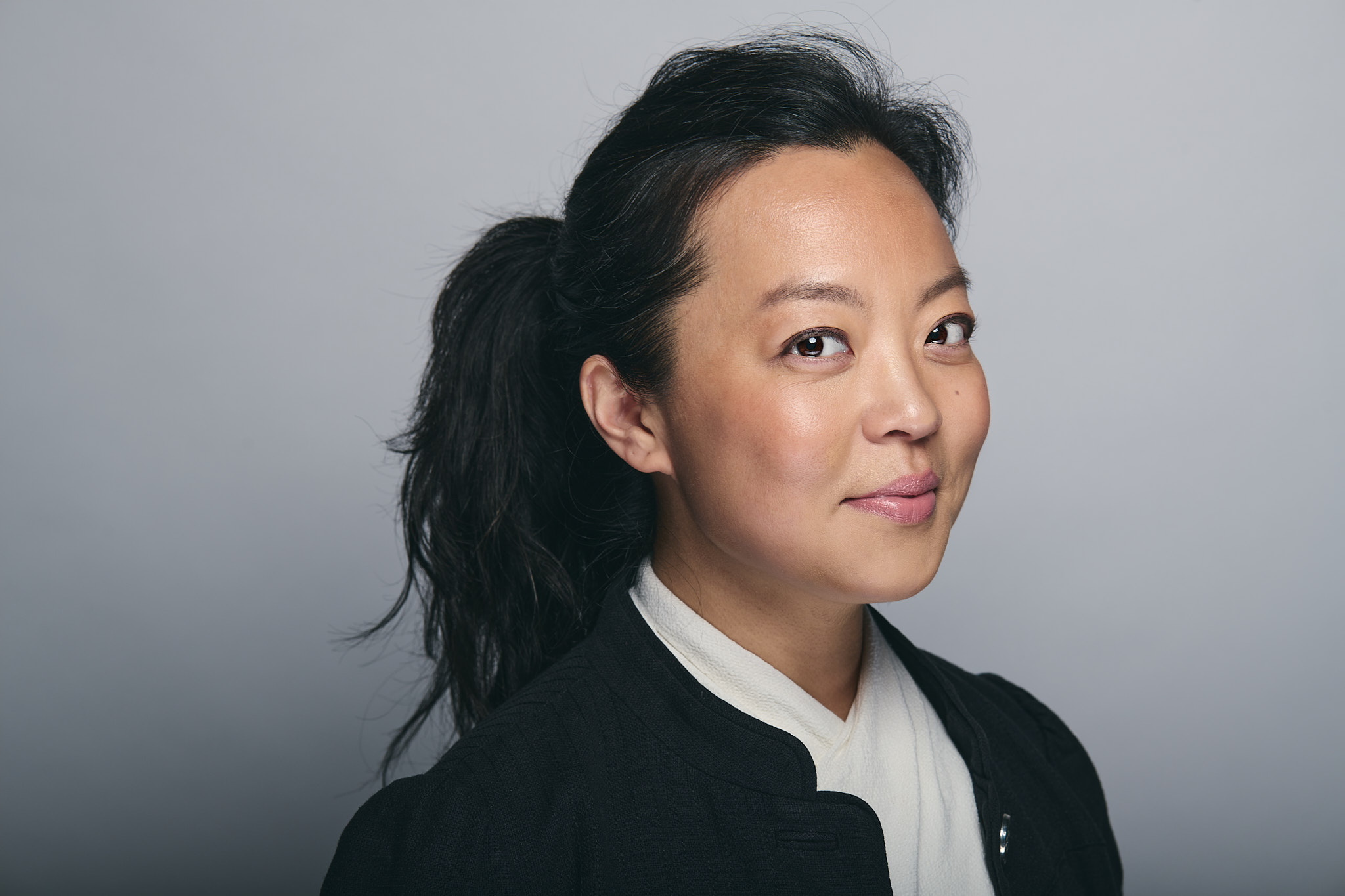
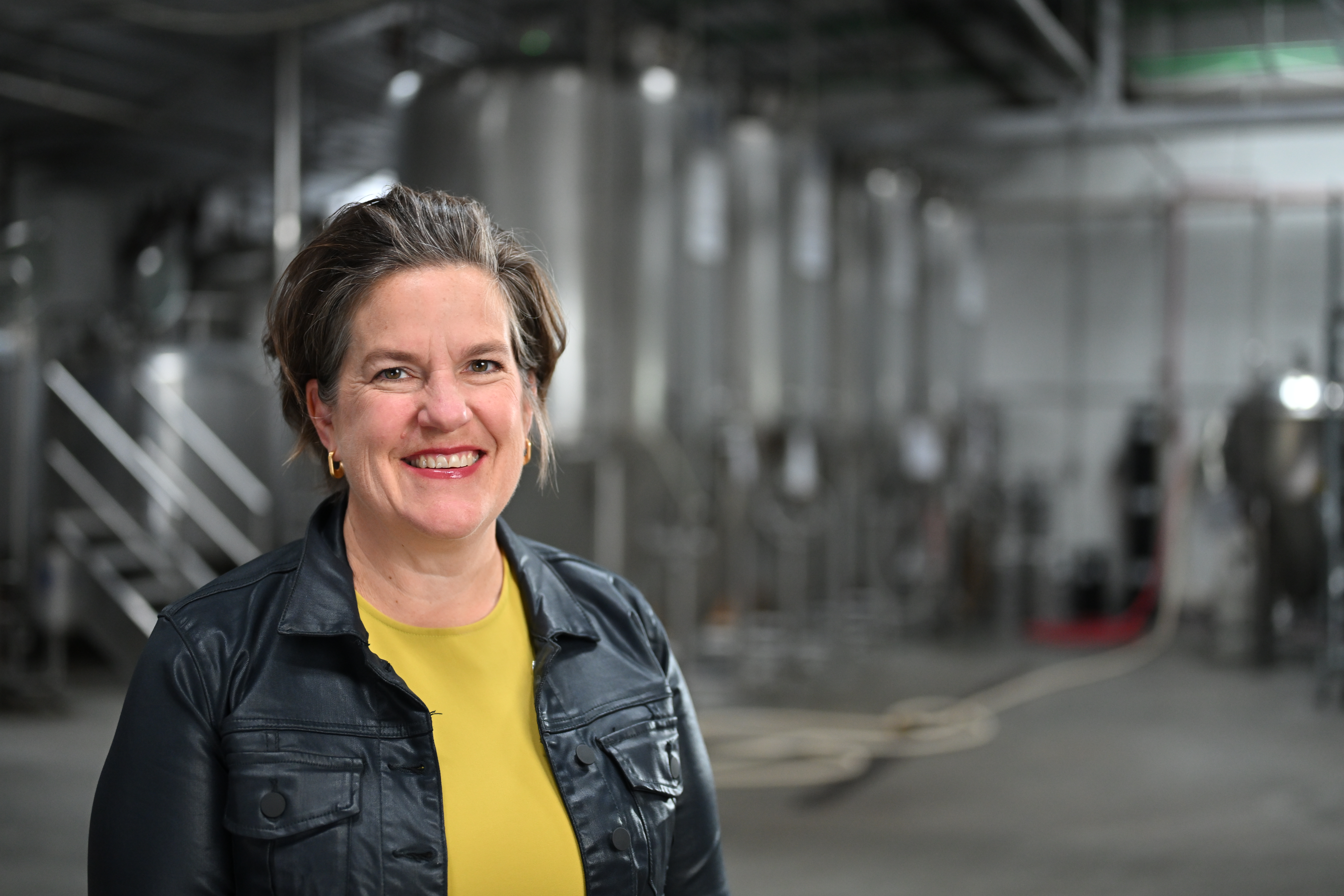
It didn’t take long for Evers’ fellow Democrats to start lining up for his job. Lt. Gov. Sara Rodriguez announced her candidacy less than 24 hours after Evers said he wasn’t running. In September, she was joined by Milwaukee County Executive David Crowley, the first Black person elected to that office; state Sen. Kelda Roys, the Madison lawmaker who finished third in the 2018 primary that Evers won; state Rep. Francesca Hong, a Democratic Socialist from Madison who is Wisconsin’s first Asian American legislator; and Missy Hughes, who stepped down from her cabinet job as development chief to enter the race.
Rounding out the field in December were former Lt. Gov. Mandela Barnes, who served as the state’s first Black second-in-command during Evers’ first term; and Joel Brennan, who had held a key cabinet post as Evers’ first administration secretary.
Meanwhile, Attorney General Josh Kaul, seen by some as potentially the party’s strongest contender, decided instead to run for a third term in his current office. Milwaukee Mayor Cavalier Johnson also passed on the race, throwing his support behind Crowley, his friend and high school classmate. Hughes quit the race in June and Crowley withdrew in July, too late to take their names off the ballot. Both endorsed Rodriguez.
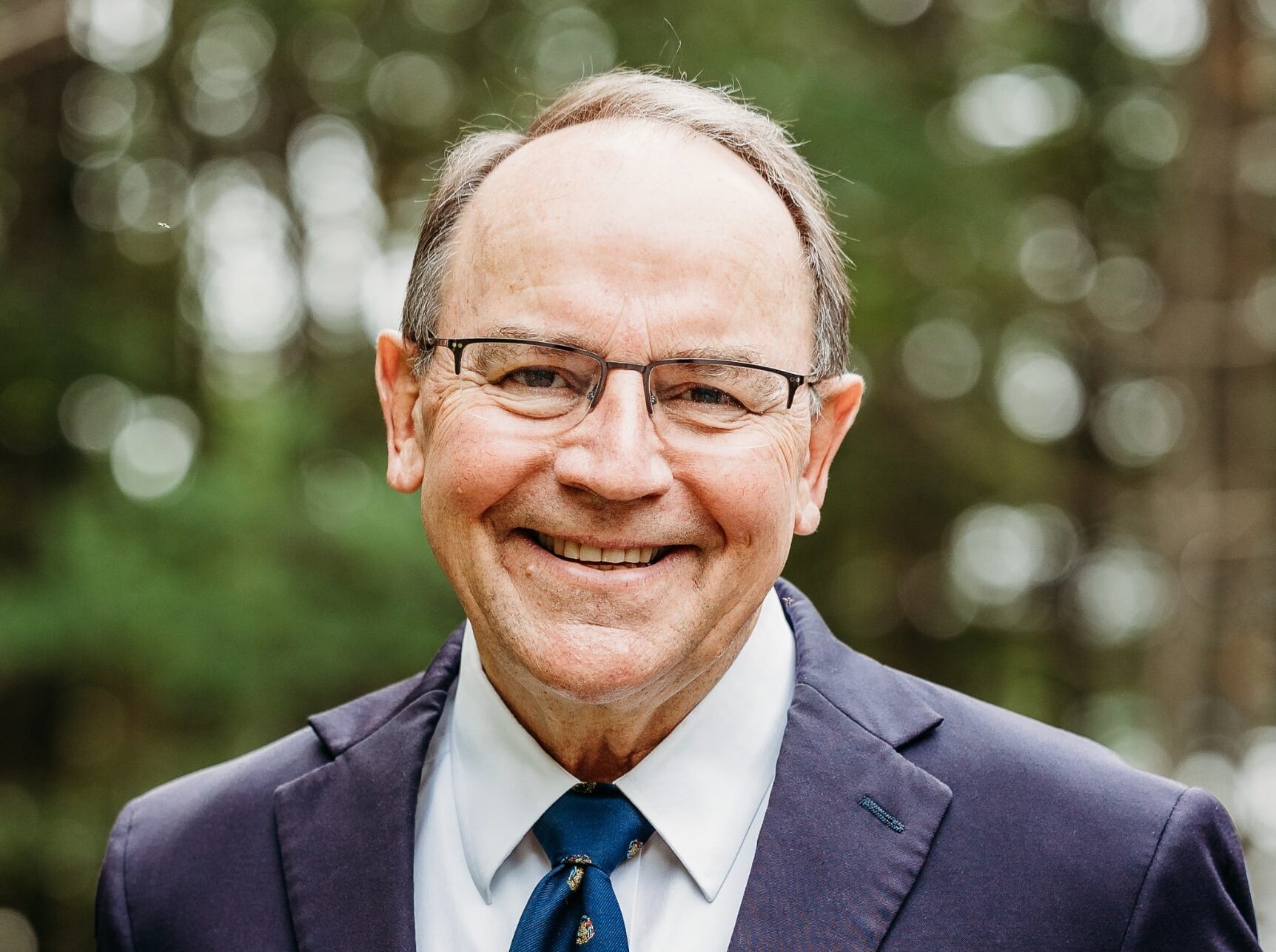
By contrast, the Republican field evolved in an entirely different way. Evers had not yet announced his intentions when Washington County Executive Josh Schoemann and Whitefish Bay businessman Bill Berrien jumped into the GOP primary race.
Tiffany, who represents a north-western Wisconsin congressional district, joined the race in September – just before Berrien dropped out over reports he was following sexually explicit social media accounts. President Donald Trump anointed Tiffany with his endorsement in January, and Schoemann swiftly exited, leaving Tiffany to face only token opposition from political unknown Andy Manske.
Most of Wisconsin’s top-of-the-ticket races aren’t this open. As Ostermeier’s analysis noted, incumbent governors sought another term in 31 of the last 37 elections.
And incumbency is a powerful factor to be absent from this election. In the 17 elections for governor or U.S. senator since 2000, all 13 previously elected incumbents reached the general-election ballot after running unopposed or with only minor opposition in primaries. All but two of those incumbents went on to win the general election, regardless of how many candidates ran in the opposing party’s primary.
Here’s what else we can learn from recent primaries for governor and senator:
Spenders vs. Savers
Contested primaries can create pricier campaigns – sometimes at the cost of the general election.
“If you have a primary, you may have to spend all of your money winning that primary,” and start the general election campaign with an empty treasury, says Marquette University political scientist Charles Franklin.
For example, former Gov. Tommy Thompson “finished dead broke” after winning an exhausting four-way Republican primary for senator in 2012, Franklin says. By contrast, then-Rep. Tammy Baldwin had won the Democratic nomination unopposed, saving up her cash for an immediate post-primary barrage of television ads arguing that Thompson’s time was past, and he couldn’t afford to respond with his own ads for a month. Thompson had been Wisconsin’s longest-serving governor and one of the state’s most popular politicians, but he was stunned by his November loss to Baldwin.
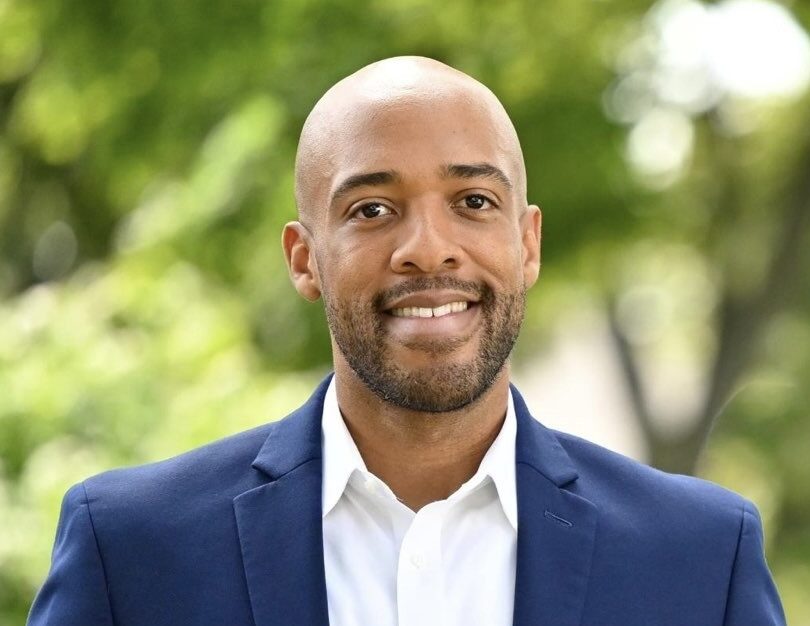
 Similarly, the cost of the primary campaign “was definitely a problem” for Barnes when he challenged incumbent Republican Sen. Ron Johnson in 2022, says Barry Burden, director of the UW-Madison Elections Research Center. Like Thompson 10 years earlier, Barnes faced an instant onslaught of unanswered ads from Johnson, who had won his primary unopposed and was painting Barnes as too far left for Wisconsin. Although Evers and his fellow Democrats carried every other statewide race, Johnson edged Barnes by a single percentage point that November.
Yet that dynamic didn’t help then-Milwaukee Mayor Tom Barrett in the open 2010 governor’s race. Barrett had easily squashed his token Democratic primary opposition, while then-Milwaukee County Executive Scott Walker was locked in a brutal GOP contest against former U.S. Rep. Mark Neumann. Walker beat Neumann that August and Barrett that November.
It wasn’t clear by press time how much this year’s primary would cost, because the candidates don’t file their most definitive campaign finance reports until later in July. Before Jan. 1, Democratic candidates had raised a total of $3.8 million and spent $986,858, while Republicans together had raised $3.7 million and spent $1.6 million before Schoemann dropped out.
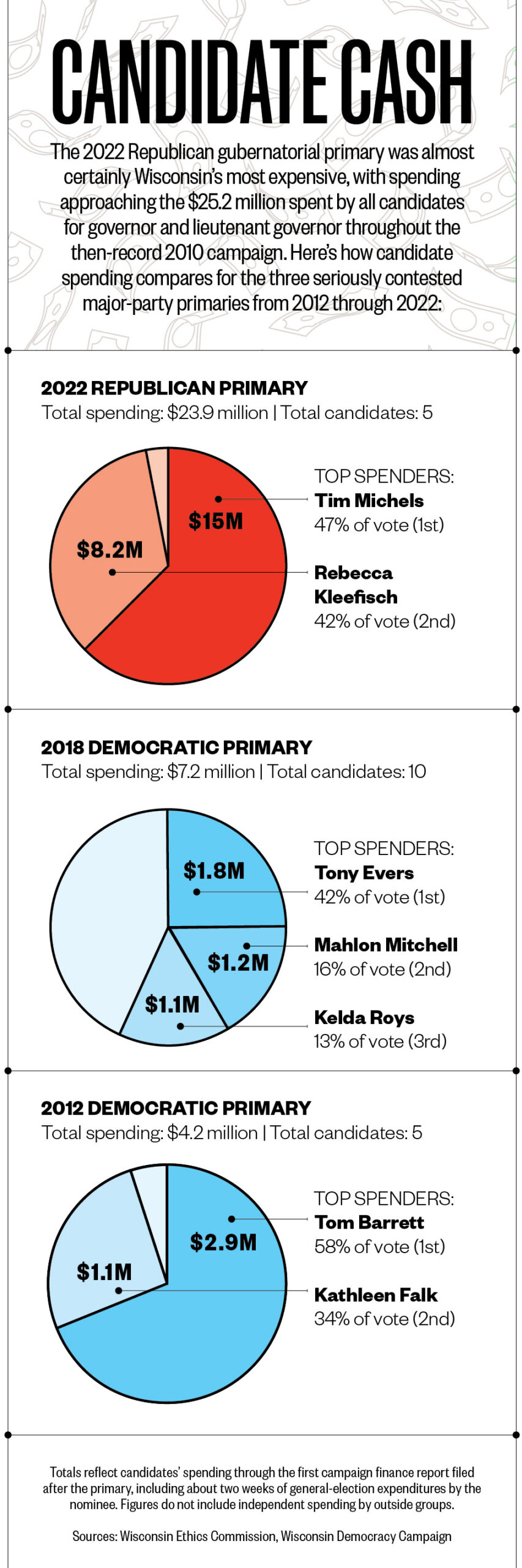
Those figures raise the possibility that total Democratic spending could be in the same league as the party’s $7.2 million primary in 2018, although probably not on the scale of the $23.9 million spent by the five candidates in the 2022 GOP primary.
The spending in the 2022 contest to challenge Evers was driven by the $15 million put out by construction executive Tim Michels. His personal wealth gave him an advantage over the second-place finisher, former Lt. Gov. Rebecca Kleefisch, even though her own $8.2 million expenditure was $1 million more than the entire 2018 Democratic field combined.
Yet Michels’ money wasn’t enough to boost him over the Democratic incumbent that fall. Evers won by 3 percentage points.
Republicans more often have nominated wealthy candidates who can finance much of their own campaigns, Burden says. But Chergosky adds, “The data shows a very mixed relationship between self-funding and electoral success.”
This time, Democrats aren’t taking any chances that their candidate will come out weakened by a big-spending primary. In September, Evers and the state party announced the Wisconsin Governor Readiness Project, which they described as an unprecedented initiative to build a campaign organization for the primary winner, “raise funds that will be available day one of the general election” and focus on “robust messaging” to “define Republican candidates throughout the primary and through November.” Burden called that “a smart strategy.” A party spokesman declined to comment on the status of the project.
Bitter or Sweet
The biggest primaries aren’t always the baddest. While Democrats have had the largest primary fields, some Republican primaries have been more bitterly contested, Franklin says. In addition to the 2010 governor primary between Walker and Neumann, Franklin pointed to three other brawls:
- The 2012 Senate primary featuring Thompson, Neumann, Madison businessman Eric Hovde and then-Assembly Speaker Jeff Fitzgerald.
- The 2018 U.S. Senate primary in which then-state Sen. Leah Vukmir defeated Waukesha County businessman Kevin Nicholson before losing the general election to Baldwin.
- The 2022 governor primary featuring Michels, Kleefisch, Nicholson and then-state Rep. Tim Ramthun.
Burden agreed the Michels-Kleefisch contest in particular showed how a small field “can be nastier than a large field.” During the GOP primary, Kleefisch pointed to Michels’ homes in New York and Connecticut to portray him as a part-time resident disengaged from Wisconsin issues. In the general election, Evers highlighted those out-of-state houses to discredit the wealthy Michels’ claims to identify with blue-collar voters.
By contrast, this year’s Democrats were “more playing nice than playing mean,” at least through the party’s state convention in June, Burden says. Still, those Democrats had taken a few shots at each other by then. Among them:
- Rodriguez questioned the electability of the two progressives leading the pack in early polls. She pointed to Barnes’ statewide loss in the Senate race – something from which no Wisconsin candidate for governor or Senate has been able to recover in 50 years. She also questioned whether Hong, the candidate who has generated the most buzz, would be too far left for the broader electorate if the Democratic Socialist advanced to the general election. Rodriguez later backtracked and said any Democrat could beat Tiffany.
- The lieutenant governor then jeopardized her own electability by saying she would draft the next state budget “behind a curtain” to avoid “a circular firing squad” of Democratic infighting. That left an opening for Brennan, Roys and Crowley to knock her and tout their own track records of crafting state and local budgets in a more transparent environment.
- Brennan, the only white male among the major Democratic contenders for the last statewide office held exclusively by white males, stumbled by suggesting Wisconsin wasn’t ready to elect a woman or a person of color as governor. He walked that comment back under fire from Crowley and others.
Exchanges like that can be valuable in the long run, by vetting candidates in ways that uncontested primaries don’t provide, Chergosky and Franklin say. They also give previously untested candidates practice in the skills of debating each other and fielding media questions, so that they learn “to be good politicians,” Burden says.
While this year’s Democratic primary had been relatively mild through press time, the party’s 2022 Senate primary candidates took an extraordinary step to avoid a nasty finale. Uniting behind Barnes, his top three adversaries – Alex Lasry, Sarah Godlewski and Tom Nelson – all dropped out before the vote, although all were still on the ballot. Godlewski and Nelson were far behind in the polls, while Lasry was trailing Barnes by only a few points.
It’s not unusual for some candidates to suspend their campaigns – including Nicholson in the GOP governor primary the same year, as well as Crowley and Hughes this year – but the scale of that 2022 exodus was “in my memory close to unprecedented,” Franklin says. He didn’t expect a repeat this year.

Although Ostermeier’s analysis found both parties have had multiple races with more than four candidates, it’s happened more often in recent years for Democrats. In addition to the record gubernatorial primary fields in 2018 and this year, he noted that Democrats had a six-way primary in 1942 and a five-way contest in the 2012 Walker recall primary won by Barrett. By contrast, of the five Republican primaries with five or six candidates before 2022, four were between 1914 and 1946 and the last one was the five-way 1986 primary that Thompson won on the way to the first of his four terms.
When the primaries are that big, the nominees frequently prevail with less than 50% of the vote, Chergosky notes. However, he considers the risk of a party fracture harming the nominee’s general-election chances to be “overplayed in this era of intense partisanship,” because the voters will likely unite behind whomever their standard-bearer is.
Pivots and Waves
That question of party unity is at the heart of the two dance moves that primary winners need to master: Doing the pivot and riding the wave.
The pivot is the traditional switch from appealing to a single party’s voters during the primary to campaigning among the entire voting population for the general election. Primaries are consistently lower-turnout elections that draw the most committed members of each party. And increasingly, the most committed Democrats are moving to the left, while the most committed Republicans are moving to the right.
As a result, candidates feel pressure to “push themselves to the extremes of their party” in order to win primaries, Franklin says.
That poses the risk of nominating someone “who is not broadly palatable,” particularly in a crowded primary, Burden says, because once they win the primary, the candidates must woo independents and try to win over at least some of the more moderate members of the opposing party in order to build a winning majority in the general election. That has long meant moderating their positions and moving toward the center.
However, Franklin says, “I think that pivot is much, much harder to do now” in an age when ubiquitous videos of candidates’ more extreme primary positions can be used to discredit their more moderate statements in the general election. Barnes “really struggled to make the pivot” in the 2022 Senate race, Chergosky says.
This issue isn’t limited to the Democrats, whose crowded primaries this year and in 2018 likely reflect the party’s long debate over whether its path to general-election success requires more progressivism or more moderation, Burden says. It’s also a problem for Tiffany, who owes his nearly uncontested primary to Trump’s endorsement and the dominance of Trump’s right-wing Make America Great Again movement in the GOP. “I wonder what the pivot even looks like for him,” Chergosky says.
If Tiffany moderates his MAGA-friendly positions, he risks alienating the most engaged Republican voters who form his crucial base. Yet if he stays on a hard-right course, he could turn off moderate Republicans in the Milwaukee area’s WOW counties – Waukesha, Ozaukee and Washington – and other upscale suburban areas, who have been “less friendly to the GOP in the Trump era,” Chergosky says.
That’s an even bigger issue for the GOP candidate in attracting Democrats and independents. In March, the Marquette Law School Poll, led by Franklin, found only 21% of independents and just 6% of Democrats viewed MAGA favorably, compared with 78% of Republicans. The same poll found 93% of Democrats and 74% of independents disapproved of Trump’s performance as president, compared with 81% approval from Republicans.
Conversely, because “Trump is generally unpopular,” Democrats could have an opening to appeal to independents and moderate Republicans, Chergosky says.
And feelings about Trump reflect an even more powerful trend – the wave election.
Every Wisconsin governor since 1970 has been elected in the middle of a presidential term. By some accounts, that scheduling choice was originally intended to distance state races from national politics.
Yet that’s not the way it’s been working in more recent years. Midterm elections often are driven by dissatisfaction with sitting presidents, and the resulting waves of opposition sentiment can swamp gubernatorial candidates of the president’s party.
Nobody knows that better than Walker. He won his first term in 2010, riding the “red wave” of backlash to Democratic President Barack Obama in the middle of Obama’s first term. It was the same year that Ron Johnson defeated longtime incumbent Democratic Sen. Russ Feingold.
Eight years later, Walker was overcome by a “blue wave” of Democratic victories as Evers and other members of his party capitalized on the 2018 backlash against Trump in the middle of his first term.
Similarly, former Democratic Gov. Jim Doyle, then attorney general, won his first term in 2002, in the middle of GOP President George W. Bush’s first term, defeating Republican Scott McCallum, the former lieutenant governor who had taken over the top job after Bush named Thompson to his cabinet. Doyle then decided against seeking a third term in the 2010 race that Walker won.
This year, the wave energy is widely expected to favor Democrats, in the face of what Burden calls “an unpopular Republican president in his second term” and an economy soured at least in part by Trump policies. This trend likely contributed to the large numbers of Democrats in the primary field this year and in 2018, Burden says.
The broad national and statewide political and economic forces that create a wave election “have nothing whatsoever to do with primaries,” Franklin says.
And if that’s true, it might not matter how many candidates ran in each party’s primary.
Larry Sandler won a Milwaukee Press Club gold award for “Boulevard of Dreams,” his August 2025 story on the I-794 debate.