

What if, instead of running away from your biggest fear, you ran towards it? That’s what Betsy Mueller, a Wisconsin native, is doing this spring. Mueller was diagnosed with multiple sclerosis, a chronic autoimmune disorder that causes the protective covering of the nerves to break down, in 2021. She was shocked, but she decided to literally hit the ground running instead of letting the diagnosis get the best of her. Running across the United States seemed like a far-fetched dream until Mueller decided it was time to step outside of her comfort zone, one mile at a time.
What was getting diagnosed with multiple sclerosis like for you?
It was really shocking because I just wasn’t expecting it. I didn’t even know what MS was at the time. I’d heard of it, but I didn’t know anyone with MS before. I went through different phases, like anger, grief and I didn’t know it at the time, but I was in a depressed state. I was really down, and I was afraid to do anything because I was afraid it was going to trigger more of the disease because I wasn’t expecting to have it. [Before I was diagnosed,] I had this numbness on the left side of my face and arm, it slowly became numb. That’s when my husband suggested that I go to the [emergency room] one day because we were going to go on a family vacation, so I was like, “Yeah, let’s check it out.” I wasn’t expecting that. For them to tell me I have lesions on my brain and that I have MS. It was just like, “What? I’m packing for a vacation.”

Celebrate this year’s winners of the Betty Awards!
[A neurologist] gave me high doses of steroids to take. He said, “Either this is going to help or it’s not.” I had a little hope that it was going to help, but then it didn’t help at all. The symptoms got worse. I was like, “Oh my gosh.” I was just even afraid to wake up in the morning. I didn’t want to be around people. I would put on this [performance,] “Oh, I’m fine,” because I only told a handful of people. I didn’t want anyone to know because I didn’t want them to look at me differently. Inside, I was really suffering.
Two or three months after that, my neurologist suggested that I get a plasma exchange. That started working, and the feeling started coming back to my face and my arm. I had five of those, and the feeling slowly started coming back. Over time, I was just like, I can’t feel sorry for myself. I don’t want to live with regret and not do things. Because of that, my husband asked me, “Why don’t we do a marathon together?”
I’ve always run. I’ve raced, but maybe a half marathon was the most. I was just like, “I don’t know.” That fear was still inside me. I don’t know why, but I thought that if I ran, it was going to trigger something in my body with multiple sclerosis, but then I realized, who cares if it does? Wouldn’t I rather go out and live life and take that risk than just sit there and feel sorry for myself, not do anything and be scared? That’s pretty much what I did.
I did the marathon. It felt good doing it, but I just felt like I didn’t want to compete with myself like I have to do better because that’s how I always felt in life, like I have to be really good at this, the best. I don’t want to have that stress. I’m just running for fun and running to stay healthy. Shortly after that, my husband and I and our youngest daughter moved to Flagstaff, Arizona, because one of the things with multiple sclerosis is a lack of vitamin D. Mine was really low. You can get that vitamin D from the sun in Wisconsin–which I love, I lived there my entire life until about two years ago—but the days were gloomy. That’s why we chose Flagstaff because there are so many outdoor activities. The sun is out all the time, even in the winter and the snow. We have four seasons and everything.
What was it like to train for running across the country with MS?
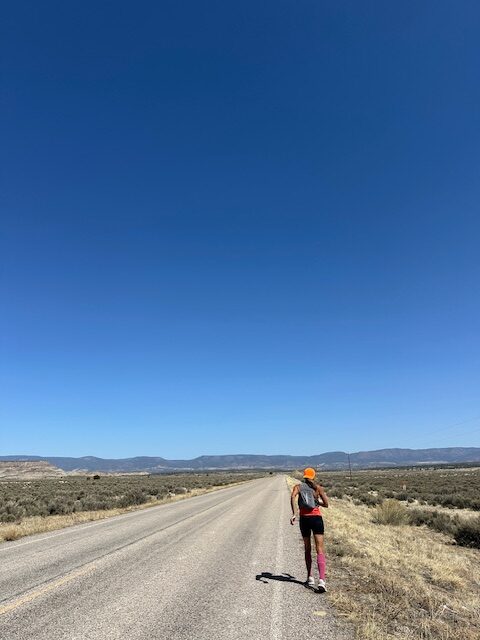
It was so weird because when we moved to Flagstaff, I was like, “Everybody’s going to do something out of their comfort zone because we didn’t move here to not do something.” I was looking for a running coach, and then I found out one of our neighbors was Matt Fitzgerald. He wrote a bunch of books about running and triathlons. He opened a running camp, and I had reached out to him, like, “Can I be part of your camp and not stay over since I live in Flagstaff?” So basically, he became my running coach, and then I was like, should I tell him this idea I have about running across America? Because he was like, “What do you want to do? Are you training? What are you training for?” And I’m like, “Well, I kind of had this crazy idea that I want to run across America.” Instead of him saying no, he was just like, “Okay, alright.” Every week, he wrote me a plan and I followed it.
It’s different running in Arizona [than Wisconsin] because it’s a dry heat. There’s not that high humidity. One of the things I noticed when I would run in Wisconsin when I found out, probably even before I found out I had MS, I would feel overheated a lot. I didn’t know why, and I was just like, “What the heck?” That’s another thing that scared me, getting overheated all the time, but after training in Flagstaff, I haven’t had that. It’s like I would get these numbing sensations in Wisconsin, and I thought, “Oh no, this is a flare coming up again.” Now that I live in Flagstaff with the dry heat, for me at least, it really [improves] my MS [symptoms].
It was just running every day. Towards the end, it was running every day for an hour, and maybe three times that week I would run three 30 miles. Maybe two weeks later, it was three 40 [miles] in a row. My coach was kind of testing me to see how I would do. I’d always do it and have fun.
What made you decide to run across the United States? Was there a reason or was it just an idea that you had?
I wish I had a really good answer for that. It’s so hard because I heard [that] other people were doing it, and I thought that is super cool. You get to see the United States in a different way; you get to meet a lot of people. I thought that would be interesting to do. I saw documentaries on it, and I always enjoyed running. I’m like, “That would be cool to do someday, that would be neat, but I’m never going to do it.” I would push that thought down instead of living this fantasy.
When we moved to Flagstaff, everything kind of aligned and that dream resurfaced inside of me. It’s not something I shared with people, because people would be like, “Okay, sure. I’m going to fly to the moon.”
When you did eventually tell people, what were their reactions?
I told people first in Flagstaff. They were just like, “Oh, wow, that’s great.” I was just like, “Okay, that’s weird.” I wasn’t expecting that, but Flagstaff’s got a running community. There are a lot of pro athletes who are super nice, and I see them all the time, like, “Oh my God, you guys are awesome!” It’s a real open-minded community.
When I told family and friends from Wisconsin, I didn’t really have to tell them face to face. My mom was, I think, a little worried, but thought it was neat. Our three daughters were just like, “This is awesome.” At the same time, they just are surprised and think it’s kind of crazy in a way. I think it’s a good thing to show them not to give up, even if you’re diagnosed with something. It’s not a death sentence. It’s easier to stay stuck in that. Looking back, I’m like, “I guess I was depressed.” My husband would tell me, “Maybe you should talk to someone.” I’m like, “No, I don’t. I don’t need to.” Looking back, that could’ve been easier to stay in. The fact that he was like, “Let’s do a marathon together,” gave me some hope. This is scary, but I’ll do it.
Has running fulfilled that outlet for you? As you said, it keeps you healthy, but is it something that keeps your mind off everything else that’s going on with you?
What I’ve learned from running, from this process of the last year and a half of training for this is that—and now I’m actually doing it–is that I’m in control of me, not this disease. That’s how I looked at it before, like, “Why should I do something? This disease is going to get me.” But now it’s like, “No, this is something I have, but it doesn’t define who I am.”
Has there been anything that surprised you about your running journey?
I thought I would get injured, just because of the miles. I can run 30 miles a day for the past five weeks, and I’m having no symptoms. Of course, now that I say that I’ll probably have a symptom. I’m going to be okay, how strong the body is. It’s so amazing because I [thought that since] I have this disease and someone doesn’t have this disease, they have to be way stronger than I am, but I have this disease, and I’m feeling really strong and still taking my medication.
Is there anything that’s been really hard for you while you adjust to running 30 miles a day and being away from home?
I have my husband and our youngest daughter, who is 11 [years old], with us, and our daughter Olivia. She came out with us after the first three weeks. Now, we have our oldest daughter, Genevieve, out with us, being the support crew. Knock on wood, the only thing that I’m finding difficult is our youngest daughter missing her friends and school. That kind of breaks my heart as a mom, like, “I’m sorry I’m doing this thing.” Usually, moms are the ones that fulfill everyone else’s dreams. It’s hard for me because I’m feeling selfish, but I’m reassuring her the best I can. Otherwise, it’s been a lot of fun.
What has been the most rewarding so far?
All the people. All the people who have reached out to me on Instagram. I was nervous because I have multiple sclerosis, but right now, my legs can still function. I was almost nervous, like, are people with multiple sclerosis who maybe can’t walk going to get my message that I’m running for those who can’t? I was nervous, but it’s been the opposite. People reached out to me and have let me know of a loved one of theirs who passed away and had MS, that they were so happy I was doing this. People with MS have said, you know, “Thanks for running for the ones who can’t.” That feels the most rewarding because I want to bring awareness to this disease that I think has a lot of stereotypes that you’re going to end up in a wheelchair. That’s just not true anymore. Maybe 40 years ago when they didn’t have all the different medications. They also used to tell people not to exercise.
Is there an area of the country that you’re most excited to run through? Is there anything you’re looking forward to?
You know, not really. I haven’t looked. I know what states I’m running through, but I don’t really look at the map because if I look, then I’m going to be like, “Wow, that’s a long ways.” Instead, I take it each day at a time. If I can run 30 miles, then I take it mile by mile, a day at a time.
Everyone is so friendly. People have been pulling over, like, “Do you need a ride?” I’m like, “Oh, no. I’m running across America!” Then they’re really excited for me. People will come back and they’re like, “I saw you this morning and now you’re over here!” They’ll bring me water. A man I met, he was saw me this morning, then came back and told my daughter, “I did a blessing for you and your mom.” It’s just really sweet. People are nicer than what we think they are. Everywhere.
When I was crossing over from California to Arizona, some man came out of a café and was yelling at me across the street saying, “I saw you earlier this week in Parker. I was thinking, what’s this girl running for? Now you’re here. Where are you headed?” So, I was like, “New York!” I just like connection so much. It just brightens my day. I yell to him my story and then he gives me these two thumbs up. People are just happy. I feel like there’s just been so many negative and bad things that it feels good.
Do you have any advice to give to other runners or anybody dealing with MS who is inspired by your story?
This is going to sound so corny, but it’s so true, that people just listen to themselves and follow that inner feeling. Don’t give up, don’t think it’s a death sentence. I hate telling people what to do, I just want people to go after their dreams. It’s hard for me because even though I’m getting all this joy from meeting all of these people, I feel like they’re the ones who are inspiring me, just these little conversations I’m having. To think I’m inspiring other people, that’s awesome. I also feel like all I’m doing is running.