
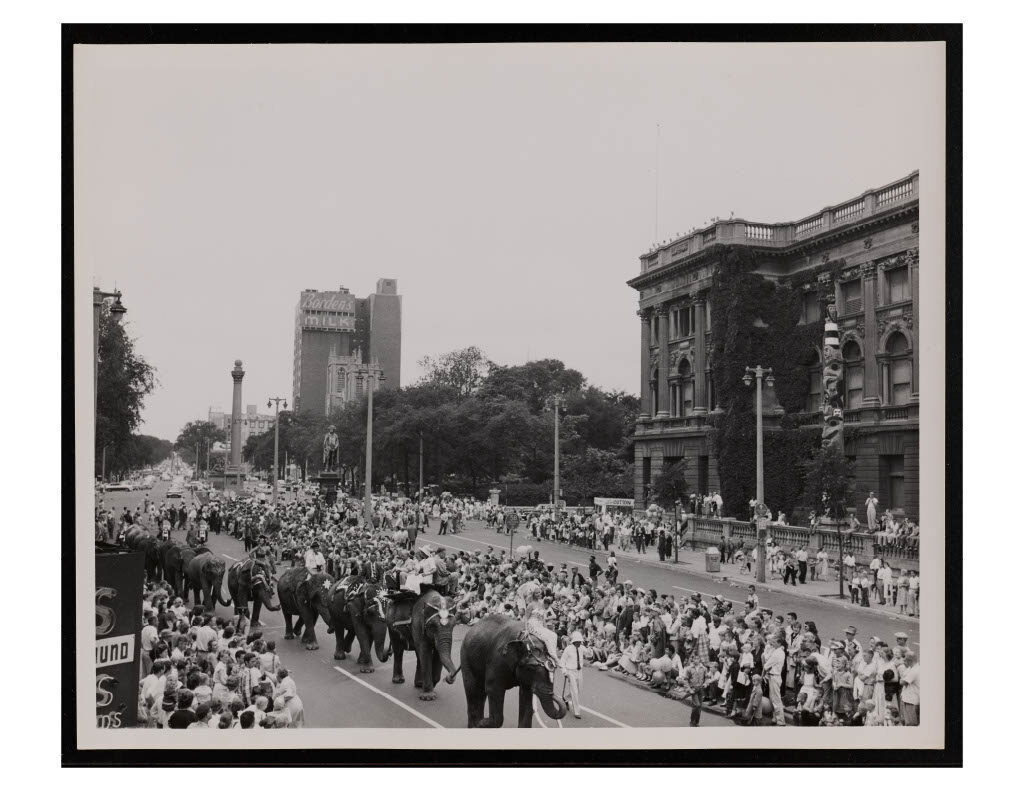
Five years before the Great Circus Parade roamed Milwaukee streets in 1963, the Milwaukee Junior Chamber of Commerce (Jaycees) held a massive promotional parade to over 100,000 people on Wisconsin Ave.
In 1958, the Jaycees sponsored the Christiani Brothers Circus shows at State Fair Park in West Allis and wanted to drive more traffic over to the shows. However, in order to parade a menagerie of animals, clowns and oddities – they needed to pay for a special permit that cost $750 ($8,667 in 2026).
News broke on May 29 that the Jaycees would sponsor a circus parade, only if, the Milwaukee Common Council waived or reduced the parade permit fee. Jaycees president Rod Lanser said profits from the circus shows would go towards funding their civic and youth efforts.

Celebrate this year’s winners of the Betty Awards!
The bureaucratic red tape tightened after a Common Council License Committee meeting on June 5, refused to waive or reduce the permit cost. The Committee stated that a city ordinance mandated the $750 fee for circus events held outside Milwaukee city limits. The only other option would be to pay a $500 daily fee for shows held inside the city, which was met with public outcry. Children wrote letters begging the Common Council to waive the fee; even children’s tears couldn’t make the Council budge.
To the surprise of the city, Harold Falk, president of Falk Corp., paid the permit fee himself, wanting the children of 1958 to experience the circus parades of his childhood.
On July 14, 1958, Christiani circus performers assembled on West Wisconsin Ave., right outside Marquette University. The crowd lined both sides of the road for blocks eagerly waiting for the festivities to begin.
The circus parade started at high noon with Miss Milwaukee, Carmen Shields, in a convertible draped with “The Milwaukee JCCs Present Milwaukee’s First Circus Parade in More Than 40 Years” signage. Clowns, performers and caged animals followed in quick succession. One of the many crowd pleasers was the calliope, a mobile steam powered instrument, which makes music by sending steam through differently sized whistles. Another crowd favorite were the 13 elephants marching in single file at the rear of the parade, each adorned with a rider.
Among the riders were parade marshal Lanser, Washington Park Zoo director George Speidel and circus historian and honorary parade marshal Chappie Fox. Milwaukee Sentinel reporter Rosa Tusa described riding an elephant as a mixture of traveling on land, sea and air. “You’re on land dangling in air, and with every heavy-footed step–the sea.”
The 1958 parade brought majesty to this city and wooed the hearts of its citizens: so how did people forget it. Well, there’s a few reasons: it was organized on such short notice with little coverage plus it was only four blocks long and took 15 minutes to pass a viewing point. However, it was one of the first modern parades with flatbed trucks moving people and animals, but it quickly built a legacy.
Fox, one of the elephant riders, became the impresario who started the Schlitz Circus Parade in 1963. He organized a larger, more extravagant event that used more traditional spectacles to impress a crowd. Ditching flatbed trucks for horse drawn carriages had a more intoxicating effect on Milwaukee, thriving for 46 years as the Great Circus Parade.