
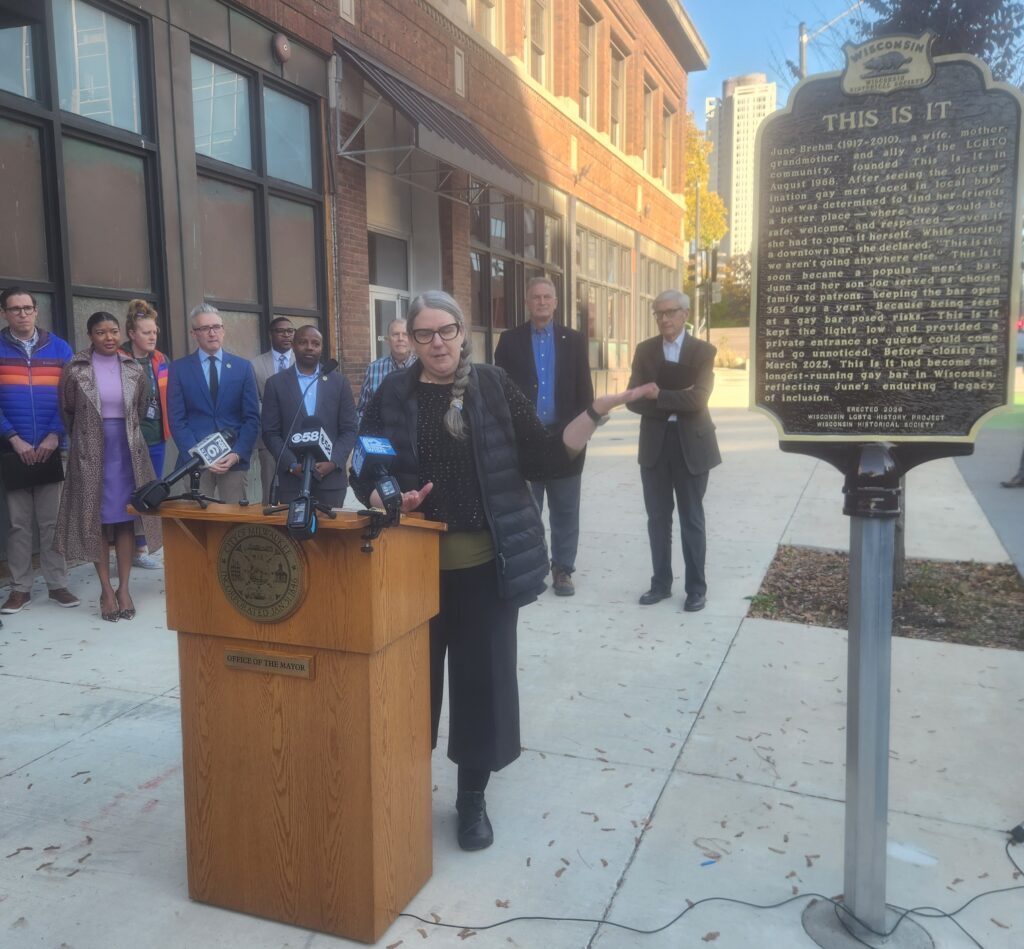
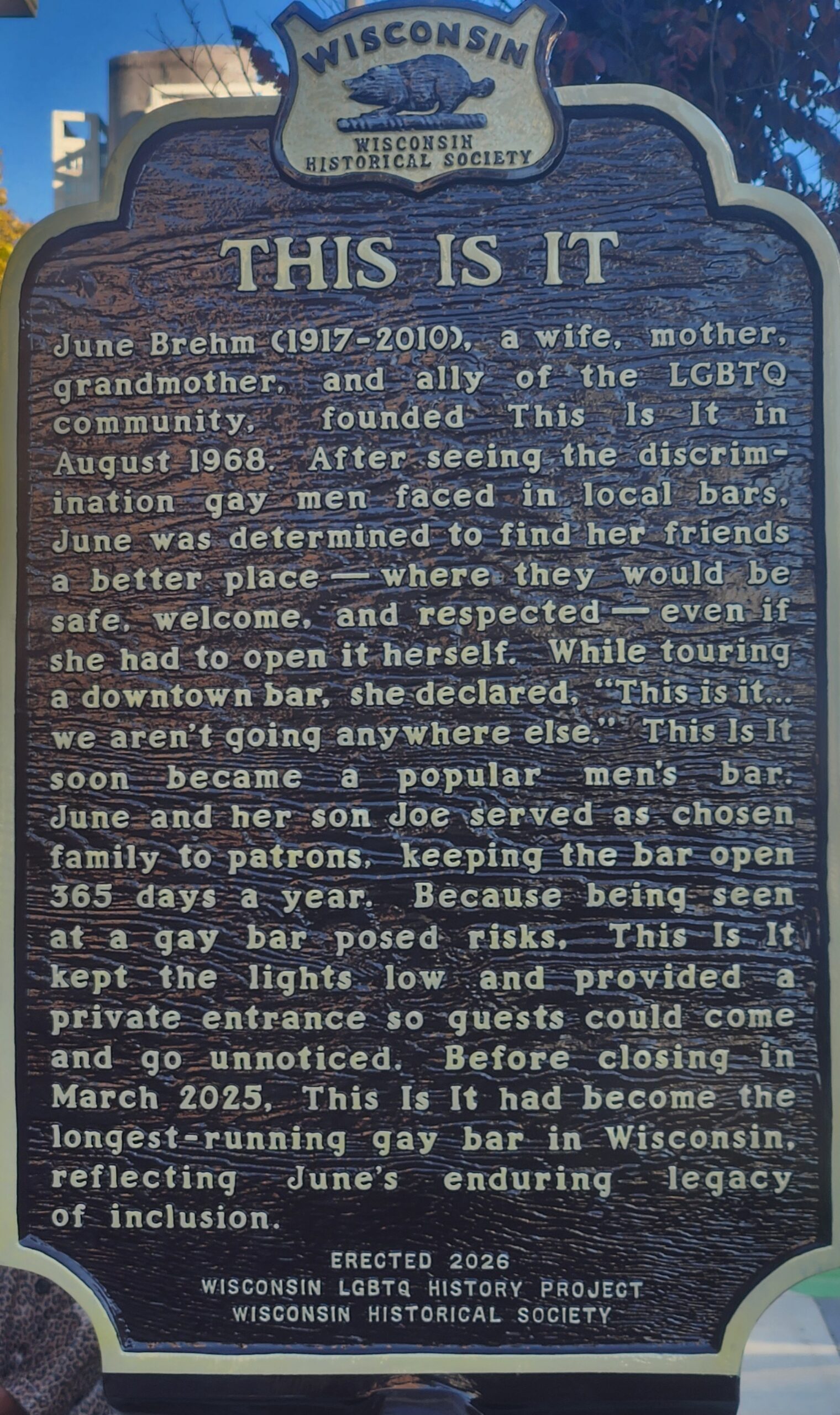
“After seeing the discrimination that gay men faced in local bars, June was determined to find her friends a better place – where they would be safe,” states wording on the historical marker, which is located on the sidewalk near what had been the front entrance to the tavern.
“It’s really cool that this was able to come to fruition, and I hope it stands as a reminder of what people can do for their community to help people that don’t have a voice,” said Sarah Freiheit, June Brehm’s granddaughter, who attended the ceremony with family and friends.
This is It stood as Wisconsin’s longest-operating LGBTQ space and one of the oldest continuously operating LGBTQ establishments in the United States, opening nearly one year before the Stonewall uprising, a series of spontaneous riots and demonstrations against a police raid that took place in the early morning of June 28, 1969, at the Stonewall Inn in the Greenwich Village section of New York City, noted Dan Terrio, a board member with the Wisconsin LGBTQ History Project.
Opening a gay bar at that time carried “real personal risk,” he said. This is It provided a place where people “could be themselves with dignity, safety and respect.
“June’s story reminds us that history is often changed not by people seeking recognition, but by ordinary people making extraordinary choices,” he said. “I’m sure she would never have imagined that nearly 60 years later, a community would gather to celebrate her courage. She never thought of herself as a hero. She believed she was simply taking care of her friends. Yet, through unapologetic acceptance and relentless allyship, she helped create a place that changed lives, strengthened a community and became part of Wisconsin history.”
The historical marker, Terrio said, stands as a reminder that “one person making the right choice at the right moment can change the course of history.”
Gov. Tony Evers addressed the crowd, stating that standing with Wisconsin’s LGBTQ community has been one of the highlights of his eight years as governor.
“The state has an incredible history of LGBTQ activism, one that deserves its place in the front of the history books,” he said. “[This is It] served a countless number of our LGBTQ Wisconsin friends and neighbors over five decades, building a space where folks can celebrate, feel seen and be themselves,” Evers said.
Milwaukee Mayor Cavalier Johnson said This is It did more than make history during its lengthy run.
“It’s a place that helped to shape the soul of this city,” he said. “This Is It stood as a beacon of community, pride and dignity for folks right here in Milwaukee. You had locals, activists, organizers, visitors, national celebrities, performers, young professionals. Everybody was drawn to this place, seeking to have connections.”
Johnson said he visited the tavern on several occasions and called it “Milwaukee’s neighborhood living room.”
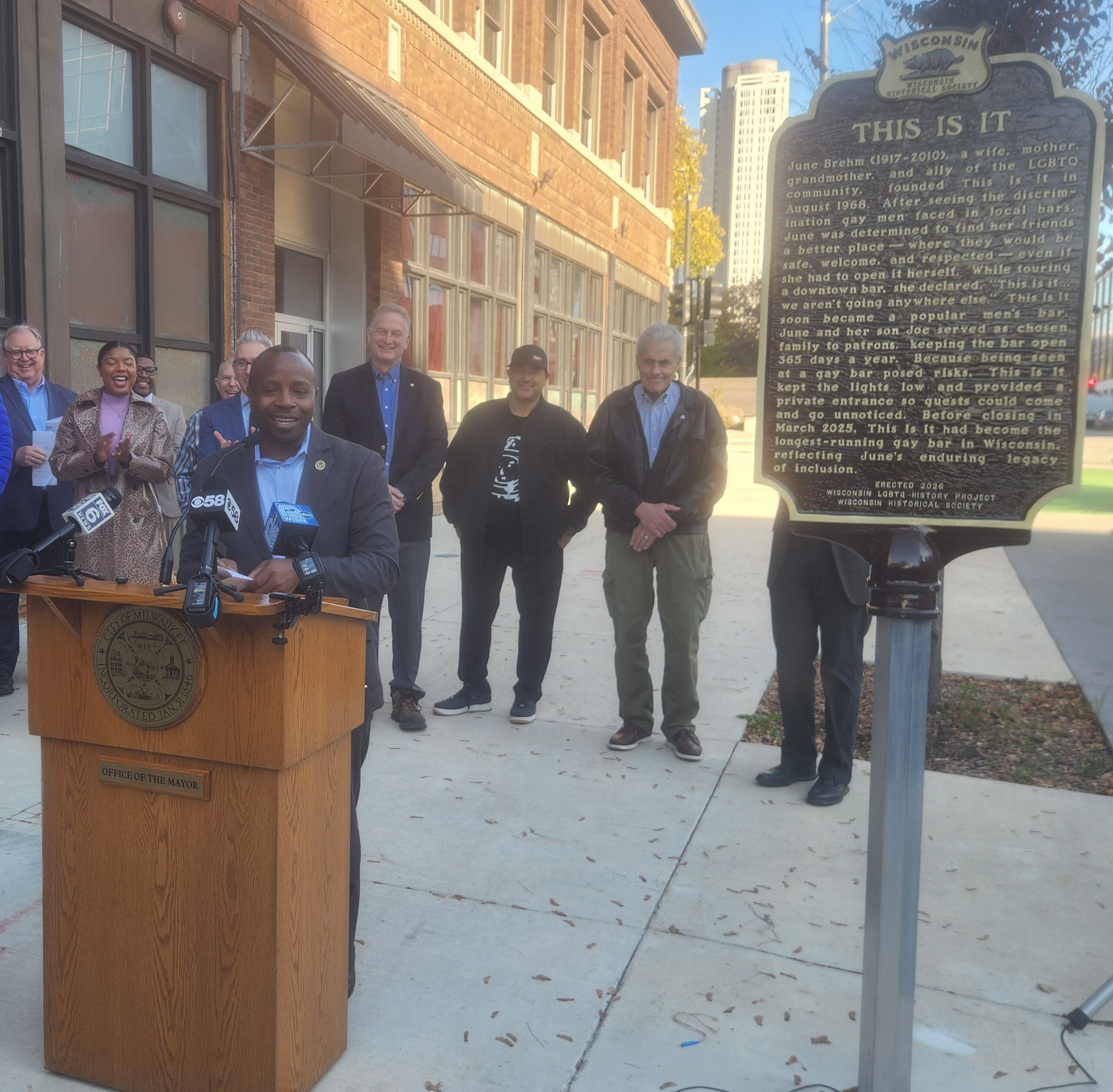
“It was a welcoming place, an open place for everybody in our city,” he added. “This marker is a reminder to everybody that as you pass it, you don’t have to wait for history to happen. Any one of us, right here, right now, at the right moment, has the power.”
Johnson said This is It also became a place of refuge during the dark days of the AIDS crisis “when the outside world was full of trauma and full of fear. It was a sanctuary and it was a welcoming place for solidarity, and it was open, not just for members of the LGBTQ+ community. It was open for anybody and everybody. Milwaukee is a stronger, bolder, and it’s a better city because of places just like this, and largely because of brave women, just like June, who stood up and said, ‘We’re going to fight to make sure that everybody in our community has a safe place.’”
Alderman Peter Burgelis, who became the first openly gay man elected to the Milwaukee Common Council in 2024, said This is It often was the first place a person walked into as openly out.
“Think about what it took to reach that handle for the first time, and then think what it meant to walk in and see someone who was happy to see you,” he said. “You could go out and run into someone you knew, and someone who knew your name. You could bring a date. You could have a bad day and sit next to someone who knew when to ask about it and when to leave it alone. I’ve had a couple of those days there as well.”
Burgelis said he’s pleased to see the marker go up but that “it still hurts that the bar is gone.”
“Plenty of people here can picture where they used to sit. They can tell you who worked behind the bar,” he said. “They can tell you who was there for them when their own family wasn’t.”
Milwaukee County Board Chairwoman Marcelia Nicholson-Bovell said generations of Milwaukeeans found freedom and acceptance at This Is It. “Sometimes when they couldn’t find it anywhere else, and that’s why today matters,” she said. “The doors may have closed, but the stories, the friendships and the lives changed here are still very much alive.”
Ritchie T. Martin Jr., executive director of the Milwaukee LGBT Community Center in Milwaukee, said small businesses like This Is It have been forced to confront rising costs and economic stability due to decisions made “far beyond their front doors.”
“This Is It closed its doors, not because history was insignificant, not because this community stopped mattering, but amid extraordinary economic pressures, including prolonged street construction that made this beloved institution difficult to access,” Martin said. “That should trouble every single one of us, because when a business closes, we lose commerce, but when a safe place closes, we risk losing community. We lose gathering places. We lose intergenerational connections. We lose the places where young people discover that they are not alone. And how do we celebrate their contributions after their doors close without doing enough to protect them while their doors are still open.”
The Wisconsin LGBTQ History Project noted that it is 100% responsible for all costs of design, installation, dedication and maintenance of the historical marker through its LGBTQ Landmarks Program and that the This Is It marker is entirely privately funded with no federal, state or local taxpayer investment.
On Aug. 1, 1968, June Brehm opened a tavern near Cathedral Square that she named This Is It. The gathering spot would change history.
Brehm, a straight woman, had a seemingly simple yet complicated mission: creating a safe space for her gay friends. A service industry veteran, Brehm had seen the spaces for which her gay co-workers had to settle – windowless, anonymous, obscure, unmarked places with little ambience.
This Is It operated at 418 E. Wells St. for 57 years as a warm and welcoming hangout. Even after the passing of Brehm in 2010 and her son, Joe, in 2016, the bar remained in operation for several more years under the direction of new owner George Schneider before closing on March 9, 2025. Schneider cited the lingering effects of the COVID-19 pandemic and street closures and construction in the surrounding area as reasons for the closure.
On Thursday afternoon, nearly 100 people gathered outside the shuttered tavern for a nearly hourlong ceremony conducted by the Wisconsin Historical Society and the Wisconsin LGBTQ History Project for the unveiling of a state historical marker honoring June Brehm and the tavern’s history.

Gift An Issue For $12 Today!