

A few weeks ago, while watching Rob Reiner’s The Princess Bride—specifically the scene where the Man in Black duels Inigo Montoya—my movie-watching companion asked me a flattering question: “Have you fenced before? You seem like you would have.” Through a full face blush I humbly answered no, with the exception of flailing foam swords in student theater productions. However, after a drop-in session at the Caliburn Fencing Club, I can triumphantly report back that now, I HAVE!
For nearly 30 years, Prévôt David Neevel and Maitre Tony Gillham have run classes, open fencing hours and tournaments most days of the week out of the Plymouth Church Gym (2717 E. Hampshire Street), the very same church where Neevel’s mother used to be a pastor. He told me he’d been fencing for around 40 years, starting at his college club in Grinnell, Iowa. Neevel’s counterpart for the day, Mat Houser, had around 20 years of experience in his own right, dating back to his college days just across the street at UWM.
Naturally, I invited the Princess Bride questioner to be my sparring partner for the afternoon. We arrived at the gym on a cloudless, quiet Sunday, and were the only fencers in attendance, everyone else presumably busy watching the ill-fated Packers/Vikings game. “Monday nights are our largest nights,” Neevel explained, “so we’ll often have 15-20 people there.”

Gift An Issue For $12 Today!
Matthew led us to the downstairs storage area and helped us suit up. We clambered into the heavy nylon jackets, donned the massive beekeeper-like masks and one-handed gloves, then wielded our swords with childlike giddiness. We used foils for the day—a thin sword weighing less than a large apple—though Matthew also showed us Caliburn’s stockpile of sabres and épées, heavier swords used for more seasoned combat.
Neevel walked us through the en garde stance after a quick fencing history lesson. Standing with our feet at 90º angles and our knees bent into a slight squat, we learned how to approach, retreat and lunge. I was taken back to my earliest days of dance class and marching band, where training yourself to activate the exact right muscle can make or break a correct movement or sequence.
After strafing back and forth across the gym floor, Neevel taught us how to attack with the foil, which scores points by jabbing one’s opponent in the torso, or target area. Neevel explained the rules of right of way, establishing offense and defense based on which fencer initiates an attack first. The defending opponent earns right of way by parrying an incoming attack, which is unfortunately the part of sword fighting video games I’m worst at. After parrying, the defending fencer can land a riposte, or a hit that basically says “nuh-uh.”
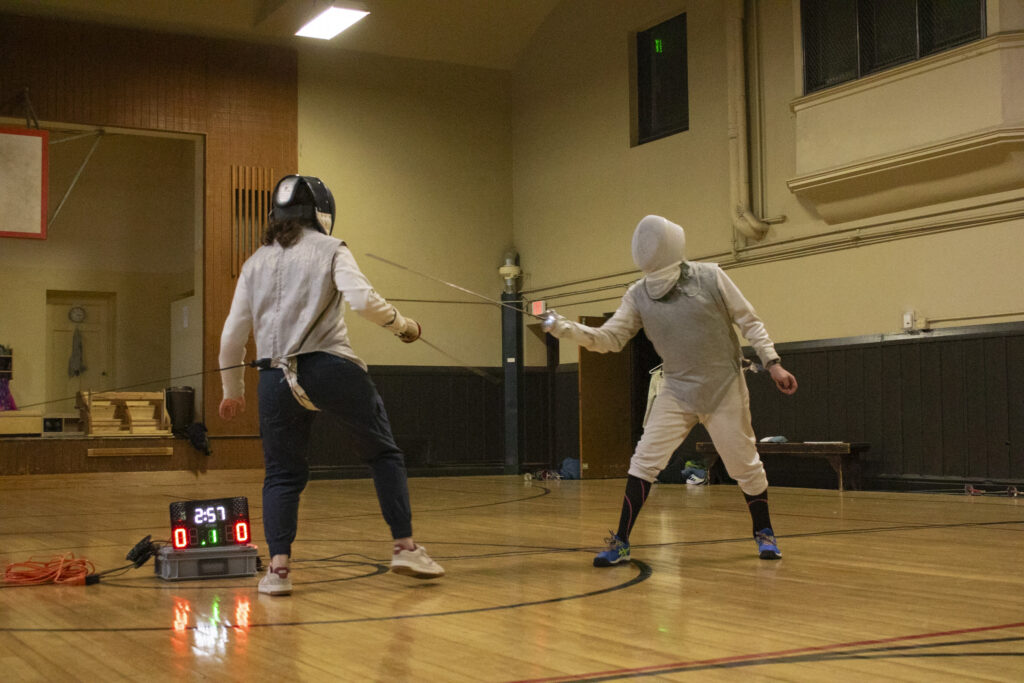
It was finally time to duel my sparring partner. We threaded cables through our jackets to electrify the swords — not enough to zap, mind you, just enough to light up the scoreboard when landing a hit on the conductive lamè vests. Neevel and Matthew hooked us up to electric cables on either side of the piste (the runway where the duel occurs), connecting us to the scoring system. The bout starts with a masks-off salute, part of fencing’s centuries-old chivalrous tradition. Our salute was admittedly dorkier than it was chivalrous. Neevel, now the referee, set us equidistant on the piste, uttering a set of commands. “En garde. Are you ready? FENCE!”
Like make-believe medieval knights, we clashed swords across the court as I managed to restrain myself from delivering Inigo Montoya’s iconic monologue. It was challenging to remember the intricacies of right of way: who it had passed to, when a riposte counted, etc. But Neevel followed each play with a clear explanation of what occurred, move by move. This is part of the ref’s job in an official match, analyzing the sometimes-split second plays with great accuracy, though for us beginners it was extremely helpful in understanding what in the world we were even doing.
I lost the first bout handily, no surprise given my sparring partner’s roller derby background. However, I was unwilling to accept total defeat. During the second bout, I decided to move off defense. Attempting the lunges, parries and feints (fake attacks) Neevel taught us, I took great pleasure battling my opponent and earning a win despite my limited wingspan, simply by going for it at Matthew’s behest. I found this to be a good lesson for the game, and for life generally.
We both thoroughly enjoyed our introductory lesson at Caliburn Fencing Club, having no clue how two hours passed that quickly. Neevel and Matthew encouraged us to return on our own time, which I’m seriously considering; club costs, $10 per session or $55 for month-long membership, are quite reasonable and as a listless 20-something I might as well take up fencing. “There’s no practical use for the sport,” Neevel admitted, but it furthered what I was already thinking: that besides from being a good workout, fencers learn how to think quickly, and challenges them to consider different perspectives, the timid learning to be bolder and the aggressive learning to be more circumspect.
If jumping into a fencing session is a bit too intimidating, a good first toe in the water could be spectating the upcoming USA Super Junior and Cadet Circuit Tournament at the Baird Center during the first weekend of December, at which several Caliburn coaches and affiliates will be working. However, a legitimate duel is incredibly fun and well worth it, especially if you’ve got a six-fingered man to exact revenge upon. Besides, after your first bout, you can make like my sparring partner and I afterwards: go grab some celebratory refreshments in Shorewood and debrief your first fencing lesson in disbelief, just loud enough to impress (or bother) passersby.