
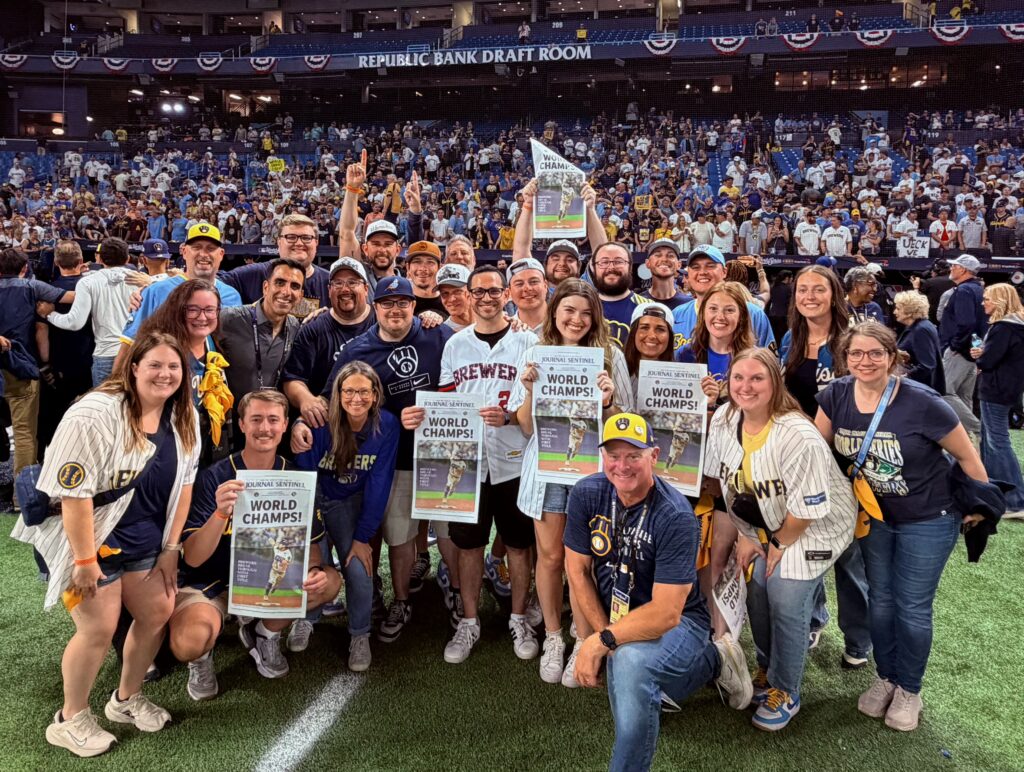
Jacob Misiorowski, Christian Yelich and company may be the faces of a world championship, but behind them is a bench most people never see: the nearly 500 full-time staffers in the team’s business and operations departments who run everything from player analytics to sausage racing.
The endless meetings, emailing and service work at American Family Field helped to bring a small market team to the biggest stage in American baseball. And the love for everyone involved was felt.
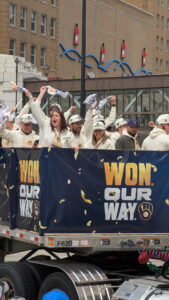
The crowd didn’t disperse as the championship players went by on their parade floats chugging Miller Lites during the World Series victory parade. An estimated 750,000 people stood and cheered on everyone on the team.
“Nobody left,” says Erica Umbach, the Brewers’ senior director of disbursements. “We stood on that float in awe the whole time.”

Gift An Issue For $12 Today!
Longevity runs deep among operations staff. A placard in the Brewers administrative offices lists at least a dozen individuals with full-time tenure exceeding 30 years. With dozens of others having worked for the team for over a decade at least.
“This place truly feels like family; it just feels right,” said Meg Lamers, senior coordinator of partnership activation, who joined the Brewers as an intern in 2024 and moved to a full-time position within a season. “It’s crazy to think that some people have been in this organization longer than I’ve been alive.”
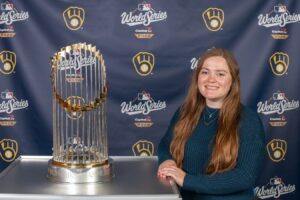
Dan Winkelman joined the Brewers in 2015 as a part-time phone center staffer and then moved up the ranks into leadership positions. He’s impressed by the large number of long-tenured colleagues in the organization.
“That didn’t happen by accident,” said Winkelman. “People stay for a reason; it’s the most measurable data point you could look for to indicate how strong culture is.”
Umbach, who started with the Brewers in 2018 after working mostly in finance for healthcare organizations, says, “I never had an inkling I’d work in sports. I came in with a different perspective than many. I just wanted to be in an organization that supported me in doing my job to the best of my ability. I’ve found this here,” she states.
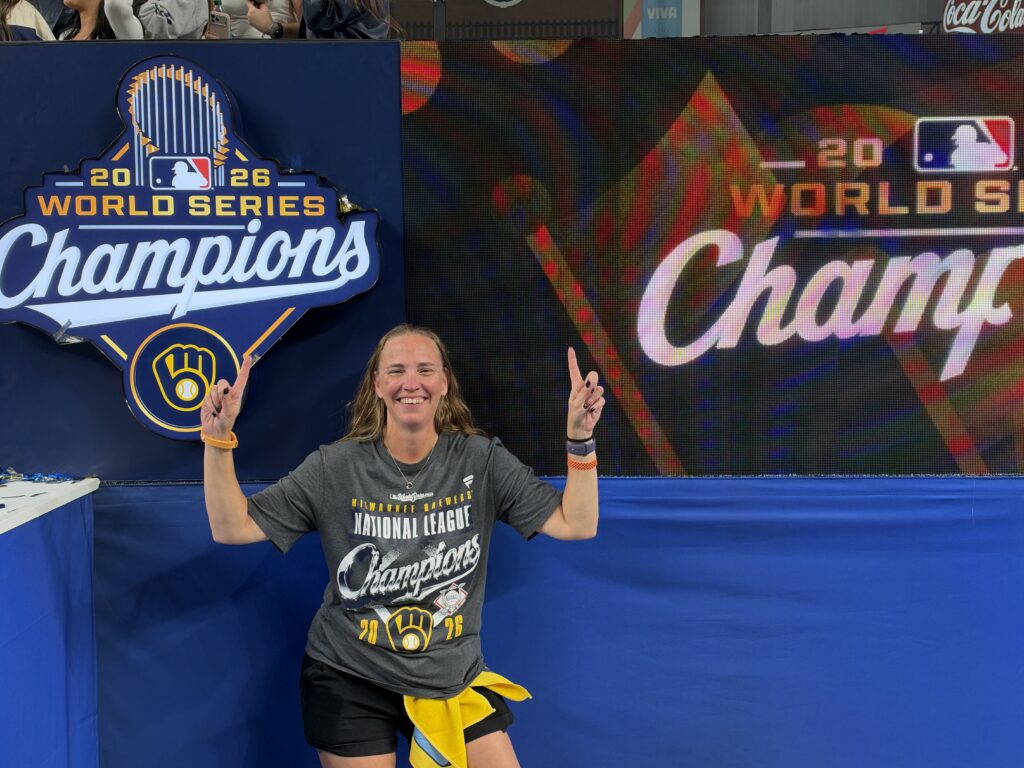
The team’s culture is purpose-built, says Rick Schlesinger, now in his 24th season with the club and president of business operations since 2019. When Mark Attanasio bought the team in 2005, he said, a stated goal was to create an environment where people want to work and stay. “He expects us to create a culture of inclusion.”
Schlesinger runs the business side: finance, HR, IT, etc. His counterpart, Matt Arnold, president of baseball operations and general manager, oversees player acquisition, roster construction, sports analytics and player development. Add hundreds of part-time and seasonal workers, and you have the machine that hosts up to 3 million fans each year.
In plenty of clubs, Schlesinger says, the baseball and business sides operate in silos. “Here, it’s one team, one goal.”
That idea got its biggest test this fall. When the Brewers announced they’d fly full-time staffers to Tampa for World Series road games, many employees were taken off guard. Executing on this was anything but business as usual. Staff did weeks of contingency planning for travel to either Ohio or Florida, arranged five planes and booked rooms across six hotels at an estimated cost of $1 million.
“Who would have expected it, right?” Winkelman states. “We get to go to a beach in late October?”
But the trip was far from a vacation. In the Sunshine State, while Umbach and her team kept processing payments, many departments held daily meetings to address fast-changing logistics and the frenzied pace of parade and rally planning.
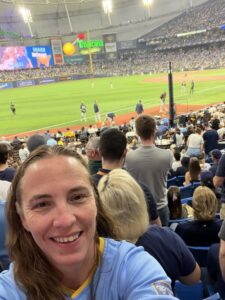
These staffers work in locations scattered across different offices, including some outside the U.S. The Tampa trip provided a rare chance for many of them to be in one place.
“It was really cool to all be there at the same time and celebrate together,” said Lamers.
Leadership didn’t forget staffers who stayed in Milwaukee to help fans to enjoy at-stadium watch parties. The club had arranged for them to attend the NLCS in Los Angeles.
“Even though they weren’t in Tampa, it was their World Series too,” Schlesinger said.
The jobs have harder parts as well. Outsiders tend to see the glamour of working in sports, rather than extra stresses and long hours during the season.
“It’s important to acknowledge the sacrifices employees make to work in sports,” said Schlesinger.
Umbach takes this in stride. “When I tell people I work for the Brewers, they say, ‘You work for one of the best companies in the state of Wisconsin,’ and I can back this up,” she remarked.
Schlesinger’s pitch as an employer is straightforward: pay people well, offer strong benefits, give them real responsibility and take a good idea from anyone regardless of title or department. Other MLB teams try to hire Brewers employees away.
“This is a credit to what we’ve created. We also see people who leave and come back,” he added.
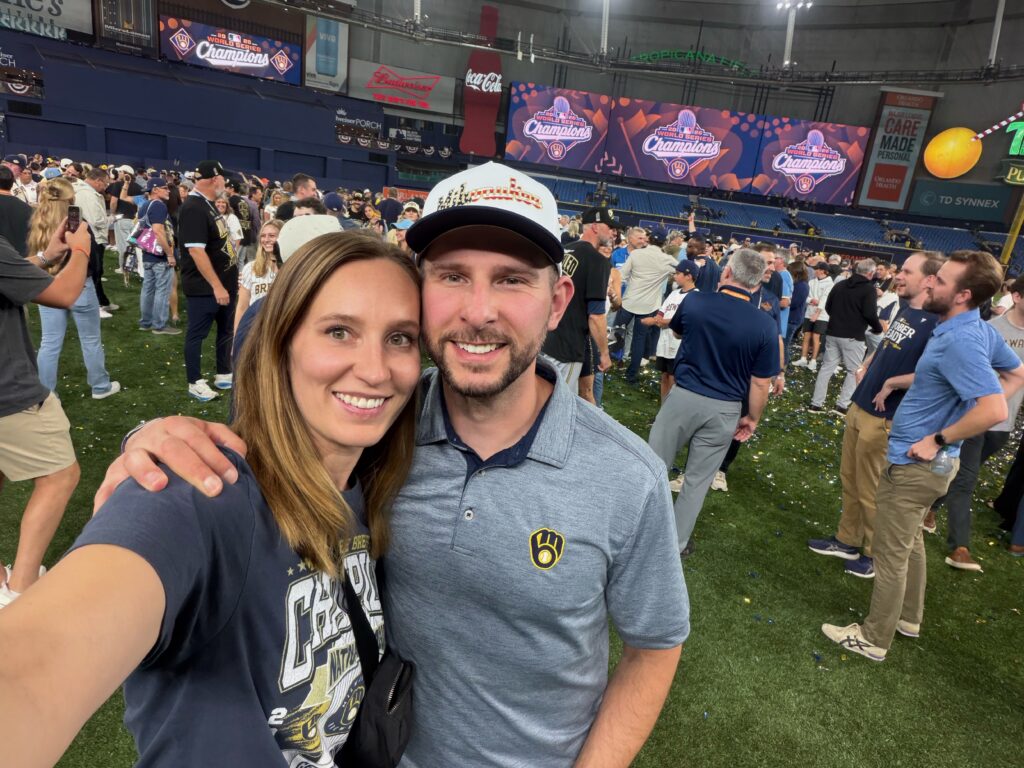
Did staffers see the frenzy of this season coming? Some weren’t surprised by the 57-year-in-the-making World Series championship, others had doubts.
“We’re still kind of relishing in the fact that it happened, it feels very surreal,” said Winkleman
What moved him even more, he said, was watching longtime staffers — people who’d “been through County Stadium, the new ballpark opening and changes in ownership — finally see it happen. This was, honestly, most rewarding for me.”
Lamers, who dreamed of working for a sports team as a kid, says front office staff members ride seasonal ups and downs right alongside players.
“This is our life and we care for this team so much. But to get here. I don’t know if it will ever truly sink in,” she added.
Umbach still hasn’t quite come down. “It was almost an out-of-body feeling, almost like a dream, and I still dream about it every single night.”
For Winkelman, Oct. 28’s victory was extra special. He turned 35 that day, a fact he kept mostly to himself for fear of “jinxing it.” During the on-field, after-game celebration, he said to coworkers, “By the way, it’s my birthday. The confetti’s for me.’”
Murphy’s words resonated with Winkelman. “He talks a lot about this all being a kind of destiny. I feel the same way on the business side. Everything went right and everything aligned,” Winkelman remarked.
Schlesinger is thrilled to receive notes from near-countless fans sharing what the World Series means to them.
“You know, it’s why we’re in sports. It’s to give joy to people. And I think ‘mission accomplished’ because many people in Wisconsin have been waiting for this moment for their whole lives,” he said.
Now, the front office is tackling something it’s never had to do; design a championship ring.
“We’re in the first inning of a nine-inning process on the ring,” Schlesinger said, adding that the Brewers’ first-time win makes it an even more special symbol.
Schlesinger, who plans to retire at the end of 2027, has spent a career thinking about what makes an organization work. He boils it down to two kinds of culture: love and fear.
“I’ve worked in both and I can tell you the difference,” he said. “At the Brewers — it sounds a little sappy — you have a culture of love, which is respect people, treat them with dignity, give them responsibility, reward them well, but also give them guidance and honest feedback so they can improve.”
As for what comes next, Umbach has it mapped out.
“Well, it’ll be Christmas,” she said. “And then we’ll do it again next year.”