

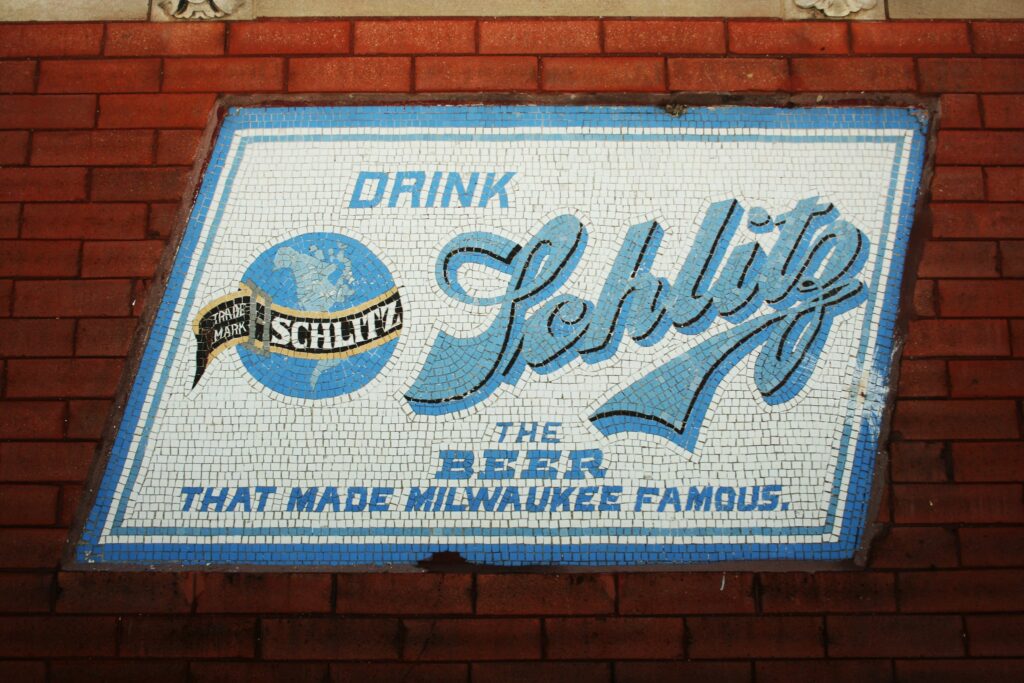
The “beer that made Milwaukee famous” is dead.
Schlitz, a brand that began in Milwaukee in 1858, has been discontinued by its corporate parent, Pabst Brewing Co. The move is part of a wave of culling of its nostalgia-driven brands.
The news comes, oddly enough, from Wisconsin Brewing Co., which announced on Thursday afternoon that it would be brewing “the last Schlitz” at its brewery in Verona next weekend.
Pabst confirmed the move on Friday. “Unfortunately, we have seen continued increases in our costs to store and ship certain products and have had to make the tough choice to place Schlitz Premium on hiatus,” Zac Nadile, Pabst head of brand strategy, said in a statement to Milwaukee Magazine. “Any brand or packaging configuration that is put on hiatus is still a cherished part of our history and hopefully our future. We continually look for opportunities to bring back beloved brands, and customer feedback is important in shaping those discussions.”
Wisconsin Brewing brewmaster Kirby Nelson spearheaded the Schlitz sendoff after hearing about its quiet discontinuation from Jerry Glunz, general manager of Louis Glunz Beer in Chicago. The Glunz family has been a Schlitz distributor since the late 19th century, Nelson says, and Glunz was in tears as he delivered the news.
“Things change, but Schlitz deserves better than just to be swept under the rug,” Nelson says. “It really needs to go out with dignity and respect.”

If someone has inspired you through their service, leadership or dedication, the Unity Awards are your opportunity to recognize them!
Wisconsin Brewing has produced Pabst products in the past, so Nelson reached out and Pabst agreed to allow Nelson to brew, indeed, the final Schlitz. That will happen on Saturday, May 23 at the Verona brewery, and Nelson (one of the state’s great beer communicators) will give a short talk in the taproom at 1 p.m. The beer will roll out in limited qualities June 27 with a big event at the brewery. (Preorders will be available May 23 on Wisconsin Brewing’s website.)
Nelson, who’s been brewing beer for more than 40 years, isn’t just throwing together any old recipe of Schlitz, or replicating the last official brew under the Pabst banner. A breweriana collector friend sent him a trove of records from Schlitz’s Milwaukee brewhouse. Using brewing logs from the mid-20th century, Nelson built a composite recipe, primarily from 1948, when Schlitz was the best-selling beer in the world. “That’s what I’m trying to do: emulate a golden era of Schlitz,” Nelson says. “Let’s see if we can get a beer that represents that.”
To do so, Nelson is using six-row malted barley and 25% yellow corn grits for the mash, while hop records from the ’30s pointed to German Hallertau Mittelfrüh and Washington Cluster.
A Long Shadow in Milwaukee
Even though it hasn’t been made in Milwaukee in at least six years, it’s hard to overstate the impact of losing one of Milwaukee’s original beer baron brands. Schlitz began as a tavern brewery in 1849 founded by August Krug. When he died in 1856, a bookkeeper for the company named Joseph Schlitz took over and, two years later, married Krug’s widow, Anna Maria, and renamed the brewery eponymously.

After Schlitz was lost at sea in an 1875 shipwreck off the coast of Cornwall – his body was never recovered, despite the elaborate marker at Forest Home Cemetery – the Uihlein brothers began running and later owning the company, though they kept the name.
During the late 19th and early 20th century period when Milwaukee’s brewing industry grew into the industrial age, Schlitz grew in kind – in part due to its success in Chicago after the Great Chicago Fire of 1871. In 1934, just after Prohibition ended, Schlitz became the top-selling beer in the world, and it stayed there for decades. It seized on its contribution to Brew City with its long-running slogan, “the beer that made Milwaukee famous.”
But in the early 1970s, the company walked itself into disaster by changing its ingredients and processes to cut costs. Loyal drinkers quit Schlitz in droves over the beer’s dramatically altered flavor profile, and the brand became a punchline. In 1982, the Uihleins – who spun their fortune into Uline business products company and remain one of Wisconsin’s wealthiest families – sold Schlitz to Stroh Brewing, ending its run as a true Milwaukee beer.
Pabst purchased the Schlitz brand in 1999 and in 2008 relaunched it with a new, supposedly 1960s-era formula. Schlitz settled into a crowded role in Pabst’s profile: a nostalgia-driven value beer that had more regional success than national cachet, a dive bar $3 tallboy. There are a lot of those kinds of beers these days, but not many that have the story that matters this much to Wisconsin, and particularly Milwaukee, drinkers.
That’s why Nelson wanted to give it a proper sendoff. “I take this stuff seriously,” Nelson says. “It’s a love letter to Wisconsin.”