
When a historical building faces potential demolition, everybody’s up in arms. Preservationists are pitted against developers. Tension is high, and so are the stakes: Once a building’s bulldozed, it’s gone for good.
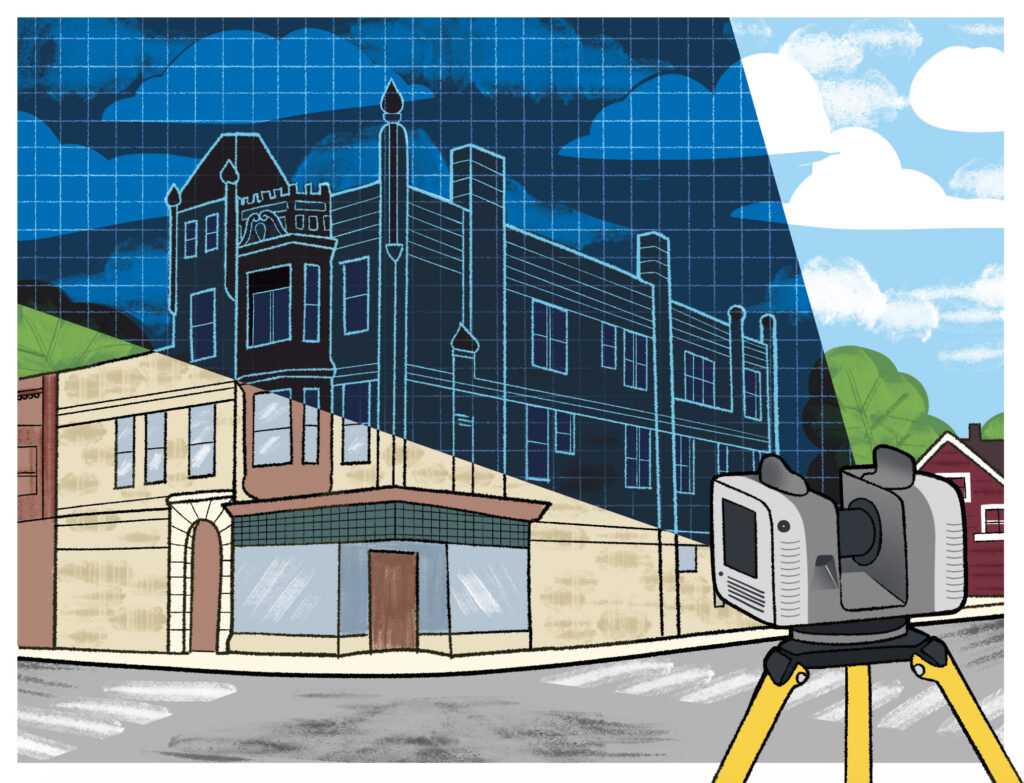
Matt Jarosz, director of UW-Milwaukee’s Historic Preservation Institute, recently introduced a cutting-edge method to preserve these buildings’ memories, as a sort of compromise. Why not laser scan the exterior of a building as a new archival process?
“A lot of groups are upset when a commission allows a demolition but, in some cases, it has to happen,” Jarosz says. “The preservation community feels a little better if they know we at least have the virtual twin.”

Check It Out!
Laser scanning is not new to Jarosz. With UWM students, he’s used this tool – which scans 900,000 points per second – to document and restore the 600-year-old Herstmonceux Castle in England, wooden pagodas in Japan and the ancient Italian town of Amelia. A laser scan of Notre-Dame de Paris cathedral facilitated its rebuild after the 2019 fire. “It helps with repair work, with identifying physical problems, analyzing the skin of the building,” Jarosz says. It costs around $800 for a small building and a few thousand dollars for a large building.
Earlier this year, Mayor Cavalier Johnson signed an ordinance into law that would require laser scanning the exterior of any historic building where a demolition permit has been filed. As of May, the Historic Preservation Commission was still fine-tuning the process. “We will be the first major U.S. city that requires such a thing,” says Jarosz.
Compared with photos and drawings, laser scanning saves money and time – and is also more accurate, says Tim Askin, senior planner with the city’s Historic Preservation Commission. “It will be actual detailed information you can take measurements off of, instead of a 40-year-old photo,” he says. “You can go out in the field and draw by hand, but even on a single-family house, it’s probably a day per side of the building, just in field work.”
Milwaukee grants 250 demolition permits each year to tear down buildings, including garages, according to Jarosz. Some are historically important despite not being listed on the state’s historic register. “What we are concerned about is even allowing demolition of our buildings in historic districts,” he says. “One of the ways to appease that with the preservation community is to laser scan these buildings.” The process is extremely quick: recently it took him just 25 minutes to scan the 1889 Hummel/Uihlein Building at MLK Jr. Drive and Center Street, which the city is seeking to redevelop.
For protected buildings, of which there are at least 2,000 in Milwaukee, says Askin, “the number of cases [the ordinance] would apply to is not even one per year. … We just don’t get many demolition requests for designated buildings.” But putting this process in place helps ensure all of Milwaukee’s architectural history is archived.
“We’re not saying to save all old buildings,” says Jarosz. “We’re saying that as we grow as a city and have new buildings, we ought to have archival records.”