
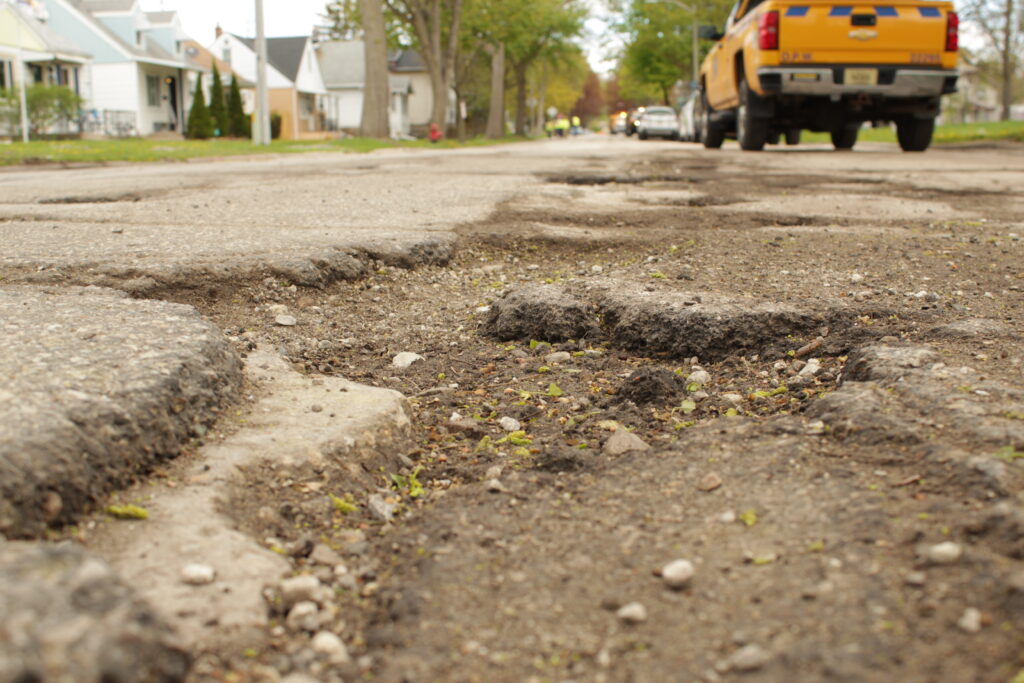
Potholes in Milwaukee are worse than ever before. Just ask anyone.
“The roads are horrendous, says mechanic Brett Stabelfeldt, owner of Brett’s Auto Repair on Bluemound at 62nd Street. “Driving through Milwaukee is equivalent to off-roading.” District 10 Ald. Sharlen Moore is reminded of it constantly. “I’ve been stopped in grocery stores [by] constituents asking about the potholes, the potholes, the potholes,” she says.
John Norquist was elected mayor in 1988 and served for 16 years as what was described as a “fiscally conservative socialist.”
“When I was first elected mayor, everyone said the potholes had gotten worse,” he tells Milwaukee Magazine. “Everyone is always saying the potholes are worse than ever.” It’s a sentiment that sounds like an aphorism, but there may be some truth in it.

Celebrate this year’s winners of the Betty Awards!
In 2002, the city fielded 6,313 complaints about potholes. That grew to 8,500 by 2004, shot up to 16,778 in 2008 – following a historically snowy winter – then came back down to 11,894 in 2009. There were 10,138 such complaints in 2024 and only 8,512 in 2025, but this year the city fielded about 18,000 reports by late June. The 11,000 complaints in April and May alone exceeded the yearly average of 10,500.
The city largely relies on the public to identify potholes. Report one at city.milwaukee.gov/ReportPotholes or 414-286-2489.
While it’s unlikely for that pace of reporting to persist all year, it’s safe to say that Milwaukee’s roads are not in superb shape for a city that once prided itself on civic infrastructure projects
In 2009, 21% of Milwaukee’s local streets were rated to be in “poor” condition. That ticked up to 34% by 2025. The city is now asking hourly employees to put in overtime to address the epidemic, going off in teams of four to five to address the most serious reports on the highest-traffic roads.
Why has it gotten so dire? Sources point to three primary culprits – each with some degree of guilt.
ONE: Decisions to delay or otherwise fail to prioritize road reconstruction projects during the Norquist administration created a backlog that continues to grow, says Kevin Muhs, the current city engineer.
Norquist rejects the idea that budget cuts during his tenure decades ago are to blame as “ridiculous” and points out two suspects:
TWO: Republican legislators who cut into shared revenue, allowing Madison to control more money than localities.
THREE: Decisions made in the mid-20th century that neutered public transit.
YOU REAP what you sow.
Deferring capital projects is perhaps the easiest way to balance a municipal budget. Nobody would really notice if you cut back on road work for a season or two. But, as then-Ald. Nik Kovac, who is now the city’s budget director, said during a Public Works Committee meeting in 2019, “if you stop investing in roads for a decade, it kind of takes 20 years to notice.”
In 1993, under Norquist, the city halved its road paving budget from $10 million to $5 million. It stayed there for the rest of Norquist’s tenure. “We didn’t try to make long-term problems for roads,” Norquist recalls during a phone call in April, though he did concede that “there was less road construction” when he was in City Hall.
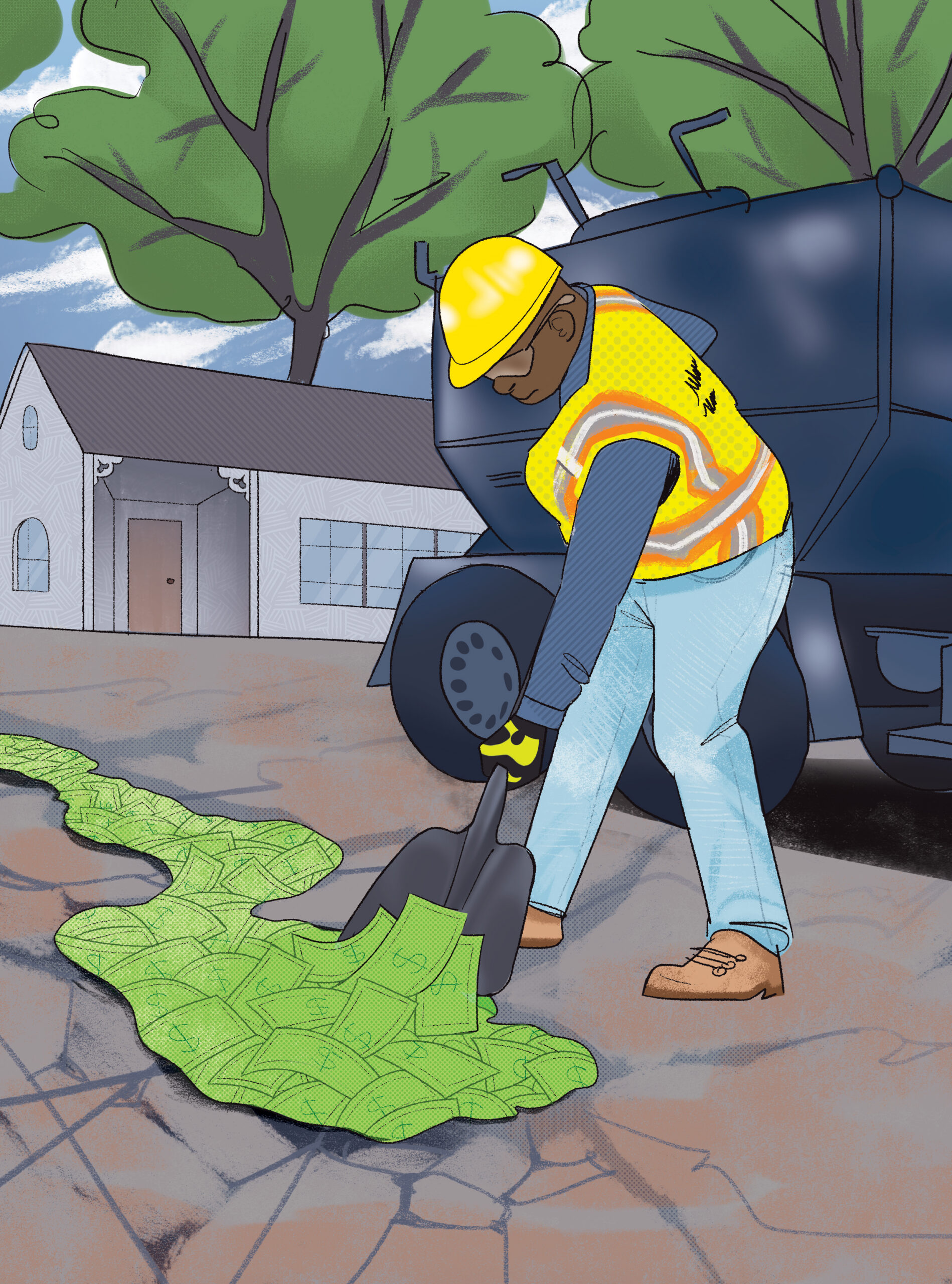
This, Muhs believes, is the city’s original sin in street repairs: “We are trying to play catchup because that’s now come home to roost.” When Tom Barrett became mayor in 2004, he gave the paving budget a boost, reaching $6.5 million by 2008. But that accounted for neither inflation nor the $55 million maintenance deficit accrued over the previous 11 years. The 2026 local road paving budget is $16.7 million, down from $18 million in 2025. (Mayor Cavalier Johnson had tried to lower 2025’s investment to $12 million as a cost-saving measure, but had his veto overruled by the Common Council.). “We have to stretch resources to maintain the infrastructure,” Moore explains.
Track all Milwaukee DPW infrastructure projects – from light repaving to major road reconstructions.
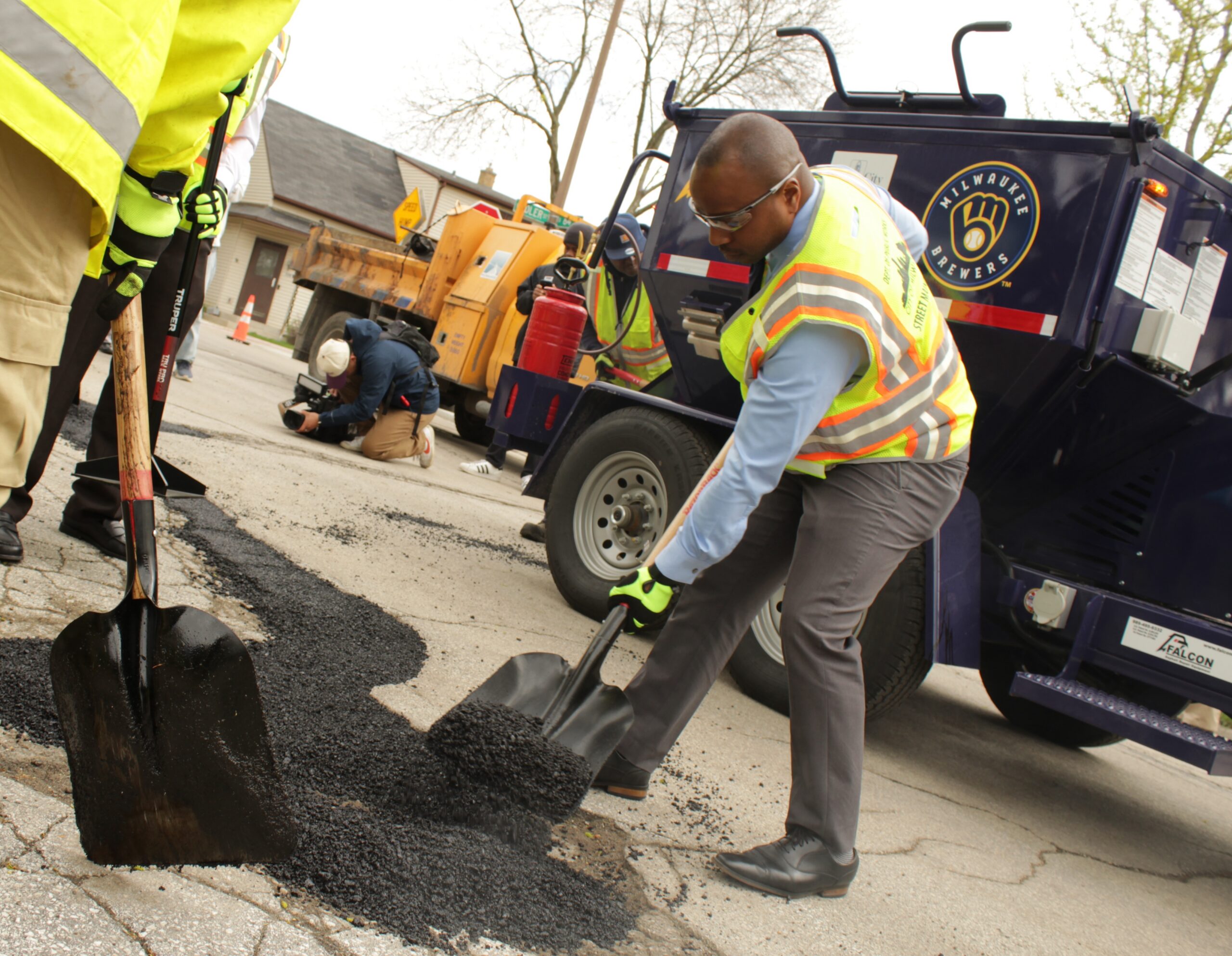
At a late June news conference on a South Side street, Public Works Commissioner Jerrel Kruschke reported that the city already had filled more than 10,000 this year, with perhaps 5,000 left to tackle. All the complaints this year had pushed the average response time up to 14 days. “These crews are out here 24/7 all year round filling potholes,” he said.
Filling potholes with hot asphalt is a solution that smooths rides and protects suspensions, but the fix is temporary. It should last through the summer – and sometimes longer – but poor application, meddling kids and unpredictable weather can undo a patch job in a matter of weeks.
A wholly reconstructed major street should be in tip-top shape for at least a quarter-century. But it costs millions to completely reconstruct just one mile of an urban street. The 1.5-mile rebuild of Humboldt Boulevard, a project that concluded in 2023, cost $8.6 million (80% of it in federal money). “The needs are way beyond what the city can afford,” says Muhs.
DPW estimated in 2025 it would cost $821 million to repair all city roads that were then in “poor” condition. Today, amid continued inflation and following a wet and capricious winter-spring that caused more damage, Muhs believes the total cost has continued to significantly grow. The city’s $2.07 billion budget for this year includes $332 million for DPW.
And there really aren’t any opportunities to make ends meet. Federal funding for roads is primarily restricted to the interstate and major commercial corridors. State funding largely goes toward arterial highways – such as National Avenue or Capitol Drive – and the state’s Local Roads Improvement Program typically provides Milwaukee with only $1 million every other year. That leaves city taxpayers to maintain the more than 1,000 remaining miles of paved roads on their own.
To help fill the gap, the city this year upped its vehicle registration fee from $30 to $41. Muhs predicts this will increase city revenues earmarked for roadwork from a little over $9 million per year to $12 million. That still falls short of covering the city’s typical $15 million-$18 million in annual spending on road reconstruction projects, so the city is covering the balance from its general fund. That revenue doesn’t go toward costs related to patch repairs, aka pothole filling, which is addressed elsewhere in the city budget.
This is where Norquist, who’s now retired from public life and lives in Chicago, blames the state Legislature. “The Republicans cut the shit out of shared revenue,” he says. When Wisconsin established the country’s first income tax in 1911, it promised that 90% of the revenue collected would go back to municipalities and counties. That has eroded to just 20% under the current model updated in 2023.
We’ve also become more personal vehicle-centric as a culture, which contributes to our worsening roadways. From 1990-2023, the U.S. population grew by 34%, while vehicle miles traveled rose by 51%.
“Milwaukee had 350 miles of streetcar in 1945,” laments Norquist. “It had 110 miles of electric bus. It had the interurban trains.” Removing all that was tantamount to “setting up Milwaukee for a world of hurt for decades and decades.” Beyond the microeconomic impacts of insufficient public transit borne most by the working class, the lack of affordable and viable transportation options leads to more cars on the road. More vehicles equals more wear and tear, which equals more potholes.
Milwaukee’s roads are bad – perhaps a billion dollars behind in maintenance and a quarter rated in poor condition. But aren’t particularly worse than any other mid-major Midwestern city. By 2036, Pew Research predicts that the U.S. cumulatively will be $86 billion behind on road maintenance and repair.
In Cincinnati, for example, the city budgeted $19 million for road repairs in 2023, $8 million short of the city’s identified need. St. Paul, Minnesota, skipped $4 million worth of planned seal coating projects in 2022 in order to balance that year’s budget. Pittsburgh’s road assessment is almost identical to Milwaukee’s: 21% of the Steel City’s roads were rated “poor” by federal standards last year.
TO START TURNING THE TIDE, there needs to be monumental changes in taxing or priorities at the federal or state levels, as revenue caps imposed by the state limit Milwaukee and other municipalities’ abilities to directly raise property taxes. Otherwise, local governments will have to make significant cuts from other departments like police, fire, administration, health or libraries. Or, we can all accept the bumpy, uneven, swerve-inducing status quo. (Slowing down can reduce a lot of pothole damage to a vehicle, notes mechanic Stabelfeldt.)
Accepting this fate may be necessary, because immediate change is unlikely. President Donald Trump’s Big Beautiful Bill last year nixed an already approved $36 million grant that would have reconstructed almost 3 miles of North Sixth Street laid down in the 1960s. Mayor Johnson at the time said the reversal was “terrible for Milwaukee.”
“The city has struggled for at least three decades with dedicating the resources necessary to improve the pavement quality of the city’s street network, particularly for those … local streets that are essentially ineligible for federal grant funds,” Muhs wrote last year in an open memo to the Common Council. In the letter, he openly prodded elected officials to pursue changes in federal law in order “to provide more direct transportation funding to municipalities.”
Which sounds like a recipe for potholes continuing to be worse than ever.
What to do in the interim? Kruschke’s advice to drivers at the press conference was to slow down and pay attention to the road – not just to drive safely but to avoid potholes. He also directed those who have experienced damage to their vehicles to submit a claim.
Potholes in the News
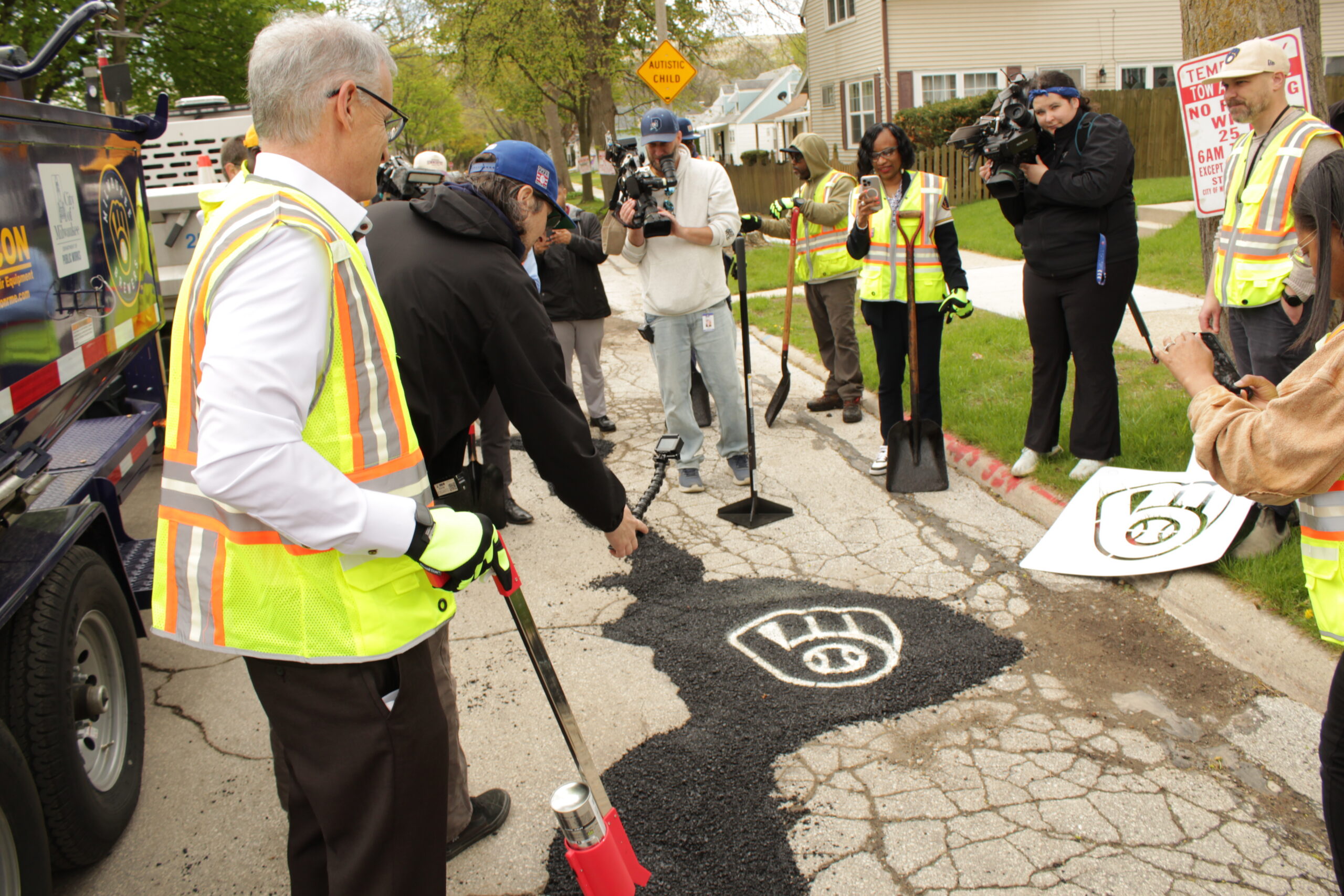
The Pothole Crew
One challenge to filling potholes is keeping the asphalt hot and malleable enough after the patch team leaves DPW’s facility. In April, the Milwaukee Brewers paid for half of a new $55,000 Falcon “hot box” machine that allows DPW workers to keep the asphalt cooking on the streets.
AI Pothole Detection
This year the city will pilot an AI-powered system called Route Reports, funded by a Daniel Hoan Foundation grant, that uses live feeds from dash cams on two DPW vehicles that drive all over the city to identify potholes.
There isn’t a clinical definition of a pothole, but we all know one when we see (or feel) one. In Wisconsin, they are most often caused by a combination of natural freeze-thaw cycles that occur every fall and spring, exacerbated by heavy rainfall. This past winter and spring were a perfect storm.
When temperatures fall below about 28 degrees, the ground freezes and thus contracts. When the weather warms again, the ground (and the road) expands again. This process – repeated over and over, season after season, year after year – weakens asphalt and concrete. Cracks form. Into those cracks, water always finds a way.
And, unfortunately for pavement, H2O has a unique property you may remember from middle school science class: when it turns solid, it expands. So, when water fills a tiny crack in a road then later freezes, it damages the road because ice takes up more space than water. As cracks and holes get bigger, they become more susceptible to water and ice, and the cycle continues.
A pothole “is less likely to happen on new roads just because there are fewer cracks,” says Muhs. “As they age, it is more likely (for a pothole) to occur over time. How asphalt fails is slightly different than how concrete fails, but both of them can result in what the public would consider a pothole.”