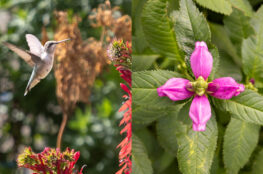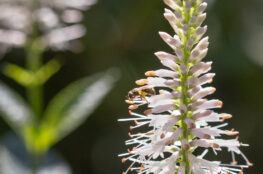


It’s not just the colors of fall that are making my yard zing, it’s the shaking and buzzing that tints the autumn soundtrack. My new and glamorous purple-pink anemone, with its elegant five-petaled faces and cute-as-a-button buds, make me think of a ladies’ lounge in a 1930s screwball comedy. (Yes, I know, those films were all in black and white, but you know it was all plush pink velvet.) When I walk by my anemone, it sounds like a bee-fueled Pollen-palooza is raging.
To learn more about bees, I attended a talk at the Elm Grove Library by beevangalist beekeeper, bee wrangler and honey purveyor Charlie Koenen. Did you know there are 517 native bee species in Wisconsin, and 90% of them are solitary bees (meaning no hive)?
But for the social bees, Charlie’s description of the complex architecture of a beehive was, ahem, bee-witching. Architect bees create modular hexagonal “rooms” for all kinds of functions: for example, a butler directs pollen deliveries to specific hexagons so the bee chefs can mix the right concoction for specific diners. Nurses take care of babies in their cradle cavities, and guards protect the entrance – bandit bees are kicked out or stung. Most important in our cold climate is the bees’ winter-long dance, beating their wings to keep the honey in the walls liquid for insulation. Amazing!
Bees are in a late-season frenzy to fill their home pantries with nectar and pollen, they shake and move to make their quotas. All this high-pitched joy proves that my work adding native plants has brought more life into the yard.

Celebrate this year’s winners of the Betty Awards!

Charlie also reminded us that our job as gardeners is to help these pollinators thrive. For example, leave your leaves on your beds and beneath trees so solitary bees can hibernate safely. Mulch leaves on your lawn (and don’t mow until these creatures emerge in May), add them to your compost piles too. I started leaving the leaves a few years ago, and I’ve had an explosion of new bugs in the air as a result. The bugs love to check out what I’m doing; the busy bees don’t scare me, but I don’t love the mosquitoes measuring me with their vampire eyes.
He also prompted me to reflect on my first-ever effort at having blooms in October. My Matchstick Quill chrysanthemums are glorious but not native; they don’t receive any bee callers. I started my native plant journey when someone mentioned to me Wild Ones, a now-national organization founded in a garden class given by Lorrie Otto at Milwaukee’s Schlitz Audubon Center in the 1970s. Hearing about Wild Ones’ mission made an orange light bulb (better for nocturnal creatures) go on in my head: I can apply my love of gardening to something much greater than me.
I did a third round of native planting this spring – thank you MMSD for your great plant selection – and hereby declare my fall yard open for winter pollen hoarding.

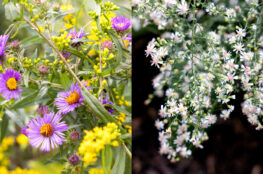
My yard is sparkling with a new round of first year native blooms, like sneezeweed and the petite petals of my asters – New England, Short’s Blue, Forked, Calico and Smooth Blue – which are scaled for the bees who rummage for nectar and pollen. I have five goldenrods in various states of radiant yellow flowering, white and purple turtleheads, and four anise hyssops started from seed. These plants entice bees with their nectar and stow their pollen on their furry bodies, a free delivery service to other plants around the yard.

Another tip from Charlie the beemeister was to stop clipping spent native flower heads. I’ve left my prairie dock, prairie sunflower, coreopsis, lead plant, rudbeckia, rock harlequin, cardinal flower and other native plants go to seed, providing snacks for birds who are migrating or staying put. I am hoping, too, that free dropped seeds will fill in my garden gaps. I just learned we should plant in groups of three to provide a “target” for the airborne foragers looting from above. This circle of life is what we all hope for in our lives of family, friends and work. I have officially added birds, bees, butterflies and bugs to my list of dependents.

Despite my skill skepticism, fall planting is going well. My lettuce transplants survived the move outdoors and the chard I sowed directly is doing nicely. My second round of green beans is going gangbusters – I’m on my third harvest already. Remember my Trader Joe’s basil hack? I just finished my 10th (and likely last) batch of pesto, a season record. You may ask: has the copper mesh around my chard reduced slug and snail damage? Well, I believe I am eating more leaves than the slugs are damaging.
I bought a lot of seed garlic at farmer’s markets, and pals Margaret and Beth have provided me with some big heads for planting. (Typically, garlic bought in the store has been treated with a growth inhibitor, so those likely won’t produce what you need.) If you don’t plant as many cloves as you’ve bought, store the garlic in a cool dark place and you’ll sharpen up any dish when needed. To plant garlic, separate each clove from the main head and remove the loose paper around each one. Plant them point up, about six inches apart and a few inches deep, covering them with some nutrient-rich compost with leaves as insulation. I protect my garlic with a square of metal mesh and tent the bed with a row cover to keep marauding squirrels at bay.
October is also when some seeds require cold stratification, which means putting them in wet paper towels and storing them in the fridge. I’ve not been terribly successful at this type of start, so I’ll instead sow smooth yellow violets and Virginia bluebell seeds outside and will cap and capture them with wire cages so I don’t accidently pull them as weeds in the spring. Onward to spring ephemerals next year; I’ll check back on any success I have.
It’s almost never too late to add more plants to your garden. Whether you buy bulbs, transplant seedlings, order garlic or native plants online or sow seeds with abandon, you still have time to feed your growing world. I am proof that any of us can extend our food production and native species support for the next month or two. Add that to your to-do list for next year!
A Few Gardening Resources
BUYING PLANTS
-
- Prairie Moon Nursery: Native plants and seeds for fall planting
- Prairie Nursery: Native plants and seeds for more fall planting
- Johnny’s Selected Seeds: Seasonal seeds
- Keene Garlic: For your 2026 haul
- The National Wildlife Federation offers a range of beautiful native plants for sale – and you’ll support their mission of protecting our native friends too!
- I bought bulbs years ago to force some spring color, but you should know that they don’t all come back every year. Any bulb loss is the soil’s gain though; just make sure any bulbs you put in now won’t disrupt the plants you are nurturing the rest of the season. There are bulb sales going on right now; get the discounts while you can.
EDUCATION
- Learn more about Wild Ones and their programs, advocacy and gateway to restoring our natural habitat that contributes to an expanded, climate resilient landscape.
- Want to learn about beekeeping, have a wasps’ nest removed or otherwise bee a part of the solution, look for Charlie Koenen here.
- I am the willing victim of online algorithms when it comes to garden sites, and just came across Kiss the Ground for Regeneration, which promotes and proves how ancient farming practices are better for the soil, for our food, for our waterways and our health. Good practices like diverse plantings, crop rotation, no chemicals etc… gives us more nutritious food and helps reinvest in our soil. We do this in our own yards, why shouldn’t big farms do it too?
-
- University of Wisconsin Horticulture, Division of Extension has online garden programs to help you make it through winter
- Joe Gardener for fun tips, tricks and classes
SUSTAINABLE GARDEN INFORMATION
-
- National Wildlife Federation: How to create and certify gardens for wildlife
- Wild Ones Milwaukee: Download the Wild Ones’ landscape design specific to Milwaukee by landscape architect Danielle Bell of Native Roots, Milwaukee. This template describes all the ecosystems that can exist in one yard, and gives you a plant list to start your native plant journey