
Spring is my favorite time of year, and May is its queen. Before we begin waxing poetic about gardening though, have you scraped off the mold from those April gully washers yet? (We better get a deluge of May flowers!) Now that it’s 50 degrees minimum out for five consecutive days, every plant’s internal growth mechanism won’t be fooled by nature’s weather, even if you are – let’s get planting.
Milwaukee’s hardiness zone is 6a, bumped from 5 in 2023 (indicating our climate is warming), so our last frost-by date is between April 26 and May 2. I have direct sowed peas, radishes, arugula, kale, spinach and lettuce. Seeds are a less expensive way to get plants into your yard, but since they do take time to produce, I’ll plug in nursery-bought eggplant, fennel, basil and tomatoes. My indoor tomato starts are tall and skinny, shall I try trenching them for enhanced strength and access to nutrients? Why not?

Check It Out!
As for my indoor starts, the Chiura Obata turnips have done very well and all the greens are perky. Almost none of the perennial seeds I cold stratified in the fridge have come up except two lupins; I’ll direct sow another round into a raised bed in the fall. Sigh. To my perennial beds I am adding a “keystone native shade garden” kit from Homegrown National Park that includes Pennsylvania sedge, calico aster, Jacob’s ladder, wild geranium, Eastern columbine, zigzag goldenrod, harebell (warning: campanula will spread, so into a pot it will go!), and heart leaved asters for a veritable pollinator buffet.
The only non-frenzied part of May gardening is mowing, or rather, no mowing. No Mow May is controversial, but if you must have grass, protect early rising ground-nesting bees by leaving your grass four inches long. They’ll enjoy the clover and dandelions even if you don’t. But don’t spray with chemicals – that hurts water, air and soil. Or replace your lawn with native “green” mulch (aka ground cover, plants that stay low and spread), remove grass from beneath your tree canopies for bouncy caterpillar landing pads, put native grasses in your park strip and nestle edibles between natives. Nature will reward you with beauty, food, and a clean conscience.
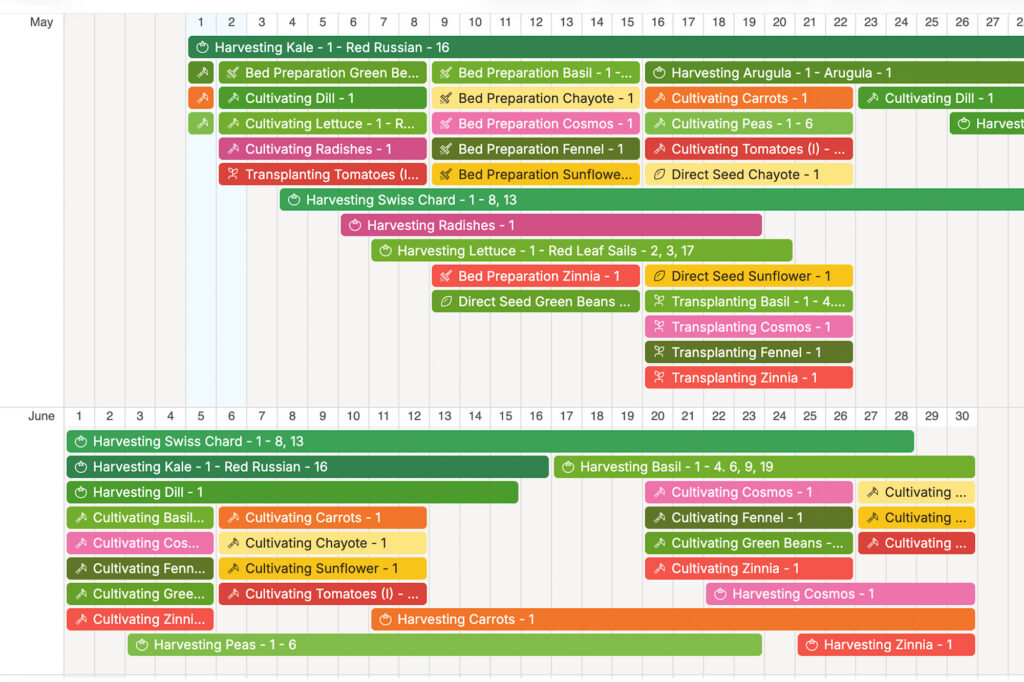
In February I attended Seedtime’s Seed to Harvest Summit to keep my mind off the snow, and my mind was blown. Seedtime is a father/son farming team who have developed a free, on-line digital tool (Gantt chart?) on how to create a three-season crop plan that allows for more food. I plugged in all the vegetables I aspire to grow this year; did I have the nerve to direct sow in that April warm front? I kept thinking about snow, and who wants to garden in mud? I’ll ramp up my third season planting in August instead.
But I will be following one the Summit’s mantras: fill your beds. Full. To the edges, corner to corner, up and down and all around. To accomplish this, I am taking the advice of Seedtime speaker Nicole Burke of Gardenary. Her designs start by planting, in the center of a raised bed, tall, “fruiting” plants (tomatoes, cucumbers) that have deep roots, typically producing in 60-90 days. In her next circle of life, she direct sows shorter “root” plants (radishes, carrots) that mature in 47-75 days. In the outer ring she direct sows “leaf” plants, whose harvest is above-ground and matures quickly. These can be “sacrificial” plants (marigolds and nasturtiums) for a living fence that distracts hungry, hungry bugs; I will opt for food (lettuce, basil and chard) instead. Burke is in Texas so some of her cheerful, year-round gardening talk stings like a humble brag. Perhaps my brother Tom, who lives in Houston, can create a four-season garden? Sibling gauntlet thrown!
During her Seedtime talk, Jill McSheehy, of The Beginner’s Garden talked about the benefits of raised beds, which are contained so there is less weeding, no soil compaction and greater water retention. If your beds are only 6-18” deep, they can be left open at the bottom to allow roots down and worms up. Deeper raised beds mean more money for soil, unless you try hügelkultur, layering raised beds with less expensive materials – first cardboard, then logs, branches and leaves, lasagna-style – finally topped by soil. It’s a compost pile and raised bed in one! McSheehy uses a simple mix of 50/50 topsoil and compost to feed her plants.
Several Summit speakers warned against using peat, a non-renewable resource that releases carbon when harvested. Hello water-absorbing vermiculite, you’ll do! As always, I’ll absorb and test several of the ideas from the Summit and will report back on my progress.

Fertilizer was another topic that kept coming up during the Seedtime Summit. I use organic fish emulsion (you can smell it from there, can’t you?) and started making banana soak last year. A new trick will be making fertilizer from the tea my partner Kevin drinks every day. The recipe is from Creative Explained: take one drink’s worth of used tea leaves, add 1 tablespoon of oatmeal, fill the jar with boiling water and let sit up to 24 hours. Strain out the solids and compost them and pour the tea on your favorite plants.
But these are small hacks compared to how much soil amendment you might need, so my advice is to compost. I have three “cold” piles, made with “green” kitchen and garden non-diseased plants along with about three times as much brown (newspaper or leaves). I turn mine every day or two to keep the breakdown (by worms or microbes) moving. The benefits of using home-grown compost include reducing waste and greenhouse gases, reducing water use, promoting healthier gardens, improving soil structure and (wait for it) increasing nutritional density of your food six to twenty times more than commercially grown food. I rest my case for composting.
If you can’t make your own compost, try organic fertilizer. The Summit speakers were unanimous in their dislike of synthetic fertilizers. Their clarion call: Fix the soil and let biology do the work. Synthetic fertilizers force plant growth and exhaust the soil, creating weak plants that can’t fight off insects or disease. I bought two bags of Leia Vaihere’s Earth Medicine organic fertilizer to support a next gen farmer. (You can reduce landfill waste by using a composting service.)
I recently came across the phrase “bloom scroll, don’t doom scroll” – we gardeners have other things to do! Leave the news “nuts” to the squirrels, I’m throwing all in with the creatures bringing my yard alive. Happy May planting, here’s to a beauteous bounty!
A Few Gardening Resources
Education
- Gardens for Good: Help Tosa Become a Community Wildlife Habitat: May 9, 2 pm-4 pm, free | Wauwatosa Public Library, 7635 W. North Avenue, Wauwatosa
Join the Tosa Wildlife Habitat team to learn about turning your garden into a wildlife habitat. I’ll be working our TWH table, come by and say hello! This event includes a kid’s activity area.
- World Migratory Bird Day Celebration: May 9, 10 am-2 pm, free with membership, includes a bird walk, drop-in activities and Raptor Saturday | Schlitz Audubon Nature Center, 1111 E. Brown Deer Road, Milwaukee
- Endangered Species Day: May 15, all day
Now in its 21st year, the Endangered Species Day was launched to celebrate America’s Endangered Species Act but now honored worldwide to protect the integrated ecosystems that make life on earth possible. Celebrations focus on wildlife and advance conservation efforts for endangered (and threatened) species in the U.S. and around the world. And get ready to color! Download their coloring book and learn facts about some of our most vulnerable species.
Buying Plants
- Friends of the Monarch Trail Native Plant Sale: May 9, 11 am – 4 pm; May 10, 11 am – 2 pm. | Greenfield Park Pavilion, 2028 S 124th St, West Allis
- Lake Michigan Bird Observatory Native Plant Sale, Free Tree Giveaway & World Migratory Celebration: May 30, 9 am – 1 pm, with guided bird walks | Picnic Area 6, Upper Lake Park, 554 N. Lake St. Port, Port Washington
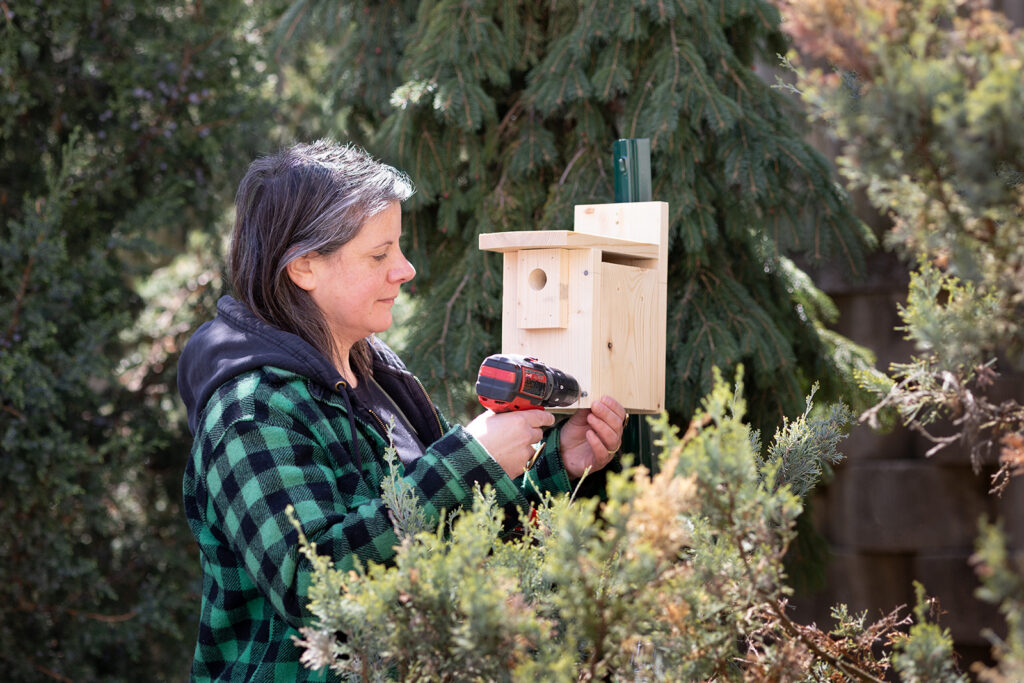
While you’re there, talk to them about their free bird nesting box program – you and your kids will love watching your new tenants thrive!
- Friends of Wehr Native Plant Sale Fundraiser: Saturday & Sunday, May 30 & 31, 10 am – 3:30 pm, rain or shine | Wehr Nature Center, 9701 W College Ave., Franklin, back of building
- Plant Sale List, Wisconsin Department of Natural Resources
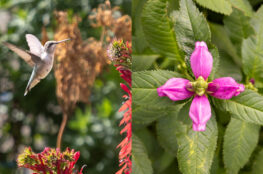
- Prairie Moon Nursery for native plants and seeds. My favorite plants include all milkweeds, sunflowers (there are a lot of perennial types!), coneflowers, cardinal flowers, columbine, anemones, turtlehead, and prairie dock (watch out, this one gets big), to name a few. I planted the rare Queen of the Prairie last year – what a tall and beautiful pink plant! I will let this one go to seed for more blooms in 2027.
Sustainable Garden Information
- Want to join me in my “rewilding for nature” journey? The Lake Michigan Bird Observatory’s Neighborhood Habitat Improvement Program is designed to support folks in adding native plants to their yards. LMBO offers webinars, yard consultations, community events and model gardens to inspire you.
- Groundwork Milwaukee is part of a national network dedicated to protecting, developing and maintaining green spaces in our area. Their pillars are addressing climate resilience, environmental remediation, habitat support and food sovereignty. I am donating to help them amend their raised bed soil, the foundation of everyone’s gardening life.
- Plant Baby Plant is a grassroots movement founded by botanist and author Robin Wall Kimmerer in support of Mother Earth. Check out her resources for ways to raise a garden or raise a ruckus!
- Join this year’s Less Lawn More Life 12-Week Challenge. Sign up for weekly doable steps and expert suggestions. Join a national movement by reducing or eliminating your lawn.
- National Wildlife Federation Garden for Wildlife
- Wild Ones Milwaukee: Specific plans for climate resilient, native gardening by Danielle Bell, Native Roots
- Want to know about birds in our area? Check out Xceret Nunez’s Chirp Chat on WUWM
- University of Wisconsin Horticulture, Division of Extension has online garden programs
- Want to expand your yard’s activities at night? Plant a moon garden! By adding white and silvery-foliaged plants you will feed those creatures doing the night shift while you slumber.
- I know you want to add specific host plants for pollinators. Take a look at National Wildlife Federation’s Plant Finder and see what lovely, crawly creatures you can attract to your yard.
- Check out Pollinator Partner’s ecoregion planting guides.
- UW-Madison Extension soil testing, your plants will thank you!
- UW-Milwaukee Extension planting guide
- New Directions in the American Landscape is an educational organization dedicated to the “art, culture, and science of ecology-based landscape design and practice”.
- Want to give the fireflies a chance? Put in orange bulbs instead of white and use motion detectors and timers rather than blasting light to outer space. For more information on supporting this lovely native bug, try the Xerces Society for Invertebrate Conservation.