
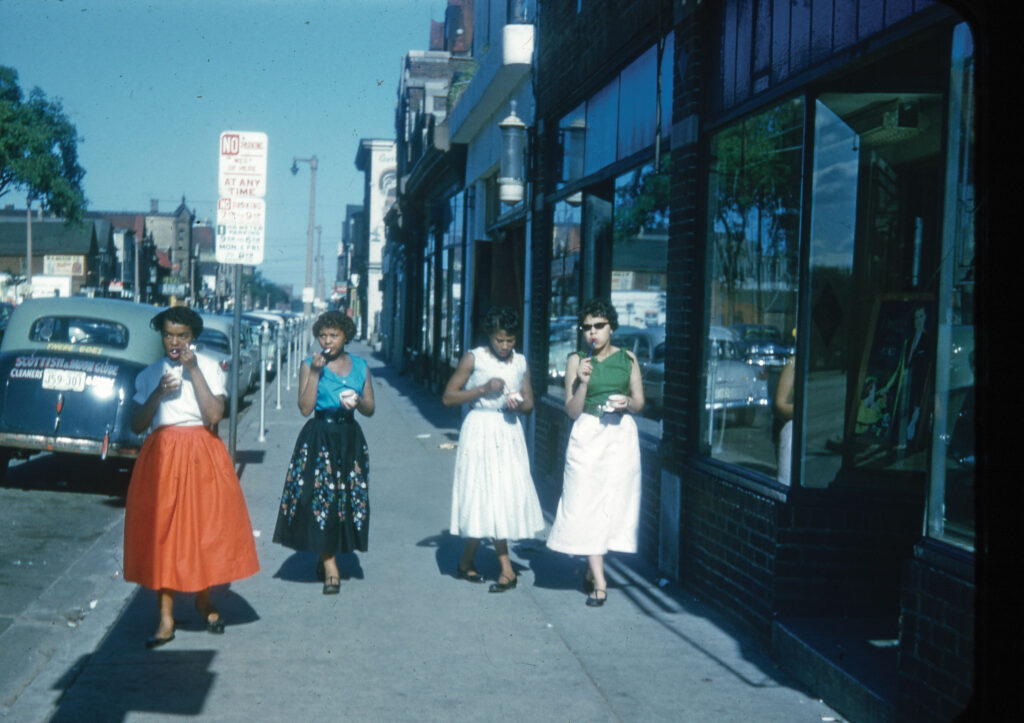
It was a warm afternoon in the summer of 1948 when four young women took a leisurely stroll down Walnut Street. They were headed west near Eighth Street, enjoying cups of ice cream that might have been scooped at any one of four parlors within two blocks of them.
Walnut Street had long been a destination for much more than frozen treats. It was the main business district for the area’s first German residents, then for eastern European Jewish families, and finally, beginning in the 1920s, for African Americans. Walnut, particularly the stretch between Third and 12th streets, became the commercial heart of the Bronzeville neighborhood, where the vast majority of Black Milwaukeeans lived for generations.

Celebrate this year’s winners of the Betty Awards!
The 1949 city directory listed Walnut Street as the home address for three Black churches, two Black newspapers, a Black musician’s union, the Milwaukee Brown Brewers Baseball Club, and music clubs that attracted Milwaukeeans of all backgrounds. One magnet was the Regal Theater, whose jitterbug contests drew throngs of young people every weekend.
But Bronzeville’s downtown offered more basic goods and services as well. At the time this quartet was out for their stroll, Walnut Street had 10 restaurants, 10 food stores, 10 taverns, six drugstores, six beauty salons, four barber shops, four lawyers, four doctors and a remarkable 13 laundries and dry cleaners. In those vanished years before big-box stores, locally owned small businesses ruled the retail scene.
It ended quickly. The 1960s were a decade of urban “renewal” in Milwaukee, and Walnut Street was a conspicuous casualty. A street-widening project wiped out the entire commercial district in just a few years. By 1969 Shorty Moore’s Bop Shop, Knox’s Music Café, Boatner’s Bar-B-Q, Luke’s Busy Bee Cleaners and dozens of other once-thriving businesses had been reduced to memories.
Take a closer look:
- Walnut Street was busy enough in 1948 to support several blocks of parking meters with one-hour limits.
- The Regal Theater was built in 1917 and showed films until 1958, when it became a church.
- Gettelman Brewing covered an entire wall with a sign promoting its beer.
- Scottish Dry Cleaners occupied the storefront at 825 Walnut St.
- Stiff cotton skirts were the norm in women’s clothing before synthetics took over.