
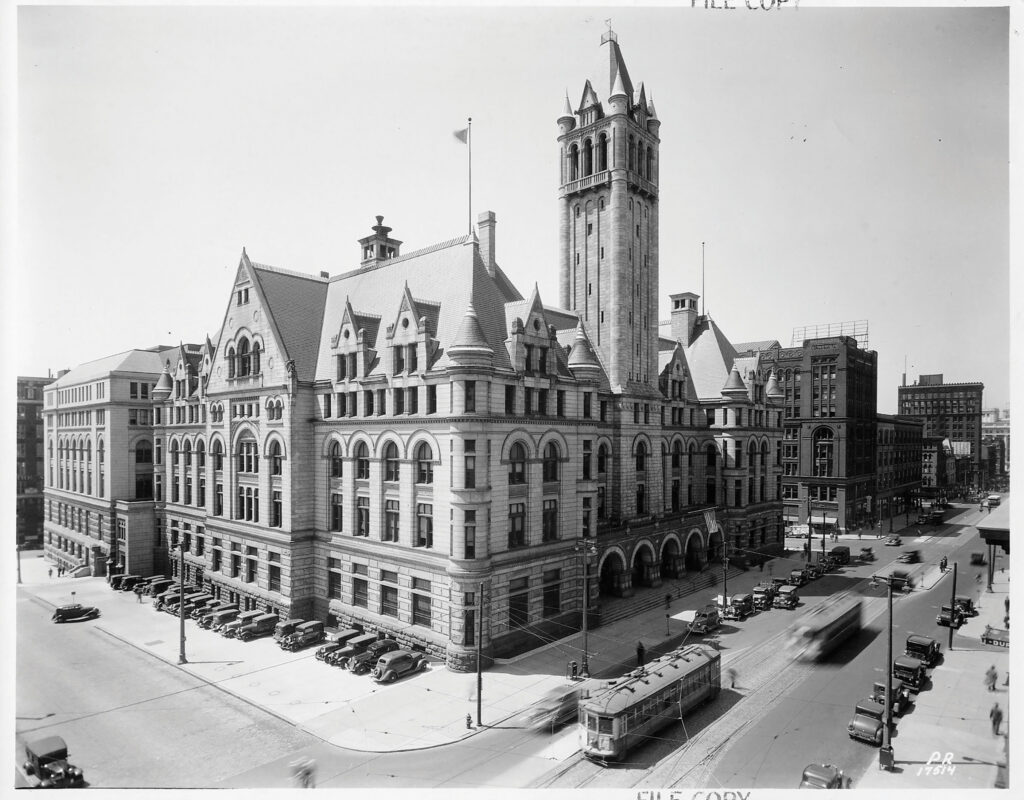
Even in an age when splendor was expected in America’s public architecture, Milwaukee’s Federal Building stood out. The Wisconsin Avenue landmark is an artfully composed ensemble of granite arches, turrets and gables massed around a tower worthy of a medieval castle. The Romanesque edifice fills an entire city block, but its bulk is relieved by the delicacy of its decoration. The stone arches crowning the main entrance are as intricately carved as the oak woodwork that graces the courtrooms inside.

Check It Out!
For all its grandeur, the Federal Building had a utilitarian beginning. Milwaukee’s population swelled by nearly 80% in the 1880s, taxing public services on all levels. Milwaukee built a new city hall in 1895 and lobbied hard for a facility that would centralize all federal functions. Congress made its first appropriation in 1889, construction began three years later, and the $1.4 million Federal Building was dedicated in 1899.
Most Milwaukeeans knew it as the “new post office.” All of the city’s mail was sorted on the floor of the soaring central atrium, with illumination provided by a glass skylight in those pre-electric days. The upper floors were a honeycomb of courtrooms and offices whose occupants regulated everything from locomotives to lighthouses to oleomargarine.
A plainer addition opened to the south in 1932, not long before this picture was taken. The post office remained until 1968, when the operation moved to St. Paul Avenue. Today the only tenants are imposing federal courtrooms and less imposing federal offices.
As the scene of high-profile trials and high-volume protests, the Federal Building is regularly in the news, but it’s surprisingly quiet on a typical weekday. This overlooked landmark still impresses, more than 125 years after its construction.
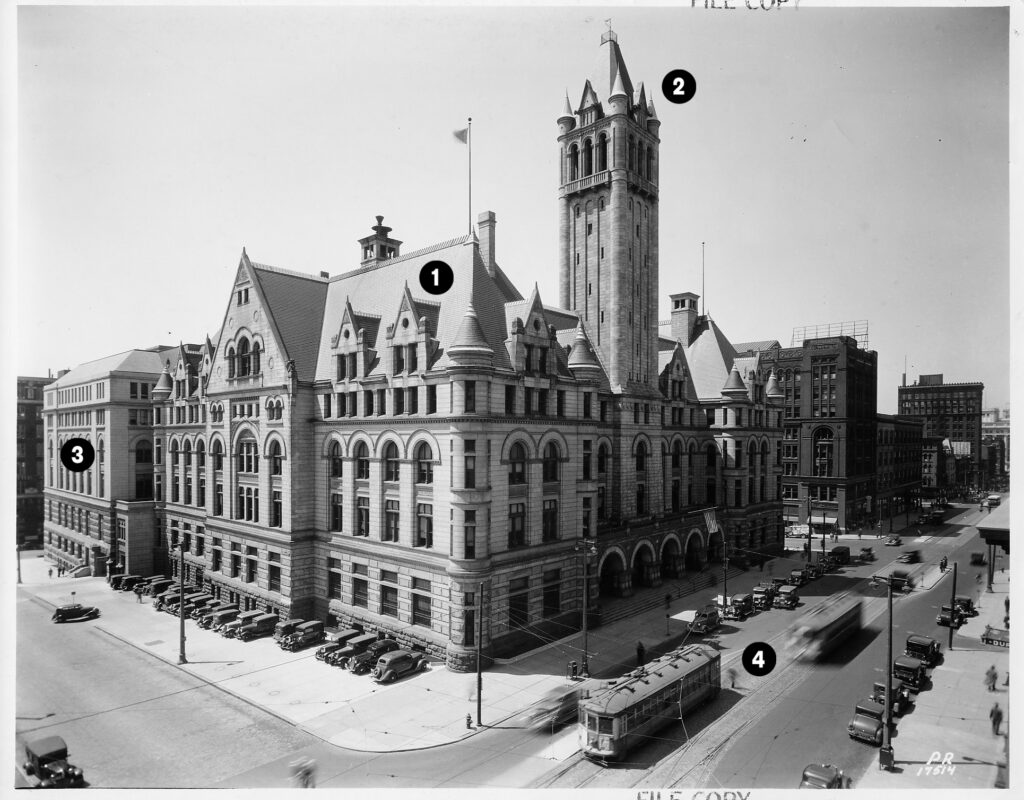
Take a closer look:
- The 1932 addition matched the original building in scale but not in splendor.
- Richly patterned stone, complex roof lines and picturesque arches were hallmarks of the Richardsonian Romanesque style.
- Plans for a four-faced clock in the tower were shelved for budgetary reasons.
- Electric streetcars started clattering Downtown in 1890.
Thanks to Judge J.P. Stadtmueller for a tour of his professional home.