

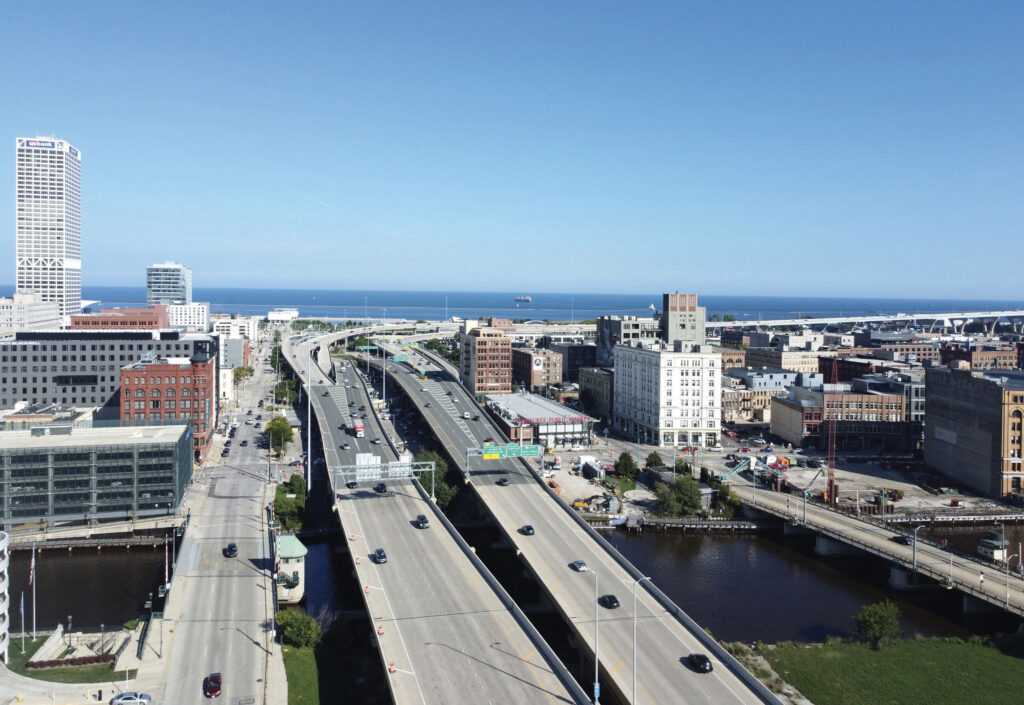
The debate over I-794 is more about the destination than the journey. On its surface, it’s a traffic engineering question: Should the state Department of Transportation renovate Downtown’s east-west stretch of freeway, or tear it down and expand Clybourn Street?
But the movement to remove the freeway has never stayed inside its four lanes. For 30 years, urbanists have imagined a future Downtown revitalized by new residential and commercial buildings along a mile-long boulevard where I-794 now stands. Without the freeway, Clybourn would become that boulevard, with on- and off-ramps at Sixth Street for I-94, at Second Street for I-43 and at Lincoln Memorial Drive for the Hoan Bridge, connecting to the Lake Parkway (State Highway 794).
RELATED READS: HOW THE PAST OF SOUTHEASTERN WISCONSIN FREEWAYS AFFECTS THE I-794 DEBATE

If someone has inspired you through their service, leadership or dedication, the Unity Awards are your opportunity to recognize them!
“This is one transformational opportunity to envision what the possibilities are for a whole new neighborhood connecting Downtown and the Third Ward,” says architect Taylor Korslin, representing the pro-demolition coalition Rethink 794.
These advocates believe in Downtown. They see razing the freeway as a rare opportunity for an awesome place to become even better – and more friendly to pedestrians, bicyclists and transit riders. Drivers would experience Downtown at street level, instead of zipping through at 50 mph.
That’s a no-go for some of the freeway’s most ardent defenders, notably older South Shore suburbanites. They see Downtown as dangerous and crowded. They want to keep I-794 so they can stay above it all, remaining on freeways until they reach American Family Field, State Fair Park or workplaces to the west or north.
Cudahy Mayor Ken Jankowski says many of his constituents only want to go Downtown for Summerfest and Bucks games, and wouldn’t even do that if the I-794 stretch came down. These opponents have a bleak view of Downtown’s present and see nothing more promising in its future.
RELATED READS: WHAT WAS EAST TOWN LIKE BEFORE I-794?
In the middle of this should-it-stay-or-should-it-go debate is a sizable “Yes, but…” contingent. They back Downtown development but worry about the consequences of reshaping the transportation network, particularly reducing access to the port for trucks and to lakefront festivals for cars. They’re skeptical about the economic impact.
Slicing traffic capacity to the Summerfest grounds is “just not something we can support,” Milwaukee World Festival President Sarah Pancheri says.
This group sees I-794 as Downtown’s highway to success, not an obstacle in its way.
Wherever this road leads, we won’t get there fast. WisDOT expects to reach a decision in 2027, followed by construction beginning in 2030. That’s more than enough time to reflect on the route that took us here and the pros and cons of the off-ramps ahead.
The Road Less Traveled
In 1995, Peter Park, then an urban planning professor at UW-Milwaukee, assigned his students to envision Downtown without I-794. That class project caught the attention of then-Mayor John Norquist, a freeway foe who named Park as city planning director.
Park and Norquist faced the same grim warnings of congestion that had led San Francisco voters to reject their city’s plan to raze the Embarcadero Freeway in 1986. But when the waterfront highway buckled in an earthquake three years later, authorities decided against repairing it. The Embarcadero’s 1991 removal showed how traffic could adapt and development could sprout in place of an urban freeway spur.

Nonetheless, WisDOT was unyielding in its opposition to eliminating I-794, which state officials saw as an integral part of the freeway system. Norquist and Park turned to a more lightly used Downtown spur, the Park East Freeway. Tearing down the Park East became part of a 1999 transportation package deal among state, city and county officials.
Leading the opposition was merchant George Watts, who insisted that ending the Park East would rip through Downtown businesses like a figurative bull in his literal china shop. He moved from Ozaukee County to launch an unsuccessful challenge to Norquist in 2000, then failed in a federal lawsuit to stop demolition in 2002.
Watts’ fears proved unfounded. Development around Fiserv Forum, new Milwaukee School of Engineering buildings and renewed interest in the Haymarket neighborhood – including the replacement for the Milwaukee Public Museum – would have been unlikely if the Park East had remained, says UWM urban planning professor Robert Schneider.
Traffic adapted as it had in San Francisco. And when George Watts & Son Inc. moved entirely online in 2017, 12 years after its former owner’s death, the store cited changing consumer buying habits, not loss of freeway access.
Which Way for the Highway?
Meanwhile, WisDOT renovated parts of I-794 from 2013 to 2015. Now, the remaining pieces need upgrades, reopening debate on the freeway stretch’s future. A $21.9 million state study is under way on whether to renovate it as is, remove it, or reconfigure it to improve safety and free a little bit of land for development.
Mayor Cavalier Johnson, a committed urbanist like Norquist, has cited the Park East as a model for I-794. The city’s Downtown Plan calls for the spur’s eventual elimination. And a study commissioned by Rethink 794 predicts the corridor could produce $1.1 billion in development, including 3,000 new housing units, generating $475 million in property taxes over 30 years.
Just as Park East Freeway demolition was something of a consolation prize for former Mayor John Norquist in his quest to take down I-794, removal of the Stadium Freeway North (State Highway 175) could play the same role for Mayor Cavalier Johnson. Like the Park East, the Stadium North is a remnant of a never-built larger freeway that ends in an urban neighborhood. Johnson and County Executive David Crowley advocate replacing it with a boulevard to remove a barrier dividing the West Side.
However, the process for the Stadium North is not as far along as the one for I-794. WisDOT is nearing the end of a $4.3 million preliminary study that is narrowing the options for how much of the West Side highway to remove. By early next year, the department could open the kind of formal environmental review for Highway 175 that it is now launching for I-794. And once a decision is reached on 175, construction likely wouldn’t start before 2030, when work is expected to begin on I-794.

Korslin says that revitalization could accelerate the trend of companies moving their headquarters Downtown and help the city’s population grow to Johnson’s goal of 1 million. The location between Lake Michigan and the Milwaukee River, close to festivals and museums, Schneider says, “makes that particular corridor an amazing opportunity.”
But Jankowski and Dale Kooyenga, president of the Metropolitan Milwaukee Association of Commerce, question whether market demand would be as strong as advocates predict. Schneider cautions development could take years if not decades. Recalling how economic conditions delayed Park East development, Kooyenga warns another downturn could leave unsightly vacancies.
Jankowski also argues Downtown development shouldn’t come at the expense of growth on the South Shore, which he says depends on freeway access through the Lake Parkway to I-794. Without that, he says, “We’re dead here. … You might as well just roll up the sidewalks. We’re done.”
Among other questions WisDOT is studying:
Traffic: Jankowski predicts traffic jams, even if Clybourn is widened as proposed. Korslin says traffic would be distributed among multiple streets. Both the removal and renovation options would redesign the intersection of Clybourn and Lincoln Memorial Drive, which has confused drivers since it was built in the previous I-794 project.
Commuting: Preliminary findings suggest commute times might be a few minutes longer, and Schneider says that would be enough to affect residents’ lives. Milwaukee’s short commute times are a key selling point, Kooyenga says. Korslin says new housing would make it easier to walk or bike to work.
New barrier? If Clybourn becomes a four-lane boulevard and absorbs a significant share of current I-794 traffic, it could grow too busy to cross safely, Kooyenga and Schneider warn. WisDOT says pedestrian and bicycle access and safety are priorities.
Bridges: Unlike I-794, street traffic must stop when Milwaukee River bridges open. Kooyenga says backups could violate federal highway rules if they extend onto the I-94 ramps that would be built at Sixth Street and Clybourn. Korslin notes the Coast Guard prohibits opening bridges for recreational vessels during rush hours, and he suggests authorities work out a deal with tour boat owners to limit their bridge openings.
Port access: Manufacturers are concerned about how trucks would reach Port Milwaukee if they have to take local streets to I-43, Kooyenga and Schneider say. The city-owned port referred questions to the mayor’s office. Johnson is “sensitive to the concerns expressed from several fronts on the impacts to truck and automobile transportation” and is “open to further discussion,” spokesman Jeff Fleming says.
Schneider says authorities must balance demolition’s possible downsides against the corridor’s future prospects. “I don’t think great places get created these days without vision,” he says.