It was a crop that required no seeds and not an ounce of fertilizer. Weeds were never a problem, and it grew best when Milwaukee’s weather was coldest. Although producing it was a low-maintenance, even no-maintenance, activity, the crop was as dependable and as profitable as the summertime products of Wisconsin’s countryside.
We’re talking about ice, of course, a renewable resource that played a critical role in the evolution of Milwaukee’s economy. Two major industries were absolutely dependent on the local supply of “hard water”: brewing and meatpacking. Beer was a seasonal business in its early decades, brewed in the cold months and sold in the warm months. Stored ice made that rhythm possible. It also transformed the meat industry, enabling packers like Patrick Cudahy and Frederick Layton to ship their products across the country in ice-packed railcars.

Nominate Somebody Now!
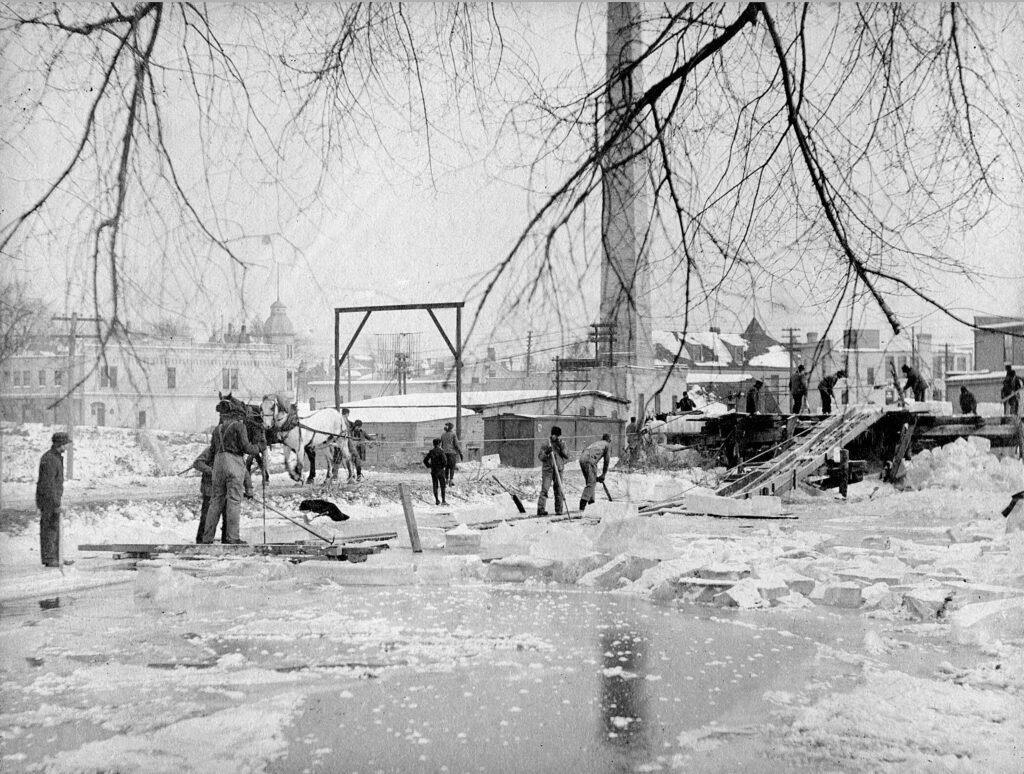
This photograph, taken probably in the 1870s and possibly on the industrial canal that became today’s Commerce Street, shows a typical harvesting operation. After horse-drawn chisel plows had scribed a checkerboard pattern on an icefield, workers sawed through the grooves to liberate hundreds of heavy blocks that were conveyed, again by horsepower, to double-walled icehouses insulated with sawdust.
Milwaukee’s output was prodigious. The Milwaukee River alone could produce 250,000 tons of ice in a typical winter, enough to supply all the city’s packers and brewers, with plenty left over to send to Chicago. That’s roughly the same weight as a couple of fully loaded aircraft carriers and a handful of destroyers.
Pollution crippled Milwaukee’s ice industry – one observer lamented “the warm contributions of the sewers” – but it was technology that killed it. Mechanical refrigeration debuted in the 1880s and largely replaced natural ice by 1920. The harvests are over, but when temperatures plummet, it’s good to remember that it was ice, not just beer, that once helped make Milwaukee famous.
Take a closer look…
- These are most likely not electric power lines but telegraph wires, a technology that reached Milwaukee in 1848.
- These blocks were being loaded onto a railroad flatcar, probably for shipment outside Milwaukee.
- Tools of the trade: an ice saw and long-handled pike poles.
- Commercial ice blocks were generally at least 18 inches thick.