In the absurdist game show Name That Schlock, three contestants play as advertising creatives who must explain the unexplainable.
“It’s like a commercial from some other universe,” says creator Neil Horsky. For over 15 years, Horsky’s collected dozens of what he calls “ambiguous objects” – doohickeys and thingamajigs whose purpose isn’t quite clear.

Nominate Somebody Now!
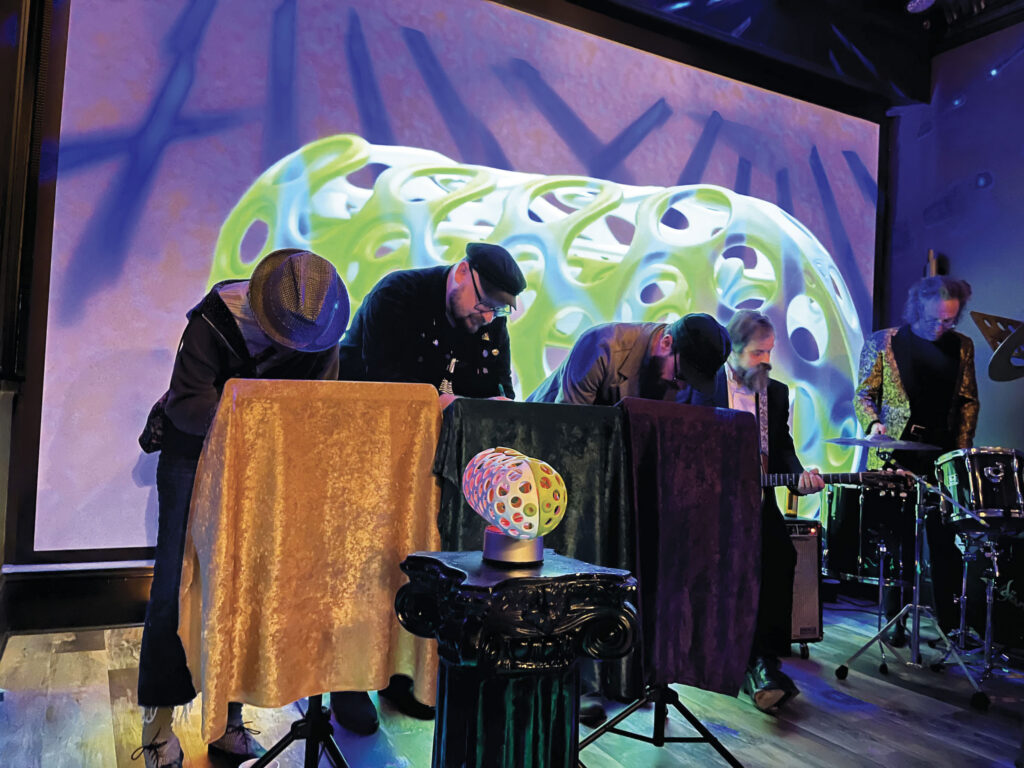
Contestants choose one of these objects and give it a name, tagline and function – the more outlandish, the better. Then, they pitch it as a consumer product in front of a judge and audience. At last January’s show, the winning pitch sold a green perforated dome as a “Global Xerox” cloning you and everyone you know 100 years in the future.
In essence, the game show is improvised comedy built on silliness and inscrutability. “You clearly don’t need this stuff; you don’t even know what the hell it is,” Horsky says. “It’s getting at the kind of absurdity of consumerism and of marketing.”
Name That Schlock is an offshoot of Horsky’s long, winding road of community art projects, starting with his master’s thesis about “games to cultivate a creative attitude.” He played the game for the first time with friends for his 40th birthday, right before the pandemic. Years later, he trialed the game as a show with improvisers and all sorts of artists in Boston, where he lived before moving to Milwaukee. Horsky worried about the game’s feasibility in a smaller city, but “I really had no problem getting a crew together here,” he says. “Milwaukee’s awesome. People are down to do your weird stuff.”
The game show’s far from Horsky’s only use of the ambiguous objects. As an adjunct instructor at the Milwaukee Institute of Art and Design, he asks product design students to make technical drawings of them. He employs them in his video art and creative workshops. And during Center Street Daze on Aug. 15, he opens the “Museum of Ambiguous Objects” at Style Machine (514 E. Center St.), an arts venue run by Horsky and his sister, Anna Newton. The interactive exhibit presents the objects as curio, with elaborate (and fictional) labels and a photobooth where patrons can pose with their favorite item.
But more than that, Horsky views Name That Schlock as a fun, freeing creative exercise. “When you don’t understand something, then it’s easier to imagine it in a bunch of different ways,” he says. “The desire to want to know what they are is understandable, but you don’t need to know that in order to have an interesting, and better, experience.” The next show is July 31 at Cactus Club.