
In some ways, painting a mural is the easiest part of bringing it to fruition, according to artist Fred Kaems. Working outdoors for hours is taxing, but just getting to that point can be even more difficult. Until recently, “Milwaukee was fairly resistant to murals,” he says. That started changing in 2016, when Kaems and some fellow artists expanded the city’s imagination for public art.

Celebrate this year’s winners of the Betty Awards!
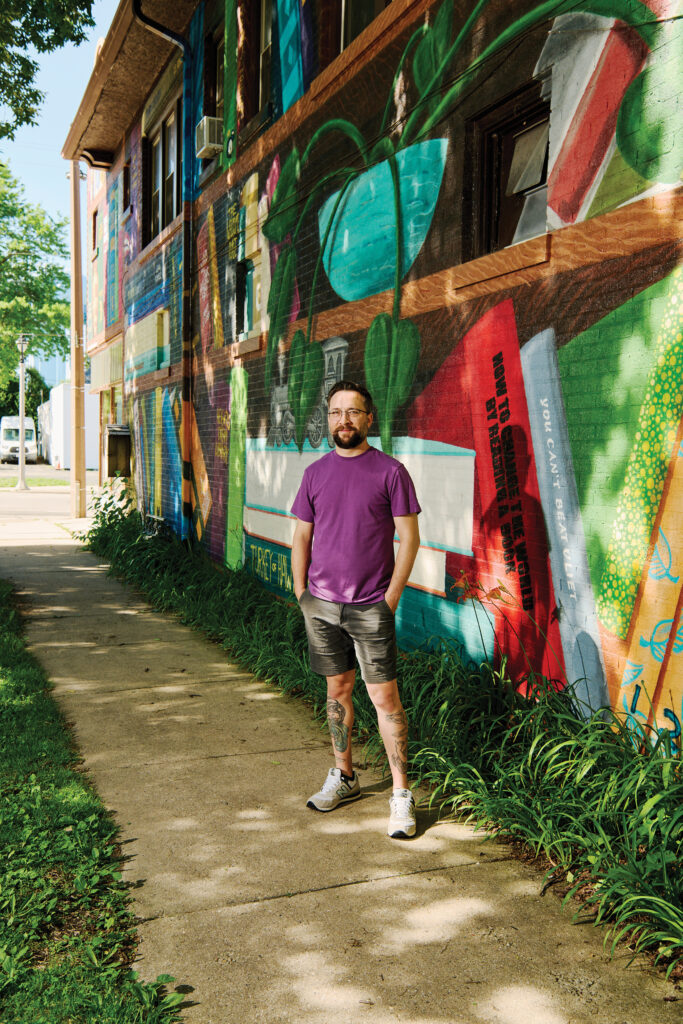
One of Kaems’ best-known works, The Dream Library at 57th and Vliet Street painted in 2020 and pictured here, was a community effort in which Milwaukeeans suggested titles for the books on the shelf. Now, with new murals popping up seemingly every other week, Kaems is happy to be part of a larger scene with more voices. “I just wanted to paint stuff and see a more colorful city.”
MilMag spoke to Kaems about how he became one of the city’s leading muralists.
How did you get started as an artist?
I’ve always kind of been creative, drawing and things like that. I don’t think I considered myself an artist necessarily. I drew stuff because I felt compelled to. And then late adolescence, early teens, I started to see skateboarding graphics and graffiti. I was really interested in how different it was. I found this one book at the Downtown Public Library about this graffiti artist from New York, Phase 2. I discovered some of these shops on the South Side that had things like graffiti magazines, and I just was fascinated by it.
As I got a little older, I started drawing things that were influenced by graffiti or skateboard decks. Eventually, I started painting graffiti, which is where I learned about spray paint. And while I don’t paint murals exclusively with spray paint these days, it’s definitely played a heavy influence, and I would say is a great percentage of the materials I’ve used on a large number of the murals I’ve done. As the internet was becoming more of a thing, I discovered this website called Stencil Revolution, and it was a message board that had all sorts of stencils on it that were beyond anything I’d ever seen. That’s where I really started to learn how to see shadows, light, highlights and things like that – all the things that give an object its volume.
How did that turn into painting murals in Milwaukee?
In my early 20s and traveling places outside of Milwaukee, whether it be domestically or even abroad, you go to these places that had so much color and life from street art or murals. When I was a kid, there were some murals in the city, but those had largely fallen off. Buildings had been torn down, painted over. There was a couple of hangers-on, but Milwaukee just felt so gray or drab, I suppose, in contrast to some of these other places I’ve been.
I painted some commercial work inside restaurants and stuff in the late 2000s into the ’10s. And then in 2015, I painted what would probably be my first mural that was not at all graffiti. It was spray paint, but it was art for art’s sake. That was at the beginning of people having glimmers (of painting more murals) because even prior to that, if you talk to people, they’d be so hesitant because they were worried there’d be backlash or it wouldn’t be well-received.
I’d returned to school (at UW-Milwaukee’s Peck School of the Arts) later in life, and in 2016, I was going to graduate. In that spring and that summer, I had a couple of mural projects I was going to do, and then the intention was that fall I was going to start looking for a job more related to my degree. It wasn’t an immediate thing, but it just kind of trickled in and turned into a thing where, with a part-time job, I was able to survive. I don’t know if I call it a career, but I guess at the moment that’s what it is, right? It was never the goal or the plan.
I have friends and colleagues that were doing similar things around that same timeline. Around 2016, 2017 – that’s when the really interesting stuff was starting to go up in the city and starting to build that imagination.
How do you view the public art scene now?
There’s a lot more opportunities for younger artists to get into it. There’s a lot more resources for people to be doing it. People are more willing to fund things that are a little more out there. And by out there, I mean more imaginative and not maybe so quite straightforward what a mural is.
I still feel that Milwaukee could grow in terms of their imagination of what a mural might look like. I’m not saying that there aren’t examples that fall into that, but not every one needs to be a skyline of Milwaukee or a cheerful sun ray. Those are great, but there should be other stuff, too – painterly or more abstract things that aren’t so easy to understand what they are.
What do you like in a mural?
I like things that are somewhat whimsical or funny. I’ve been told I have a fairly dry sense of humor, so maybe not on-the-nose funny, but things that would make me laugh. I put little references to things in paintings because I want to have some fun myself, you know? Easter eggs or whatever you want to call them sometimes, if they make sense.
What considerations do you have to make when painting a mural?
Walls come in many shapes, sizes, surfaces. Then there are things that you might have to work around: Maybe there are power lines nearby that wouldn’t be safe to work by. Maybe there’s a bunch of shrubs that you got to get up above to do it. There’s a lot of things you have to consider when you’re designing so you can paint the thing you’ve drawn and not show up and there’s a drain pipe right where that person’s face is supposed to be. When I was younger, I painted houses for a couple of summers and learned a lot about surface prep and materials that have benefited me in my professional career. Also: What direction does the wall face? How is it going to wear in the sun? Is it going to get a lot more rain or wind over the time? Because that might dictate what colors you might want to stay away from. Typically, red fades faster than blue.
I’m thinking about those things as I’m making a drawing. And then, once we finally get to the point of painting, now we’re having fun and hopefully all the complicated stuff is done, and I can just put some music on and jam out and paint, and maybe talk to some interesting people and eat some lunch in the shade. You know, go about my day.