Milwaukee’s historic Brady Street neighborhood is the focus of a new documentary more than two years in the making and brought to life by more than 80 UW-Milwaukee film students.
Brady Street: A Portrait of a Neighborhood serves as a history lesson about the East Side community, from its early days as a haven for Polish, German and later Italian immigrants, then as a counterculture hotbed followed by a troubling decline until a modern-day, ongoing rebirth.
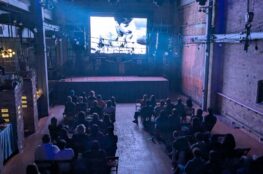
The documentary, which drew large crowds for its screenings at the Milwaukee Film Festival, involved students at every level, under the direction of Sean Kafer, program director of docUWM, the school’s documentary media center.

Nominate Somebody Now!
There’s plenty of on-screen interviews along with intriguing archival footage and images that add to the intrigue of the film.
“The residents and the Business Improvement District wanted a film, a documentation of what this neighborhood was over the last 150 years,” Kafer told an audience gathered for a sold-out screening of the film at the Downer Theatre. “So, they reached out to UW-Milwaukee. Eighty students have put their hands on this and really created this film.”
An extended interview with Frank Alioto, a local historian and author of a book about the neighborhood, serves as the backbone for the film. However, dozens of subjects are interviewed, including long-time residents, business owners, past and present, and neighborhood leaders and celebrities, of sorts, such as the Very Rev. Timothy Kitzke, long-time and beloved leader of Three Holy Women parish, which includes a pair of Catholic churches, St. Hedwig and St. Rita, that serve the Brady Street neighborhood. Kitzke also presides over the annual pet blessing and parade along Brady Street each October to coincide with the feast of St. Francis of Assisi.
Teri Regano, owner-operator of The Roman Coin, a long-standing Brady Street watering hole, speaks of how the presence of many neighborhood taverns gives Brady Street its homey feel. “I’ve got customers who say that the bar is their living room,” she said. Regano also provides a rare peak into the tavern’s basement, where two full-size bowling lanes still stand despite being inactive for ages.
The film gives a rundown of the neighborhood’s robust tavern environment, then and now. A documentary about Brady Street wouldn’t be complete without a discussion about two long-standing Italian businesses in the community – Glorioso’s Italian Market and the Peter Sciortino Bakery.
Eateries also get their due, including Zaffiro’s, a popular spot for pizza and Italian fare that has operated for more than 70 years, and Thai-namite, which opened in 2010 and is emblematic of the neighborhood’s evolution. And there’s a series of compelling interviews with Mimma Megna, who for nearly two decades operated the popular Mimma’s Café that featured a rotating menu of items from various parts of Italy.
A portion of the documentary focuses on Brady Street’s transformation into a thriving counterculture hub in the 1970s, defined by a “free-for-all” atmosphere. Before Summerfest there was the Brady Street Festival, where tens of thousands of people in search of art, culture and music celebrated in the neighborhood’s streets. A scaled down version of the festival continues to this day.
Then came the precipitous decline, which left many Brady Street residents and business owners feeling unsafe and even scared. The atmosphere along Brady Street had become, as described in the film, that of a “classic American ghetto.”
Businesses closed and many residents left. Others stayed and put up a fight to take back their neighborhood.
The Brady Street Area Association and the Brady Street Business Improvement District came along to help lead the neighborhood’s redevelopment and put “a new heart in this barely living corpse,” as stated in the film.
The revitalization of the area has transformed the Brady Street neighborhood into a diverse urban haven.
“It’s people that make the street. It’s really about people and getting people involved,” longtime resident Julilly Kohler said.
In a bit of a twist, Brady Street begins and concludes with Mark Denning, who is enrolled with the Oneida tribe of Wisconsin and is a cultural speaker and an educator at UW-Milwaukee. Denning’s role is to remind viewers of the presence of various native tribes in the area long before the arrival of the first immigrants and how the confluence of waterways in what became the Brady Street neighborhood served as a foundation for trade, agricultural and fishing.
This film serves as an educational experience for the students who helped make it happen as well as the viewers who, no doubt, learn a lot about one of Milwaukee’s most fascinating neighborhoods.