It could be the political equivalent of a subway series – from a city that has never had a subway.
Milwaukee County Executive David Crowley is the latest entrant in a 2026 Wisconsin gubernatorial race that, for the moment at least, features only Milwaukee-area candidates.
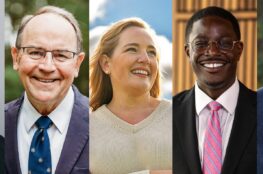
Crowley joins Lt. Gov. Sara Rodriguez, a former legislator from Brookfield, in the Democratic primary, while Washington County Executive Josh Schoemann faces Whitefish Bay businessman Bill Berrien on the GOP side in the contest to replace retiring Democratic Gov. Tony Evers.
Also throwing his can into the ring is longtime American Family Field beer vendor Ryan Strnad, a Democrat who has far better odds of working in the stands for a real World Series next month than of reaching the gubernatorial version of the Fall Classic next year.
This regional dominance won’t last long. Republican U.S. Rep. Tom Tiffany of Minocqua, state Sen. Kelda Roys (D-Madison) and Wisconsin Economic Development Corp. Secretary Missy Hughes, an Evers appointee, are all expected to announce their candidacies soon.
Democratic Attorney General Josh Kaul hasn’t said whether he will run. Other potential candidates include former Democratic Lt. Gov. Mandela Barnes and Madison Republican businessman Eric Hovde, both unsuccessful candidates for U.S. Senate seats.

Know somebody making an impact in Milwaukee?
Considering how slowly the field has been growing, political scientist Charles Franklin says he doubts it will reach the record size of the 2018 Democratic primary, when Evers defeated Roys and eight others for the nomination to challenge incumbent Republican Scott Walker.
Officially, other candidates have plenty of time to get into the 2026 race. The filing deadline isn’t until June 1 for the Aug. 11 primaries. But serious contenders are going to need months to raise money and to build up their name recognition in a particularly low-profile field.
“None of these candidates are going to be very well-known statewide,” says Franklin, director of the Marquette University Law School Poll.
When Evers entered the 2018 race, his name recognition was only at 30%, even after he had been elected twice as state superintendent of public instruction, Franklin says. He was able to get it up to 40% before the primary and 60% afterward. Kaul, also a two-term statewide elected official, could be in a similar spot.
And it just goes down from there. Tiffany was only at 25% in 2023, when he was considering a 2024 challenge to Democratic Sen. Tammy Baldwin; Rodriguez holds a traditionally low-profile job; and Crowley is probably well-known only in the Milwaukee media market, although that’s a big plus in a Democratic primary, Franklin says.
Area Underrepresented in Governor’s Mansion
While the Milwaukee metropolitan area is the state’s largest population center, it hasn’t accounted for a big share of Wisconsin’s governors. Races featuring two major-party candidates with southeastern Wisconsin ties are even more rare – but like World Series with two teams from the same city, they are not unheard of.
Both of the two most recent examples involved Milwaukee’s former Democratic Mayor Tom Barrett and Walker, who lived in Wauwatosa. Barrett lost to Walker, then Milwaukee County executive, first for an open seat in 2010 and again in a recall rematch in 2012.
The 2010 contest apparently was the first time in U.S. history that the mayor of a state’s largest city faced the chief executive of the same city’s county in a gubernatorial election. That won’t happen again in 2026. Mayor Cavalier Johnson is endorsing Crowley, ending speculation about his own candidacy. They’ve been friends since high school, and their strong working relationship has endured longer than those of their predecessors. Much-celebrated alliances eventually frayed between Mayor John Norquist and County Exec Dave Schulz, and between Barrett and County Exec Chris Abele, while Walker was on less-friendly terms with both Norquist and Barrett.
Walker was also the only Wisconsin county executive to win any higher office. Both Crowley and Schoemann are hoping that record won’t last.
Before 2010, two Milwaukee natives faced off in the 1978 governor’s race, when UW-Stevens Point Chancellor Lee Dreyfus, a Republican, defeated Democratic Acting Gov. Marty Schreiber. Decades earlier, Progressive Republican Gov. Francis McGovern, a former Milwaukee County district attorney, fended off a 1912 challenge from Milwaukee County Judge John Karel, a Democrat.
Aside from Walker, McGovern and Schreiber, a former lieutenant governor who filled out Gov. Patrick Lucey’s term, Democratic Milwaukee Mayor George Peck was one of the few regional residents to win the top office, serving two two-year terms from 1891 to 1895.
However, Franklin says the belief that outstate voters are anti-Milwaukee may be exaggerated. He notes that Milwaukee’s Barnes ran only 1 percentage point behind incumbent Republican Ron Johnson in the 2022 U.S. Senate race, and outperformed some Democrats running for open Assembly seats, even while running behind Evers’ successful re-election performance.
Plenty of History There for the Making
The Barnes results offer hope for other Black candidates like Crowley, Franklin says.
If elected, Crowley or Barnes would be Wisconsin’s first Black governor. For that matter, Rodriguez, Roys or Hughes would be the first woman governor and Kaul would be the first Jewish governor.
Black candidates traditionally have faced steep hurdles in statewide elections, and asterisks are attached to their only two victories. Civil rights pioneer Vel Phillips won a single term as secretary of state after a 1978 campaign in which she famously never mentioned her race or gender. That led Barnes to joke about being the first “openly Black” statewide officeholder. But he was elected as Evers’ 2018 running mate, not on a separate ballot.
Still, as Phillips proved repeatedly at the city, county and state levels, somebody eventually has to be first. And making history is nothing new for Crowley. He’s the first Black county exec, just as Cavalier Johnson is Milwaukee’s first Black mayor.
Crowley also holds the distinction of winning his office by both the narrowest and the widest margins in its 65-year history. As a state representative, Crowley edged out State Sen. Chris Larson, a fellow Milwaukee Democrat, by just 0.6 percentage points to capture his first term in 2020. But as an incumbent, he gained a second term by obliterating perennial candidate Ieshuh Griffin by 70 points in 2024.
Nobody is going to win Wisconsin’s governorship by 70 points. But in this closely divided swing state, Crowley’s experience with razor-thin elections could come in handy.