


While writing my novel, I feel torn between writing a romance story, complete with throbbing muscles and heaving bosoms, or writing a book exploring personal growth readers can connect with; something they can point to and say, “That’s me.” There’s a lot to be said for both, but I never found them satisfactorily compatible. Not many of us experienced sweeping love stories that made our hearts race faster. We may want that, fantasize about that, but our own stories don’t often reflect that. And that’s OK. Romances aren’t meant to be real – they are fantasies minus the wizards and unicorns (or with them, cause that would be AWESOME).
Bodice-rippers (as a friend once called them – referring to their provocative covers) have a place near and dear to my heart. When I finished graduate school, I was exhausted and burnt out from reading, analyzing, and dissecting James Joyce, Jane Austen, Shakespeare, Chaucer (in Old English), Edgar Allen Poe, and so many more. All were wonderful (OK, most were wonderful – some were just painful), but taking stories apart word by word makes it impossible to disappear into the carefully created world. Our focus was on finding themes, metaphors, and connections to the literary movements of the day (ie. Compare Ralph Waldo Emerson and Henry David Thoreau, then discuss how they differ as examples of Transcendentalism).
After graduation, I needed brain candy. I found it in authors like Stephanie Laurens, Julia Quinn, Nora Roberts, and Johanna Lindsey (and JK Rowling – but I’ll argue till the end of time she belongs on a list with Charles Dickens, George Eliot, and every other great author). I devoured their books, picking up 10 at a time from garage sales (a great, cheap way to find new authors). I disappeared into worlds of dukes, dances, strong male characters who knew what they wanted, strong women who wouldn’t take any guff from said strong men, and – of course – some steamy scenes.
Since many years have passed since graduation, I’ve incorporated more serious literature back into my library. My mom likes to pass on her used book club books to me. I enjoyed Life of Pi, The Help, and adored The Hindi Bindi Club, but when I’m stressed and need a little escapism – I will always turn to my romances.
While my book provides many opportunities to explore the physicality of love, there also seems to be more. My characters have a lot of growing to do, self confidence to gain, and a city to explore before they can be together. Though there is sizzle, I see more in their journey to love than sexual attraction. They find each other because they find themselves first. But it is a romance, and there is chemistry. How do I reconcile this?
I found my answer in Anna Nicole, a new opera staged at London’s prestigious Royal Opera House. While I haven’t actually seen the opera, reviews have been surprisingly good. Jessica Duchen from London’s Independent said the opera is “varied, acidic, and lyrical” and follows “the rise and fall of Western excess itself.” Anthony Tomasini from the New York Times said, “The London audience ate it up. But so did I, because in the end this is a musically rich, audacious and inexplicably poignant work.” This is high praise for a titillating and trashy topic more appropriate in US Weekly or Star than the Royal Opera House stage.
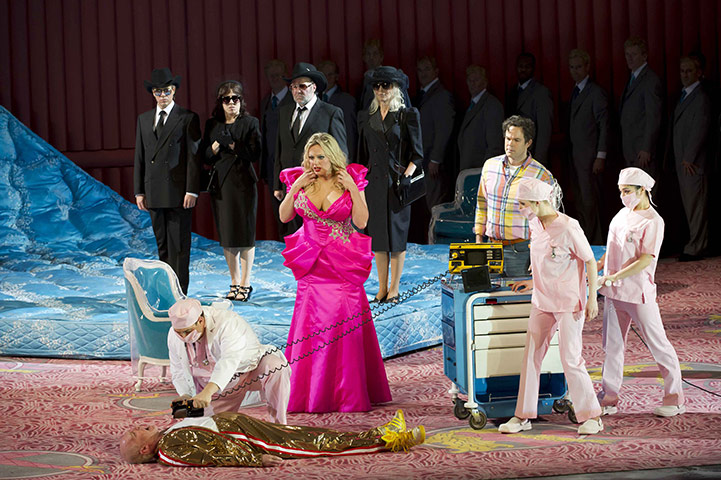
Photo – Reuters
The creators mined Anna Nicole’s life, one often maligned and mocked, for unexpectedly perfect operatic material. The handling of the subject matter elevated it from merely trashy to worthy of positive reviews from some of the most respected papers. Yet the content is still bawdy. They’ve managed to do both, make incredible, meaningful art while telling a tawdry tale. This gives me hope I can find a balance in my own work between suggestive and substantial; that my characters can discover themselves figuratively and physically. But fear not, I shall avoid the heaving and throbbing body parts (at least most of the time).
So, dear reader, what do you read to escape? Science fiction, fantasy, thrillers? Who are your favorite authors? What are your favorite books? I’m always looking for my next great escape.
March 29 page total = 89

