

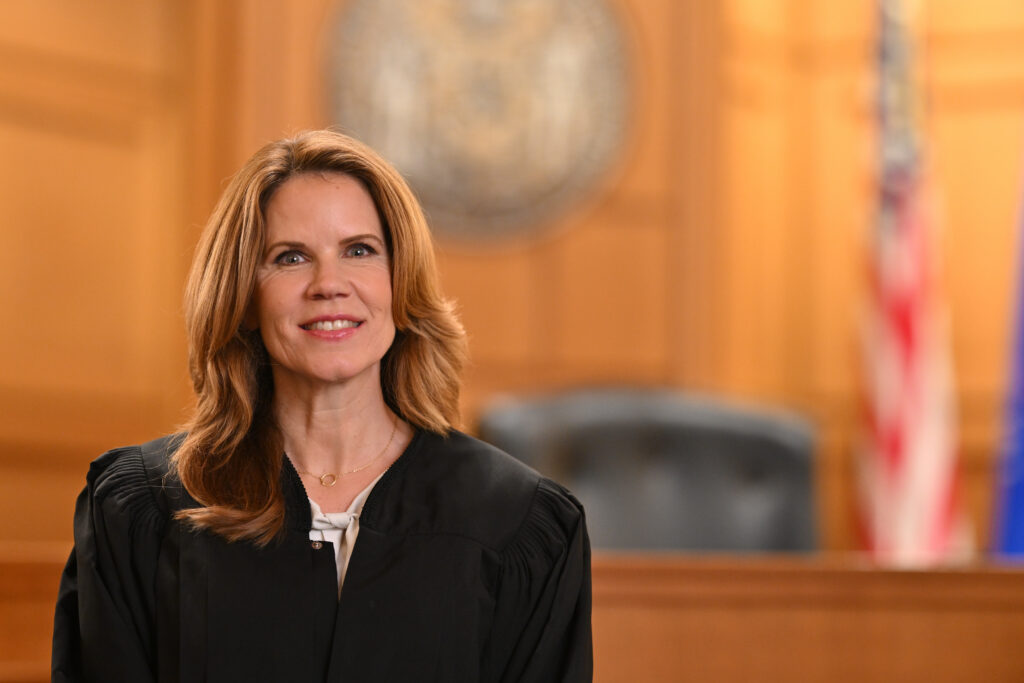
The song remained the same as Chris Taylor notched another lopsided liberal victory in Tuesday’s Wisconsin Supreme Court race – and the name of that tune is the Donald Trump blues.
With the Republican president’s Wisconsin approval ratings at a record low, traditionally red Ozaukee County flipped into the liberal column for the first time in two decades, together with the normally conservative suburbs of Grafton, Menomonee Falls and the Town of Germantown.

Celebrate this year’s winners of the Betty Awards!
While Taylor continued a string of liberal wins, she scored the biggest Supreme Court victory in 26 years, with 60.1% to conservative Maria Lazar’s 39.8%, a 20.3-point margin that nearly doubled those of the last four liberal justices.
That qualifies as a landslide in a swing state where a single percentage point has decided five of the last seven presidential races, the last two U.S. Senate elections and one of the last two governor elections. Marquette University political scientist Charles Franklin noted conservative Diane Sykes was the last Supreme Court justice to outperform Taylor in her 66%-to-34% triumph over liberal Louis Butler in 2000.
Taylor’s Win Is Part of a Pattern
The turnaround for liberals in the officially nonpartisan high court races dates to Trump’s first term in the White House. Conservatives had won five of the last seven contested Supreme Court elections before Trump’s 2016 victory. But now-Justice Rebecca Dallet broke that streak when she won in 2018, and with Tuesday’s results, liberals have won five of the last six races.
In the Trump era, 14 previously red Milwaukee-area communities have flipped Democratic or liberal:
- Port Washington for now-Justice Jill Karofsky in spring 2020
- Cedarburg, Greendale and Greenfield for winning Democrat Joe Biden in the fall 2020 presidential election
- Thiensville for losing Democratic presidential nominee Kamala Harris in 2024
- Elm Grove, Franklin, Hales Corners, Mequon, Oak Creek and Waukesha for now-Justice Susan Crawford in 2025, and
- Tuesday’s three for Taylor.
Taylor ran ahead of Crawford in all of those communities Tuesday. She also narrowed Lazar’s margins of victory in many still-red suburbs, compared with their votes for Brad Schimel, Crawford’s losing conservative opponent in 2025. Lazar edged Taylor by only a fraction of a point in Brookfield and led by just 1 or 2 percentage points in Butler, Saukville, the Village of Pewaukee and the Town of Brookfield.
Ozaukee County last voted for a Democrat in a major statewide race in 2006, when it backed then-Sen. Herb Kohl for a fourth term. Taylor carried the county 52% to 48%, essentially reversing the margins by which it had supported Schimel and former Justice Dan Kelly, the losing conservative in 2023.
Other area counties followed a more traditional pattern. Taylor won 76% of the vote in Milwaukee County, with 84% in the city and 69% in the suburbs, all slight improvements over Crawford. Lazar carried her home ground with 54% in Waukesha County and scored her highest statewide percentage with 62% in Washington County, both behind Schimel’s numbers.
Although Supreme Court elections are officially nonpartisan, they have become increasingly polarized along ideological lines since 2007. Franklin has charted the correlation between how Wisconsin counties vote for president and how they vote for high court justices, rising from practically zero in 1978 to a 98.5% match between support for Crawford and Harris or for Schimel and Trump.
Never was that linkage more obvious than in 2025, when billionaire Trump backer Elon Musk actively campaigned for Schimel, futilely throwing $55.9 million of his own cash into the record-breaking $144.5 million race.
Spending was much lower this time, and Lazar didn’t play up her connection to Trump. But she still suffered what political scientists call the “presidential penalty,” joining the growing ranks of conservative and Republican candidates who are being rejected by voters recoiling from the increasingly unpopular Trump and his policies on immigration, tariffs and the war with Iran.
The latest Marquette Law School Poll found 56% of Wisconsin voters disapproved of Trump’s job performance, compared with 42% approval, a net negative of 14 points that is the lowest of his two terms. Franklin, the poll’s director, says that sentiment likely contributed to liberal turnout in the Supreme Court race.
Abortion was also a factor. Taylor previously worked for Planned Parenthood, while Lazar was an assistant attorney general who defended restrictions on abortion. This is the third Wisconsin high court race that liberals have won since the conservative U.S. Supreme Court – with three Trump-appointed justices – struck down Roe v. Wade.
What Does This Mean for Future Races?
By itself, Taylor’s victory doesn’t necessarily predict Democrats will win the November gubernatorial race, Franklin cautioned. The turnout of 32% was lower than those of the last three Wisconsin Supreme Court elections, although still higher than average for a spring election with a high court race and no presidential primary.
Also, flipping a community for one race doesn’t guarantee it will stay flipped for all races. Port Washington has now voted for liberals in four straight Supreme Court elections while remaining red in presidential, gubernatorial and U.S. Senate races. And many of the suburbs that switched to the liberal side for high court and presidential elections nonetheless backed conservative Brittany Kinser in her losing challenge to liberal incumbent Jill Underly in the spring 2025 race for state superintendent of public instruction.
Still, Democrats are hailing Taylor’s victory as part of a nationwide trend of wins for their side in off-year and special elections in Trump’s second term. Franklin pointed to the factors behind that trend.
“Republicans face difficult headwinds in the fall from national forces, and those forces almost certainly boosted (Democratic) turnout and depressed GOP turnout on April 7,” Franklin says.