
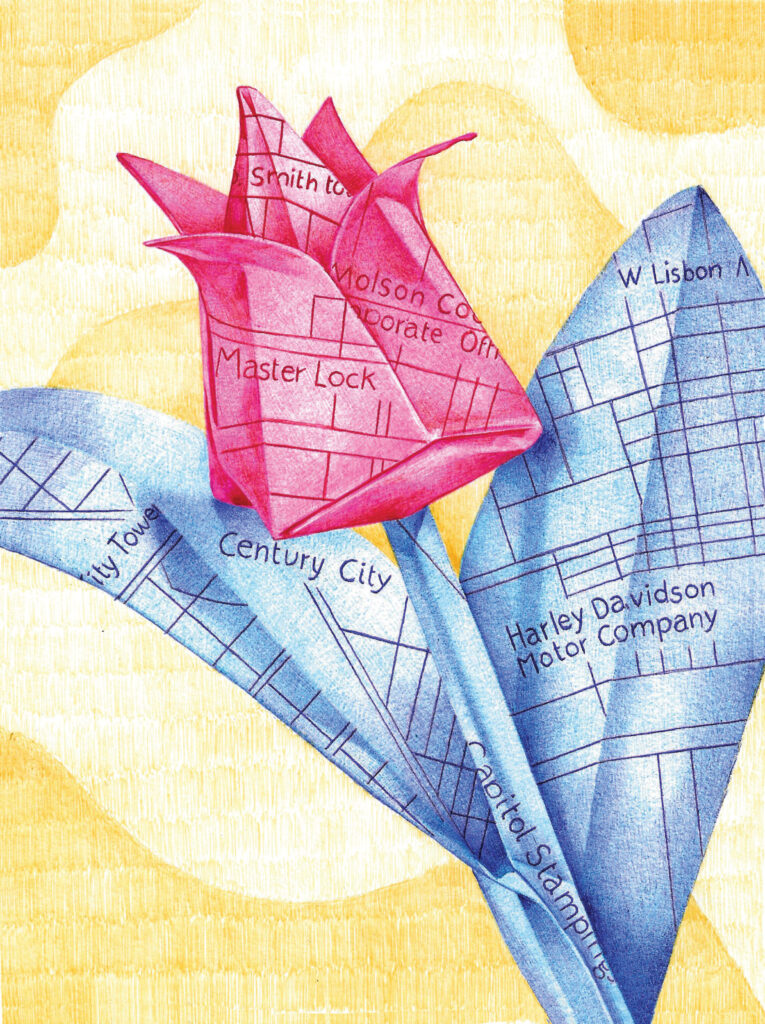
For more than a century, Master Lock Co.’s North Side factory has churned out a variety of products, but the core of the company’s business is plain to see for all passersby. A large replica of its signature laminated padlock sits atop the north end of the facility.
The multi-building site at 32nd and Center streets has long been an anchor and provider of decent-paying jobs in one of the city’s poorest neighborhoods. But after decades of cuts by Deerfield, Illinois-based Fortune Brands, the plant is set to wind down operations beginning in October until it’s permanently shuttered next March. Four hundred jobs will be lost.
Few prominent manufacturers remain in Milwaukee’s storied industrial corridor along the rail line, serving businesses on 30th Street, and Master Lock’s closure adds to the challenge for those working on an ambitious redevelopment vision.
“Master Lock leaving is very unfortunate,” says Cheryl Blue, executive director of the 30th Street Industrial Corridor Corp., who grew up in the Amani neighborhood, about 10 blocks from the plant. “It’s always been a huge part of the neighborhood. However, we are never going back to a plant with thousands of workers and three shifts, so we have to think about how to rebuild and redevelop this area according to the needs of the 21st century.”
Celebrate this year’s winners of the Betty Awards!
Blue and City Development Commissioner Lafayette Crump say an all-encompassing strategy is being implemented to breathe life into the corridor. “The city is deploying holistic reinvestments in the 30th Street Industrial Corridor to improve residents’ quality of life, create more job opportunities and enhance pedestrian safety and traffic calming efforts,” Crump says.
Blue has led the area’s nonprofit organization, which started in 1991, for seven years. “This industrial corridor, unlike others, is located in neighborhoods, in Black neighborhoods in particular, so we see people as our greatest resource,” she says. “We believe that an investment needs to be made in the people who live here who helped to build Milwaukee into this manufacturing powerhouse that it was and is.”
THE CORRIDOR, as it’s called, is generally bounded by Hampton Avenue on the north, 27th Street on the east, Highland Avenue on the south and 35th Street on the west. More than 500 of its 880 acres are zoned for industrial use, and manufacturing is likely to remain a necessary part of The Corridor, Blue says.
Beer giant Molson Coors and motorcycle heavyweight Harley-Davidson continue to operate near The Corridor’s southern boundary. But other large manufacturers, like Badger Meter, Briggs & Stratton and A.O. Smith, as well as many smaller firms, have either exited The Corridor or shut down altogether, leaving a multitude of vacant and underused buildings and property. “Many of those factories are gone, so the area is challenged,” Blue says.
Nevertheless, The Corridor remains part of the deep-rooted industrial landscape of the region. Milwaukee has the second-highest concentration of manufacturing in the country, trailing only San Jose, California, according to a report issued earlier this year by the Metropolitan Milwaukee Association of Commerce. More than 111,000 workers were employed in manufacturing in the Milwaukee area in 2021, the most recent year for which data is available, second only to the health care sector.
One investment that The Corridor leaders envision is a new satellite campus for a historically Black college or university, where the focus would be on providing education and training to prepare job seekers for work. They are in talks with “a few” potential partner schools, Blue says, but she declined to name them.
“We would partner with corporations to customize the curriculum toward their needs,” Blue says. “With many manufacturers having problems attracting talent, there is a renewed interest in this area because manufacturers want to be closer to the workforce. A lot of people aren’t able to get to factories in the suburbs. Manufacturing here in The Corridor is assumed, but I also want to focus on investing in the people and the neighborhoods because it all has to go together.”
“We believe that an investment needs to be made in the people who live here who helped to build Milwaukee into this manufacturing powerhouse that it was and is.”
– Cheryl Blue, Executive Director of the 30th Street Industrial Corridor Corp.
Another priority is the creation of a 6.2-mile bike trail along the still active but low-traffic freight rail line. The trail would offer the neighborhoods vital connections to job and education centers, supermarkets, the city’s other trails and much more. “It’s a longer-term project,” Blue says.
Foremost among The Corridor’s many potential redevelopment sites is the Century City Business Park, the 84-acre site of the former A.O. Smith/Tower Automotive bought in 2009 by the city, which also invested $40 million to clean up the property and update infrastructure. Century City struggled for years to gain traction but has seen a recent uptick in activity.
Good City Brewing moved its corporate offices and warehouse to a building in the business park known as Century City I, located near Capitol Drive and 31st Street, which is now fully leased. Other tenants include Craft Beverage Warehouse, Klein-Dickert Glass and B83 Testing and Engineering. Spanish train maker Talgo Inc. refurbishes rail cars in a separate building. Hundred Acre urban farm also operates at the site. In July, Quad – the global printing and marketing company that owns Milwaukee Magazine – launched a recruitment, training and retention hub at Century City Tower, 4201 N. 27th St.
“We’ve had to do a lot of work in terms of the reputation of the area,” Blue says. “A lot of times people think that this isn’t a place where they would want to be.”
The city continues to actively recruit businesses near and far for Century City and The Corridor, Crump says.
Century City’s location is logistically appealing for businesses, though, and the brand new building is a selling point, says Dan Katt, Good City co-founder and the leader of a group that purchased Century City I. With that building full, there’s talk of a second building. “We’ve had a lot of interest,” Katt says. “But with the cost of construction and interest rates and where the rental rates need to be, it’s a big challenge to build anything right now.”
Signs of Progress
- A recent $5.5 million EPA grant includes $2 million to clean up 13.7 acres at 3940 N. 35th St.
- A contaminated vacant lot at North Avenue and 30th Street is being cleaned up and transformed by MATC into a training ground for electrical power line mechanics.
- More than $3 million of city and private money will expand Melvina Park, across from the former A.O. Smith/Tower factory, adding nearly 4 acres as well as a multi-purpose court, field and event spaces, and nature-based play areas.
BUT NOT EVERYONE is so keen on industry remaining the centerpiece of The Corridor’s economy.
“Manufacturing is certainly an important part of the history of the neighborhood, but I’m not 100% sure it’s necessarily the future,” says Maricha Harris, executive director of Dominican Center, a nonprofit that works in tandem with neighborhood association Amani United. “When I reflect on the conversations that are happening in the Amani neighborhood with residents and other stakeholders, I’m really intrigued about what opportunities are available in water and agriculture.”
Dominican Center opened a hydroponics lab in 2019 to provide fresh produce to the neighborhood and to foster jobs and entrepreneurship opportunities. “I’m very intrigued about how we can create some pipelines and pathways into blue and green jobs,” she says.
Blue is hopeful that the corridor can mimic the mixed commercial and industrial success of the Menomonee Valley a few miles south of the heart of The Corridor. But Master Lock’s departure, the loss of its family-supporting jobs and the empty buildings it’ll leave behind present an unanticipated hurdle where plenty already exist.
“Our goal is to be the driving force to support the redevelopment of The Corridor with and for the people who live here,” she says. “People in the neighborhood are very concerned about the lack of investment. They’re also concerned about gentrification. Our goal is to work with industry and the community together. We also want to see the number of people who live here increase as we work on that redevelopment.”