

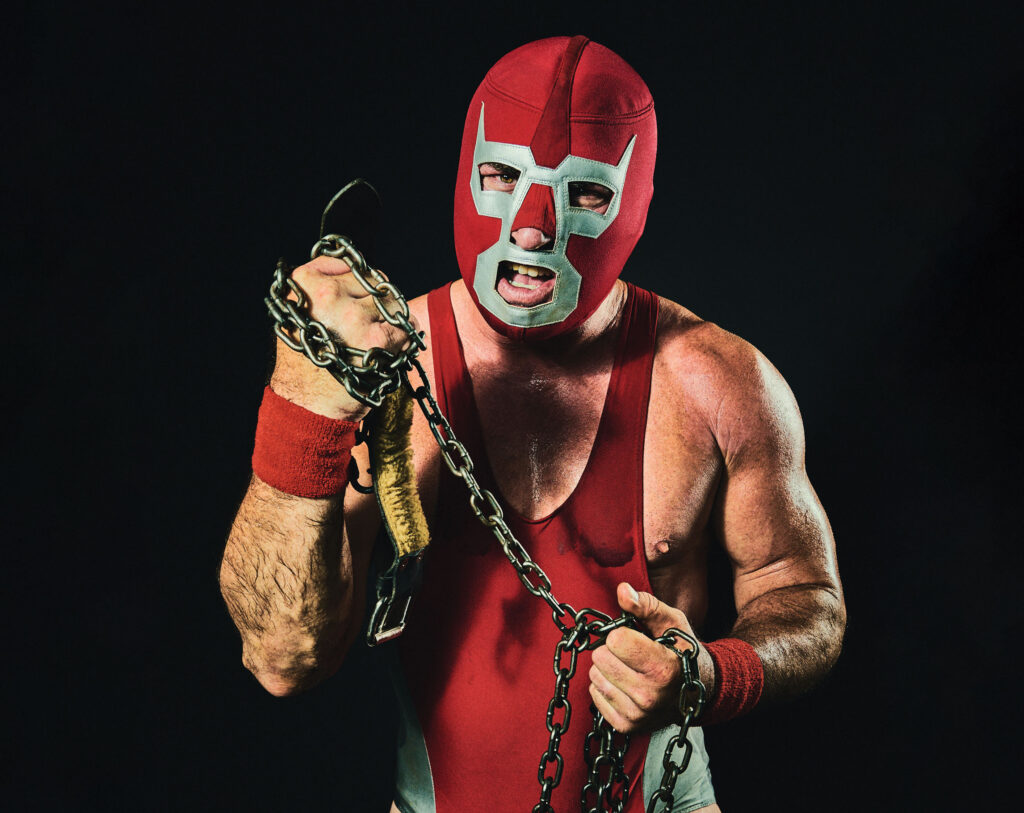
If it were up to him, The Beast wouldn’t have a retirement match; he’d just fade into the lore of Mondo Lucha, Milwaukee’s rowdy concoction of wrestling, burlesque and music. But the menacing, red-suited wrestler – whose identity remains a secret – is a longtime fan favorite and the organizers wanted a send-off. “Who am I to say no?” he says.

Check It Out!
Since his debut in 2008 at Mondo’s first Turner Hall show, The Beast turned from villain to embattled hero. The brawler finally won it all in 2019, when his (real-life) parents joined him in the ring to celebrate. After 30 years of wrestling, he feels he’s accomplished everything he wanted. “I want to get out before people are saying, ‘He should have gotten out five years ago.’”
The Beast will take on his archnemesis Darin Corbin for one final (nearly sold-out) showdown on Sept. 18 at Turner Hall Ballroom. MilMag asked the mysterious muscleman – who doesn’t talk during matches – about all those years slamming himself and others on the mat.
How did you decide now’s the time to retire?
There’s always been an eye on it. For me, it just got to the point where I want to support (the Mondo producers) as long as I can, but I really had to look at what my career was doing. … The miles add up, the matches add up. So far, I haven’t gotten any sort of serious injury. I’d really like to go out saying that. I joke to a lot of people that I’m going to get through the match and everything’s going to be OK, and I’m going to jump off the apron to walk to the back, and that’s when I’m going to blow my knee out.
How would you describe The Beast?
The unstoppable force and the immovable object. The Beast is driven. The Beast likes to get in and brawl; The Beast likes to have the people behind him. He was on the other side of the coin as a bad guy for the first three shows, and then luckily, he was able to see the light and turn that around. Quite honestly, I have not understood the appeal or why it worked for so long, especially when The Beast was under the Russian iconography that he had for the longest time. We did have to switch that in ’22. I don’t want to bring too much into it, but with the world environment at the time, the decision was made to remove the iconography but still keep the character.
How did you turn into a good guy?
Good marketing, good writing, good presentation. I’ve gone on record to say Mondo is one of the few promotions that I’ve worked with that had both the wrestling know-how and the production ability to really come off with a good product. Oftentimes, especially with local wrestling groups, you get great wrestling minds, but you had zero budget. Other times you might have a budget, but the person running the whole deal is deluded and doesn’t really know what they’re doing. But Mondo luckily came along at a good time, had good storytelling, was able to capture the imagination of the public at the time, and from there was able to grow. And with The Beast’s mask, that’s very easy to put on a poster. As far as I was concerned, I just wanted to show up and do a good job for what I was being hired to do.
How have you seen wrestling evolve since you started?
Wrestling has changed from what was once an emotional experience, where you’re trying to reach into people to have them feel the way you want them to feel, to more of a spectacle presentation, where now the performers are doing all sorts of larger and more theatrical and more aerial and more intricate moves to get the oohs and the aahs. There’s nothing wrong with this. It’s just different. That’s just not where I come from. It would have been a task for me to go out and redo how I present myself and learn new moves and do all of this, but by that time I’d already been 18, 20 years in.
Now that you’re retired, are you looking forward to going to shows not as a wrestler?
Nope. As a wrestler, I always made it a policy to not go to shows I wasn’t booked on, because if you’re not booked on the show, you don’t belong in the locker room. Have you seen the movie Beyond the Mat?
I have not.
Beyond the Mat was a very late-’90s documentary done by Barry Blaustein. It documents one of Terry Funk’s last matches, quote unquote, with Bret Hart at Amarillo. There’s a friend of Terry Funk’s that he wants to come to the show, and the guy says, “I’m not going to the show because I’m not booked. … Terry, I’ve seen it. I’ve been in the locker rooms. I’ve seen those old dogs in the back that are just sitting there waiting for somebody to recognize them, just looking for a scrap of recognition. And I don’t want to be that old dog.” That’s where I’m coming from right there.
Do you think you’ll miss anything about it?
I am going to miss the camaraderie of a good locker room. There was always a certain romance in, after the show, you hit the highway. You’ve got your towel around your neck. You light up that first cigar, and you’ve got a two-to-three-hour ride home. There was a certain romance in late-night drives like that, especially when the weather’s good and the roads are open. … Another odd thing I love is a small-town show. When the baby face or the good guy wins at the end, and everybody cheers, and it just seems like for 10 minutes, everything is perfect in small-town America. You can get back to real life the next day, but there’s just a good feeling of being able to create that.