

A crucial component of Milwaukee Film’s community-building vision is their Black Lens program, “fostering meaningful conversation, promoting celebration and strengthening community through cinema.” Widening their Black Lens, Milwaukee Film presents the Michael Schultz Award each year “to a luminary Black filmmaker.”

A Milwaukee native, Schultz is the critically acclaimed director of Car Wash, an urban, blue-collar response to American Graffiti, and the widely influential 1975 film, Cooley High is the award’s namesake and first recipient. Schultz was on hand Saturday Nov. 14 at the theatre to present the 2026 Michael Schultz Award to actor, director and writer Kasi Lemmons.
Kasi Lemmons is an associate arts professor at New York University’s Tisch School of the Arts and has directed several films, including her unforgettable debut Eve’s Bayou, the immensely successful Harriet (which received multiple Oscar nominations), Whitney Houston: I Wanna Dance with Somebody and several others. Lemmons, continues to be an essential voice for the Black experience, as an actor, director and educator.
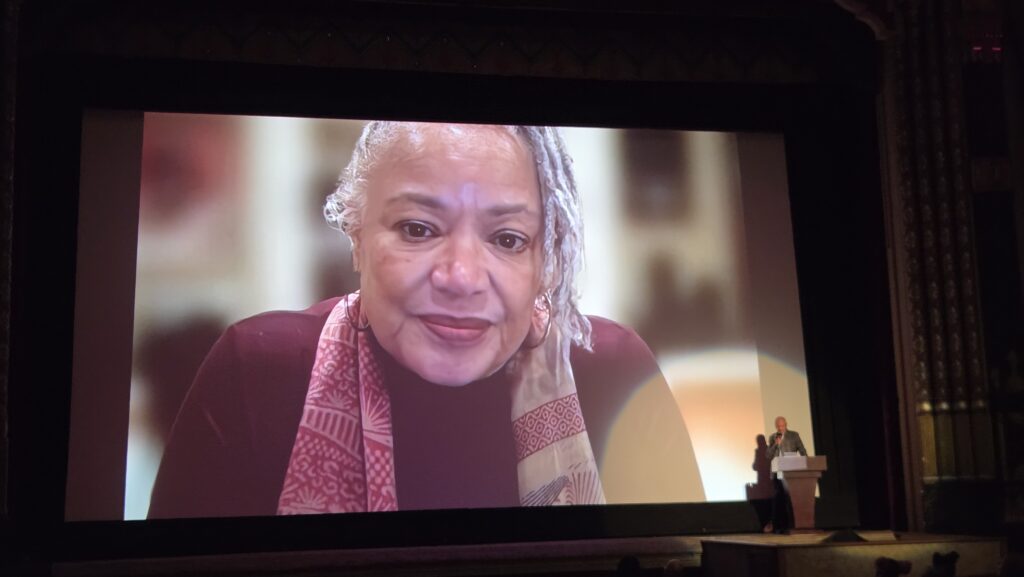
Due to unfortunate and untimely tech issues with the FAA, Lemmons was without a flight to Milwaukee this weekend, but she was on hand virtually to accept the award and participate in a stimulating chat with Schultz, after a screening of her 2007 Petey Greene biopic, Talk To Me. Later, Lemmon’s harrowing and telepathic masterpiece Eve’s Bayou was brought back to life with a director’s cut for our Milwaukee audience.

Gift An Issue For $1 Today!
Before the screenings, I was able to catch up with Milwaukee’s Michel Schultz for a fun talk about film, school and how being an astronaut might not always be a viable career path.
Michael Schultz
Schultz generously shared his impressions on AI’s impact on film, the resilience of Black filmmakers and the importance of having “big balls” and believing in yourself as an artist. But mostly, Mr. Schultz was ready to wax ecstatic about the award winner, director Kasi Lemmons:
“Kasi Lemmons is a filmmaker who tells the truth with grace. Eve’s Bayou announced a major voice, and she has never stopped growing, from Talk to Me to the Met Opera stage. She’s also teaching and lifting up the next generation of directors. That’s what this award is about: craft, courage and generosity. I couldn’t be prouder to put my name on an honor going to her.”
Lemmon’s Talk to Me is a wonderful stick it-to-the-man film about Ralph Waldo “Petey” Greene (portrayed perfectly by Don Cheadle), who worked his way up through poverty, addiction and jail time to become a Black media personality, community organizer and civil rights activist in Washington D.C. during the 1960s and 70s. Greene keeps it real despite the rank racism within his chosen industry, and the assassination of Martin Luther King Jr., in the aftermath of which Greene went on air to urge people to stay home with their anger, and refrain from further violence. The film highlights the timelessly vital music of James Brown, Sly and The Family Stone, Otis Redding, Sam Cooke and much more; all as Greene struggles to walk the line between the life he chooses and the life others try to choose for him. Martin Sheen shines as Greene’s radio boss, inhabiting the caustic respect white establishment begrudgingly gave Greene throughout his career.
Watching Lemmon’s directorial debut, Eve’s Bayou, brought to mind Toni Morrison, the brilliant author of another complex, tragic first effort, The Bluest Eye. Both stories dig deep into family trauma, zeroing in on fraught fathers with clairvoyant horror and elegance. Morrison once wrote: “Sometimes you don’t survive whole, you just survive in part. But the grandeur of life is in that attempt.” Entrenched within Eve’s Bayou is that attempt to survive not just the happenings of youth, but the memories themselves. A Black family fights to outrun the past, the present and the future in this timeless film, which holds up to the highest extent.
Lemmons spoke to us from the big screen at the Oriental Theatre, making the best of transportation kerfuffles, and communicating with a wondrous smile the steps that brought her the award. Lemmons and Schultz chatted for half an hour about film, art and life.
Lemmons: I was writing very early in life and then I started writing scenes. Eve’s Bayou was my first time trying to write a script for myself.
Schultz: It was so deeply, brilliantly written. What drew you to that subject matter?
Lemmons: I was auditioning as an actor, and a casting director said: instead of reading the lines from the script, why don’t you tell me a story about your family. And I started telling this wild story that’s actually true. My mother and my aunt went to a fair and saw a fortune teller who told my aunt “you’re a Black widow, the next man you marry will be a dead man!” It was in my family folklore, which he loved, but I didn’t get the part. I went home and wrote this story down and I started to realize I was writing down my life in sort of a fantastical, kind of folklorish way, so all the stories became Eve’s life.
Schultz: So it’s somewhat autobiographical, right?
Lemmons: The main story isn’t, but the stories within it are. My aunt was a psychic, a very flamboyant character. My sister and I were very close, she used that kind of language. It was very much an experiment in language and a type of poetry I heard as a kid, a sort of African American poetry, that’s very Southern.
Schultz: You have taught and are teaching a lot. I really applaud you for reaching back and cultivating the next generation of filmmakers. What attracted you to teaching?
Lemmons: As an advisor to Sundance, I enjoyed working with filmmakers. I taught at USC and UCLA, and I thought I might take a gig. I moved back to New York and NYU Tisch Grad Film is where I teach, I think it’s the best program in the world. I have taught so many wonderful filmmakers.
Schultz: I would love to come and sit in on your class so I can learn something.
Lemmons: You have to come speak to my class, so they can come learn something!