
The people have come for the cheese.
It’s a March Wednesday, and the large exhibition hall of the Monona Terrace convention center in Madison is packed with fromage fanatics. At 10 a.m., the World Championship Cheese Contest opens its doors to the public, allowing hundreds of enthusiasts to get a glimpse of the men and women who determine, to put it simply, the biggest cheese.

The sharp, earthy smells of thousands of wheels fill the room – Colby from Muscoda, mozzarella from Japan, Gorgonzola from Denmark. The bright red floor of the Frank Lloyd Wright-designed space is full of motion. A ring of more than 25 chest-high tables surrounds the room.
At each, a pair of white-coated judges in matching caps emblazoned with the contest logo stand across from each other, cheese arrayed in front of them – some in small wheels, some in curds, some even in spread form.

Celebrate this year’s winners of the Betty Awards!
A sip of water, a bite of green apple, and their palates are cleansed. They judge with intensity and intricacy, examining the packaging for unpleasing wrinkles, the rind for cracks. They sniff at the blocks and sink metal “triers” into wheels, the syringe-like tools pulling forth fresh tubular samples called “plugs.”
With finicky exactitude, they place each piece gently in their mouths for the most important test of all. They let it sit on the tongue, move it around, chew as needed to get a sense of texture and give. And then cheese tumbles from chapped lips, slick chunks dropping into plastic-lined buckets with gentle plunks.

These arbiters of cheese glory make their judgments on glowing iPad screens, marking each dairy deduction, as dozens of volunteers – distinguished by their brown hats – haul to judging tables circular wheels ranging from half a foot in diameter to over two feet.
In this room and far beyond, hundreds of cheesemakers wait on results with bated breath. These people who have devoted their lives and careers to the careful, intricate, unforgiving art of crafting delicious cheese have come together from across the planet to pit their work against one another.
At stake over the contest’s three days is the highest prestige in their craft. Three thousand three hundred and seventy-five cheeses from 25 countries and 34 U.S. states are duking it out. Some of these cheesemakers are Wisconsin’s big players, working in massive factories with research and development teams: Emmi Roth, Sargento, BelGioioso. Other wheels are from the reserves of our state’s many smaller makers: Hill Valley Dairy in Milwaukee, Alpinage in Sturtevant, Uplands in Dodgeville. They’re all up against the Swiss and the French and the Japanese and, of course, the dreaded Californians, usurpers of the Dairy State’s dairy production title.
Held every other year since 1957 by the Wisconsin Cheese Makers Association, this is the Oscars of cheesemaking, the top contest with the most elite entrants. It brings winners not only pride in their artisanship but also the kind of customer attention that can supercharge a large cheesemaker’s sales – or keep a smaller one afloat.
After Monroe’s Emmi Roth took home the coveted first-place overall win in 2016 for its Grand Cru Surchoix, a firm, washed-rind alpine-style cheese, the company said that sales of that variety and others rose by double digits the following year. In 2024, company president Tim Omer told Brownfield Ag News that the company’s total cheese business stood at more than double 2016 levels.

“Contests are very important,” says Dominique Delugeau, a cheese judge for 40 years who moved from his native France to the United States in the late 1980s and now lives in Wisconsin. “You judge yourself against the best, and then all of a sudden, you can become the best.”
In the midst of all this, I wander – a novice in a world of experts, a journalist plenty experienced in cheese consumption but embarrassingly ignorant of its creation, trying to understand this particularly Wisconsin art, the people who keep it alive, and all the milk, mold and brine that go into crafting a championship-winning cheese.
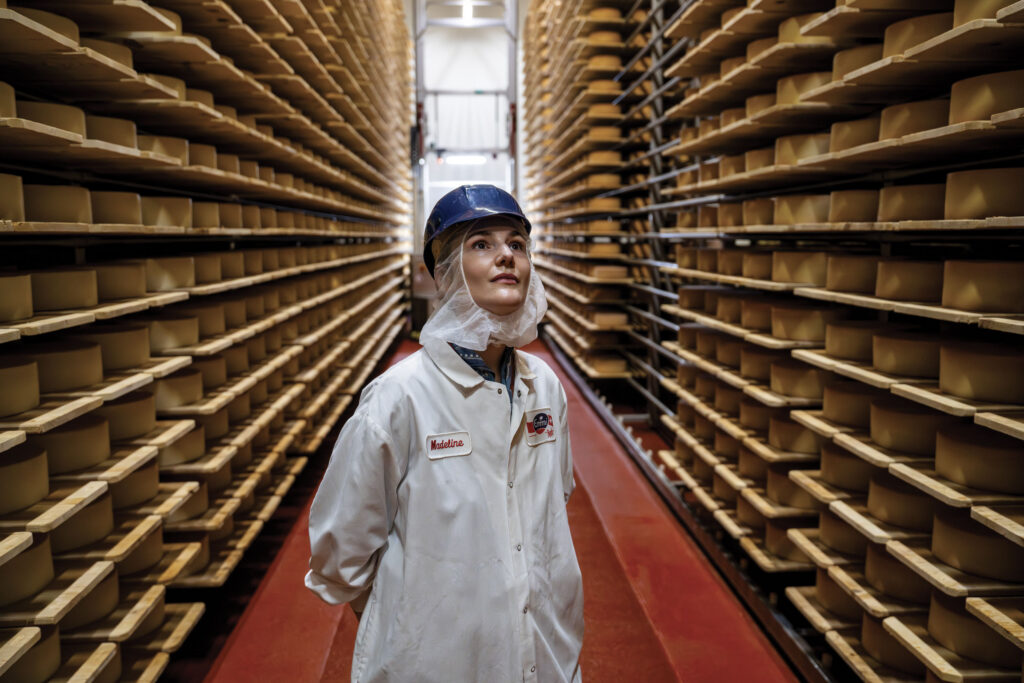
THE EMMI ROTH CHEESE CAVES HURT. When cheese is left to age, mold forms across it, producing enzymes that break down the milk proteins and unleash ammonia as a byproduct into the air around it. The more time passes, the more ammonia the cheese releases. One wheel isn’t that intense, but stack hundreds of them up to a 22-foot ceiling and leave them for months, and the resulting acidic stench is so overwhelming that it burns the eyes.
Well, some eyes. “This is my favorite place,” says Madeline Kuhn, one of Emmi Roth’s cheesemakers. “When I was new, I told them they could just put my desk down here.”

Three months before the World Championship Cheese Contest, Kuhn gives me a tour of Emmi Roth’s vast cheese production facility in Monroe. It’s one of Wisconsin’s largest operations, created in 2009 when Swiss food giant Emmi acquired Wisconsin-based Roth Käse.
To get inside the caves, normally closed to the public, cheesemakers must suit up in protective coats, goggles, shoe coverings and helmets, repeatedly washing their hands at stations that line the factory floor along the way. Outside the caves, the earlier stages of cheese production are carried out – vats of milk are churned into the curds that will eventually be pressed into wheels and aged on those shelves. In the factory halls, dispensers at calf level spray foam on the floor to kill what germs may cling to your sole.
The concept of a “cheese cave” may sound rustic, but the robot cleaning the cheese, proves that notion quickly false. The bulky, rectangular automaton rises and falls on support beams, coating the foot-wide wheels in a solution of salt, water and bacteria, brushing them and flipping them when needed. The wheels are aged on untreated spruce boards imported from Switzerland – the porous material helps absorb moisture and humidity and even imparts an earthy aroma.
When Kuhn speaks about the cheese turning the air into a burning soup, it’s almost the way someone might discuss beloved pets. She explains how the fresher cheese is intentionally placed close to older wheels. “They’re communicating with each other,” she says. “The older cheese is giving off most of that ammonia and it’s helping the younger cheese – the cheese is living and breathing.”
Kuhn – who comes from a multi-generational Wisconsin dairy family and has a degree in food science from UW-Madison, has been at Emmi Roth for eight years. Fresh out of college, she was the company’s first full-time hire in research and development. Now 31, she works in percentages and calibrations, proposing and implementing production changes large and small – slightly more buttermilk in the Gorgonzola, a tweak in the brine, a new salting procedure. Small batches of her proposed changes are made and tested and made again, with results like Roth’s aged Gouda, one of her projects that hit store shelves in 2021.
We leave the caves and the factory floor to see Emmi Roth’s championship display, mounted in a less olfactorily challenging environment. Hanging on the wall of the visitor center is not a plaque or a trophy but a big WWE-style belt. The 2016 World Championship marks the last time an American-made cheese won that honor. The most recent American win before that was in 1988. In an industry dominated by Europeans, it’s a distinction that makers across our state were fighting to reclaim in 2026.
PASSING JUDGEMENT ON CHEESE MAY NOT SEEM DIFFICULT. In fact, many of us do it all the time – usually along the lines of “pretty good!” or “smells like feet.” But talk to a professional cheese judge for five minutes, and it becomes clear that there is another level of tasting, driven by technique, vocabulary and highly trained palates, that renders most of us rank amateurs.
When Drew Kordus tastes a cheese curd at the World Championship, he makes minute judgments, deducting fractions of fractions of points for variations in flavor most consumers can’t detect at all, slight flaws in aroma, ingredient imbalances, even the shape of the curd itself. Kordus is a Wisconsinite – a food quality manager at Great Lakes Cheese in Plymouth – who’s judged the last four world contests.
Later that day, he’ll be judging “high heat” pepper-flavored cheese, he tells me. “If you see us all sweating, that’s why.” The nearby green apple slices and jugs of water will be particularly crucial. When you put richer cheeses in your mouth, they gradually form a thin layer of fat across the roof that dulls your sense of taste unless you keep washing it away with acidic apples and water.
Across the table from Kordus is Enda Howley, who flew from Ireland to judge the contest. Each American judge is paired with one from overseas. A cheese expert from Japan, Takayuki Miura, is judging his classes with the help of a translator.
The World Championship Cheese Contest By the Numbers
→ 3,375 cheeses judged
→ 25 countries competing
→ 148 classes judged
→ 56 judges from 22 countries
Pairing judges is meant to ensure that one taster with a rogue palate doesn’t unleash an unfair critique. Over the first few samples, the two “calibrate.” They see where their scores are landing, and if they’re in near-alignment, that means they’re judging at something near objectivity. Kordus and Howley are comfortably on the same level for the flavored curds they’re working through, whereas judges who find they have different impressions of the same cheese must figure out what the problem is and get on the same page before they can continue. Delugeau recalls once being paired with a woman whose perfume was so intense, he struggled to judge the aroma of the cheese in front of them.
Across the room, Leyda Ponce de León, a food science professor at the University of Puerto Rico, is judging cream cheese a couple of tables down from Peter Mitchell, an English cheesemaker who is still reminiscing about the more than 60 sharp cheddars he assessed on the first day of the contest.
“This is a really well-organized event – probably more organized than the events we have in the U.K.,” Mitchell says with a laugh. It’s his first year as a judge at the World Championship and he plans to bring lessons from the show’s intense method back to his country’s smaller shows.
“There are a lot of repeat judges – we’re like a family, in a way, when we come back together and celebrate all these amazing cheesemakers,” Kordus says. “This is the best place to be for the best cheese in the world.”
THE ALPINAGE CHEESE CAVE SMELLS QUITE NICE. That’s because I’m touring it on the day the cheesemaker finally finished moving into a new facility in Sturtevant, and only a few racks of cheese, just a month old, are producing ammonia in there.
Alpinage operates on a vastly smaller scale than Emmi Roth. Instead of a squadron full of workers patrolling a vast production floor, the Alpinage team consists of three people – and one of them is a newborn with wide eyes and a little bit of drool hanging from his lip.

Paula Heimerl is changing her 9-month-old son’s diaper in the small lobby, while her partner (in both business and life), Orphée Paillotin, speaks about his family’s small cheesemaking operation and the raclette that he hopes might one day win “best in class” at the World Championship.
Wearing a sweatshirt that reads “Countless Horrors Await But I Remain Faithful To The Cheese,” he sounds like a guy on the other end of a grueling marathon. It had taken 18 months to uproot Alpinage from its first, smaller facility in Oak Creek and build a new “cave” in this Sturtevant industrial park, all with the baby on the way and hopes to buy a new home for his growing family.
Paillotin, 40, was born and raised in Paris, and when he moved to Milwaukee in 2015, cheese was far from his mind. He was doing IT work for Poclain Hydraulics, the France-based company that had secured his green card.
One night at a Brady Street bar, he was watching the French soccer team in the World Cup when he met Heimerl, an interior designer. The two hit it off, and soon Paillotin learned that Heimerl’s parents were dairy farmers, the owners of Saxon Creamery. They introduced Paillotin to the world of Wisconsin cheese, joking that a man from a mecca of cheese shouldn’t be working behind a monitor all day.
Paillotin – whose family in France is in the restaurant business – started to take those jokes seriously. In 2019, he got his cheesemaker’s license, and while both were still at their day jobs, he and Heimerl launched Alpinage in that minuscule facility in Oak Creek.
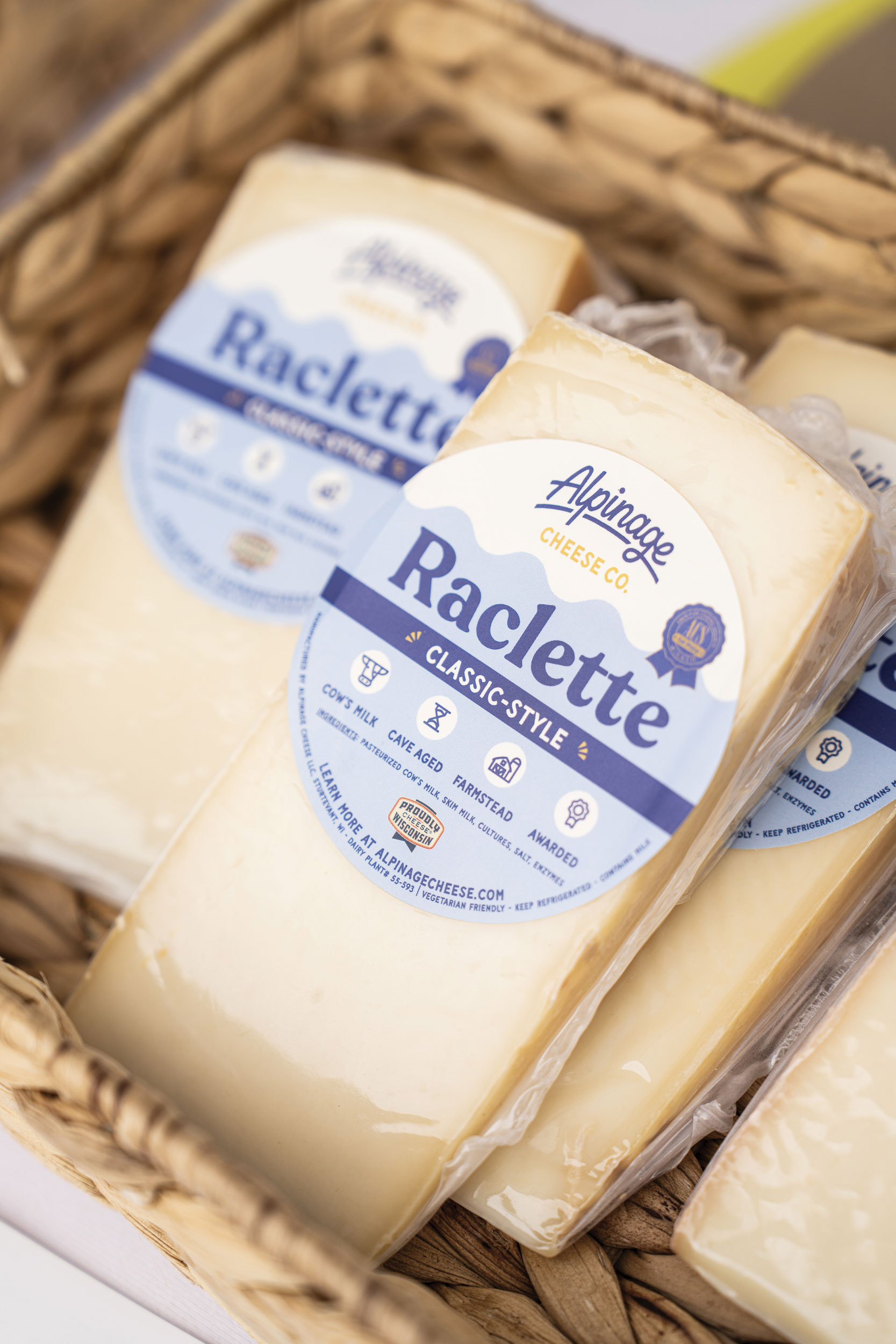
The young couple thought it would be fruitless to try selling a more commonly made cheese like cheddar or Gouda when hundreds of producers large and small were already cranking out delicious versions. Instead, they decided to go for a niche. Alpinage, they decided, would make one cheese: raclette, an aged, semi-soft Swiss with a slight earthy funk to it that few in Wisconsin produce.
With no infrastructure to start from, Paillotin turned to UW-Madison, where anyone with a cheese recipe can pay to have a tiny batch of their cheese made and aged at its Center for Dairy Research.
- Aged Cheddar Midget, Henning’s Cheese, Kiel
- Cello Artisan Copper Kettle Parmesan, Schuman Cheese, Turtle Lake
- Aged Cheddar – One to Two Years, Land O’Lakes, Kiel
- Odyssey Peppercorn Feta, Klondike Cheese Co., Monroe
- BelGioioso CreamyGorg, BelGioioso Cheese Inc., Denmark
- Red Rock, Roelli Cheese Co., Shullsburg
- Castello Smoked Cracked Pepper Gouda, Arla Foods, Kaukauna
- Roth Grand Cru Surchoix, Emmi Roth, Monroe
- Ocooch Reserve, Hidden Springs Creamery, Westby
“I was not happy with the result,” he remembers. He adjusted before making his first 20-wheel batch in Oak Creek. They were good enough to sell at local farmers markets. He and Heimerl walked into Glorioso’s and convinced them to stock the new cheese. Sendik’s called when a customer from a farmers market asked if the store stocked Alpinage. And in 2024, their raclette took fifth in its class at the World Championship. Soon enough, both Paillotin and Heimerl went full time into cheese.
Alpinage’s new Sturtevant cheesemaking facility is coincidentally within walking distance of Poclain Hydraulics, Paillotin’s former employer. “If I squint, I can see my old boss,” he says.
In contrast to Emmi Roth’s automated caves, the Alpinage folks had mostly been handwashing their cheese with the help of one small machine that washes one wheel at a time. The cost of specialty cheesemaking equipment, Paillotin says, is prohibitively high, and getting their relatively small facility up and running was “physically and mentally exhausting.”
But now the two new parents have big goals for the future: more cheeses, maybe new varieties, renting out their caves to other makers. And in March, their raclette was back in Madison at the World Championship, where they hoped to fare better than fifth.
TAKING A LAP AROUND THE WORLD CHAMPIONSHIP CHEESE CONTEST is like immersing yourself in another world. Even discussions between two American judges are so specialized that they seem like they’re in some foreign tongue. The easy bandying about of specialty cheese names, techniques and other jargon is overwhelming; occasionally you’ll hear a word like “provolone” and think oh, I know that one!
There’s even a certain tension at times. A couple cheesemakers refuse to talk to the press before their cheese is judged – not out of animus but an almost superstitious caution. One maker had placed in the previous year’s U.S. Cheese Championship – held on World Championship off-years – and they don’t want to answer jinx-worthy questions like, “Think you’ll win again?”

While the judges wear white hats, there’s another group, wearing brown ones, affectionately called “the B team.” They’re the volunteers who help the judges, hauling wheels of cheese, fetching water and running other errands on the floor. That might not sound like the kind of work people jump at, but MaKenzie Skibbie, among many others, filled out her application within minutes of it going live – any later, and all the spots would have been taken.
Skibbie’s mother worked at Marieke Gouda in Thorp, and after school, young Skibbie would watch the workers making cheese while her mom finished her shift. She remembers spending many hours fascinated by how those vats of curds and whey turned into the tasty stuff in her fridge. Now, she volunteers with her mother at the championship. “We’re a community,” she says of her brown-capped legion, who have their own exclusive “B team party” after the day’s judging is done, when they finally get to unwind.

As I finish talking with Skibbie, the contest results continue to roll in for the latest classes judged. Walking out of the room, I overhear a middle-aged man speak with an unmistakable Wisconsin accent. “They beat us? I’ll be darned.”
HILL VALLEY DAIRY SMELLS LIKE FINE WINE. The factory in Walker’s Point – a rare urban cheesemaker – doubles as a wine bar and tasting shop. Hence, it houses the churning vats of milk behind a window that keeps the smells contained, while still allowing interested visitors to watch the small team making new batches of the cheese they’re sampling. Hill Valley is somewhere between Emmi Roth and Alpinage in size – nowhere near mass production, but with multiple employees, revenue streams and cheese varieties.
Walk inside, and an owner will probably greet you. On the day I visit, like just about every day, Ron Henningfeld and his wife, Josie, are hustling at their factory-shop-bar.
Ron, 43, was raised in the dairy industry trenches. His grandparents founded East Troy’s Romari Farms in 1942, passed it onto his parents, and when Ron started Hill Valley in 2016, he sourced his milk straight from the family farm. “I knew that to be successful with this cheese business, I needed to do something that stands out,” he says. He makes cheddar, Gouda, curds (a low-cost and popular profit-driver for many makers), but the niche he’s carving is in alpine-style cheese, modeled after those originating in the European Alps.

Hill Valley’s flagship is Luna, an original alpine-Gouda hybrid Henningfeld created. Hitting that specialty niche does carry costs – Hill Valley pays more to source materials for alpine-style than other cheeses, and there are long delays of six to 24 months to recoup the investment as the cheeses age at a facility in East Troy.
But it seems to have paid off. Luna took third place in its class at the World Championship in 2022.It’s the only one he submitted to the contest this year. He’s confident in his other creations, but those slim margins and long aging times don’t allow him to sacrifice many free wheels for the judges to sample. To enter a cheese costs an $80-$95 entry fee, along with typically at least two pounds of the cheese in its original form. (The entry guidelines include the all-caps exhortation, “DO NOT CUT YOUR CHEESE!”)
Regardless of how Luna fares, Henningfeld says, there’s value in the submission alone. Each maker receives a detailed results sheet. Each entry begins with 100 points – a platonic ideal of that style of cheese – and judges then note each deduction. The cheese wasn’t firm enough, the odor wasn’t quite right, the coloring was mottled, and on and on. “We don’t get feedback on what’s good,” Henningfeld says, laughing. “We just get told what’s bad about our cheese, and we can assume the other things aren’t problematic. A lot of times, we recognize that these characteristics that are technically flaws are what our customers like and what sets our cheese apart.”
BOB KOENIG ONCE TRIED TO MAKE TAHINI CHEESE CURDS. The cheesemaker with Carr Valley in La Valle is locked in a perpetual “competition to see who can come up with the most unique flavor,” against his colleagues. Koenig thought he might have discovered something great with the rich, nutty Middle Eastern flavor. “It was really good for about 15 minutes,” he remembers, as we talk amid the bustle of the World Championship. “But then the citric acid just turned the curds into rocks.”

That’s cheese R&D for you. Cheesemakers that have the time and the resources to constantly experiment run into plenty of walls. And mistakes sometimes don’t make themselves known for long stretches of time due to the aging process.
Henningfeld shook his head when he talked about the dread that came from a minor change to how he salts Hill Valley’s cheese: “If it’s [worse], oh my gosh, I won’t know for 18 months.”
Those intricacies of flavor, that careful calibration of ingredients, all reach a crescendo at this contest. Koenig has been attending for the past two decades, since he was a teenager working at Carr Valley, and he notes that the company used to win best in class awards quite often – now, not nearly as consistently.
While that might sting the ego, it’s a sign of something good: There’s more great cheese out there. “The best cheese I’ve ever tasted has been these last two years,” he says. “Everyone is bringing their A game. Now a win is the best thing ever.”
AFTER ALL THE CAREFUL JUDGING, the scores logged to the decimal, the gallons of palate-cleansing water, the final round determining the top 20 entries in the World Championship Cheese Contest is amusingly simple.
You have tables. You have wheels of cheese. And you have poker chips.
All the first-place winners in the classes are placed on tables – some fresh, some cut over the previous two days – and the judges surround them, chips in hand. Then, all at the same time, they put their chip on top of the cheese that’s their favorite of the bunch. The 56 judges rotate tables until totals are tallied. The 20 cheeses with the most chips advance to the final judgment.
“These are the 20 best cheeses in the world,” Delugeau says. From those, the winner is chosen.
This year, like every contest for the past decade, the winner was not an American. Beemster, of the Netherlands, took home the gold for its Royaal Grand Cru with a score of 98.68. First and second runners-up were both Swiss. In fact, this year’s 20 finalists only included two American cheeses, one from Washington state and one from Vermont. Yes, Wisconsin was shut out.
The Badger State, though, per usual, excelled in the classes. Our state took 45 first-place finishes, the most of any state, including in smoked provolone, Monterey Jack, aged cheddar, Havarti and, of course, Colby, which was developed in its namesake Wisconsin town. But the competition was stiff. Hill Valley’s Luna didn’t place in Hard Cheese with Natural Rind, and even Emmi Roth was shut out of the coveted top three in the classes it entered.

Pailloton couldn’t make it to the World Championship, but he watched for results to roll in for Alpinage’s raclette, the cheese he’s devoted himself to perfecting for seven years. When results arrived, he couldn’t help but feel disappointment. Alpinage took fourth place, missing out on third and its glory by only 0.145 points.
“Fourth – the worst place,” he says, half-jokingly.
But that “worst place” put his tiny cheese operation at the head of the U.S. in its class, beating every other American maker and many Europeans, and moving Alpinage up one step from its showing in the last contest. Some would call it a victory for a two-adult, one-baby operation, but Pailloton isn’t satisfied. That’s the spirit of the competition, or even the whole point: to go against the elite in your craft, to push yourself to achieve your absolute best, to create something that can withstand the most intense level of criticism and still come out on top.
“When I came to Wisconsin 40 years ago, there was some great cheese, but not all cheeses were great,” Delugeau says, looking back on four decades of judging. “Now, U.S. cheese has won the world contest, every year, we raise the bar.”