
THIS STORY IS PART OF OUR ‘PURPLE REIGN’ FEATURE. READ MORE HERE.
Different Drummers
While Sen. Robert “Fighting Bob” La Follette was the most successful third-party presidential candidate from Wisconsin, he wasn’t the only one. Third-party and independent tickets have featured three other presidential candidates and three vice-presidential hopefuls with strong ties to this state:
George Edwin Taylor
First Black presidential candidate: Taylor worked as a newspaper reporter and editor in La Crosse before moving to Iowa, where he became active in politics. After the National Negro Liberty Party nominated him for president in 1904, he received less than 2,000 votes nationwide.
Emil Seidel
Socialist vice-presidential candidate: Seidel was Milwaukee’s first Socialist mayor (1910-1912) and the first Socialist to lead a major American city. He was the running mate of Eugene Debs on the 1912 Socialist ticket, which won about 6% of the national vote.

Celebrate this year’s winners of the Betty Awards!
John Schmitz
Third-party presidential candidate: Born in Milwaukee, Schmitz was a California Republican congressman (1970-1973) and conspiracy theorist. After fellow Milwaukee native Arthur Bremer shot and paralyzed former Alabama Gov. George Wallace in 1972, the right-wing American Independent Party nominated Schmitz instead. With 1.4% of the national vote, Schmitz finished a distant third.
Frank Zeidler
Socialist presidential candidate: Zeidler was the last of Milwaukee’s Socialist mayors (1948-1960). When he ran for president as the Socialist nominee in 1976, he received about 6,000 votes nationwide, mostly from Wisconsin and particularly from Milwaukee County.
Bill Dyke
Third-party vice-presidential candidate: Dyke was the last Republican elected as Madison’s officially nonpartisan mayor (1969-1973). He joined the American Independent Party ticket led by former Georgia Gov. Lester Maddox in 1976, while distancing himself from Maddox’s segregationist stands. They took 0.2% of the national vote.
Pat Lucey
Independent vice-presidential candidate: Lucey was Wisconsin’s Democratic governor (1971-1977) and U.S. ambassador to Mexico (1977-1979). In 1980, he became Illinois Republican Rep. John Anderson’s running mate in an independent bid for the White House. The pair finished third, with 6.6% of the national vote.
Diversely Forward
For much of Wisconsin’s history, major elected state and federal offices have been dominated by straight white males. Today, the governorship is the last such office never held by a woman, a person of color or an open member of the LGBTQ community.
Dena Smith
First woman elected to statewide office: Smith was assistant to her husband, State Treasurer Warren Smith, and was appointed to fill the rest of his two-year term after he died in 1957. After one term out of office, she was elected to the post as a Republican in 1960 and served until her own death in 1968.
Shirley Abrahamson
First woman on Wisconsin Supreme Court: Abrahamson was appointed to fill a vacancy in 1976 and went on to win four 10-year terms, retiring in 2019 after a record 43 years on the court. By seniority, she became the first female chief justice in 1996, until Republicans pushed through a constitutional amendment that allowed conservative justices to oust the liberal Abrahamson from the chief justice role in 2015. Women now hold six of the high court’s seven seats.
Vel Phillips
First Black person elected to statewide office: Phillips won the 1978 secretary of state race after a campaign in which she never mentioned her race or gender. She already had been the first woman and first Black member of the Milwaukee Common Council, Milwaukee County’s first female judge and Wisconsin’s first Black judge. She served one four-year term before losing the 1982 Democratic primary to her predecessor, Doug La Follette.
Steve Gunderson
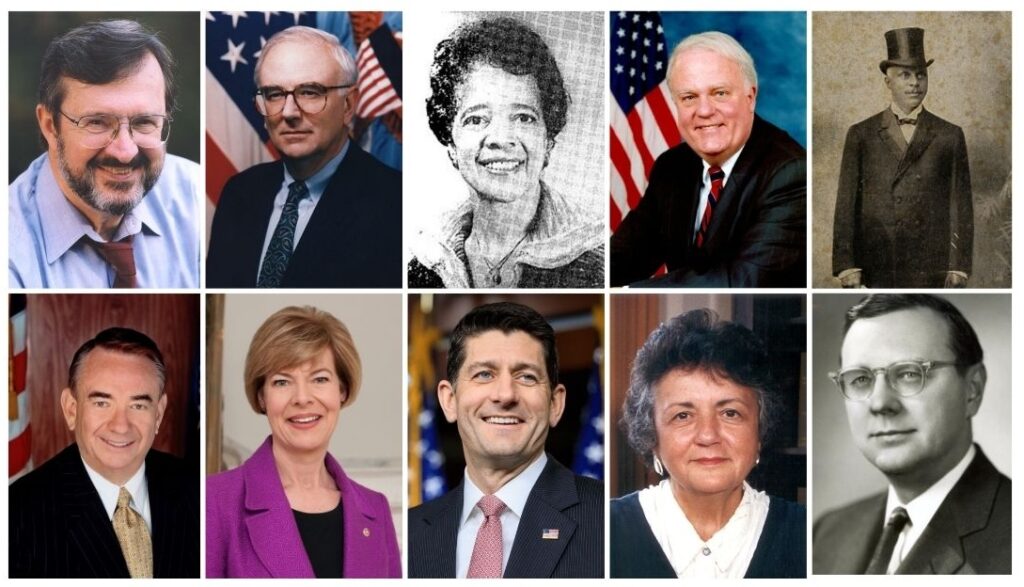
Wisconsin’s first openly gay member of Congress: Representing Western Wisconsin’s 3rd District from 1981 to 1997, Gunderson postponed his planned retirement and won his final term after he was outed on the House floor in 1994. He was the nation’s first openly gay Republican congressman to be re-elected.
Herb Kohl
Wisconsin’s first Jewish senator: Kohl was the owner of the Milwaukee Bucks and the former CEO of his family’s chains of department stores and supermarkets when he was elected to the Senate as a Democrat (1989-2013). He chaired the Senate Aging Committee.
Tammy Baldwin
Wisconsin’s first woman in Congress: When she was elected to represent the Madison-centered 2nd District in 1998, Baldwin was the first person nationwide to win an open House seat after coming out as gay. In 2012, the Democrat was elected as Wisconsin’s first female U.S. senator and the Senate’s first openly gay member.
Gwen Moore
Wisconsin’s first Black member of Congress: Moore won Milwaukee’s 4th District seat in 2004. She is now serving her 10th term as a Democratic member of the House.
Also noteworthy:
- Glenn Wise, first woman in a constitutional office (Republican, appointed secretary of state, 1955-57).
- Russ Feingold, whose election made Wisconsin one of the first two states to be represented by two Jewish senators (Democrat, 1993-2011).
- Louis Butler, first Black Supreme Court justice (appointed 2004-08).
- Mark Pocan, America’s first openly gay congressman to succeed another openly gay House member (Democrat, elected to 2nd District seat, 2012).
- Mandela Barnes, first Black man elected statewide (Democrat, lieutenant governor, 2019-23).
- Steve Kagen, Wisconsin’s first Jewish congressman in 78 years (Democrat, representing northeastern Wisconsin’s 8th district, 2007-11), after Milwaukee Socialist Victor Berger.
Wisconsin on the Hill
Some members of Wisconsin’s congressional delegation have played an outsized role on the national stage. Here are a few of the state’s most influential lawmakers:
Victor Berger
America’s first Socialist member of Congress: Berger, the leader of Milwaukee’s Socialist movement, won his first House term in 1910, lost his seat in 1912 and won it back in 1918. But when he was convicted of violating federal law for his nonviolent opposition to World War I, the House refused to seat him, repeating the process after he won a special election. The Supreme Court overturned his conviction and he returned to office from 1923 to 1929.
Alexander Wiley
Senate Foreign Affairs chair: Wiley, a Republican, was Wisconsin’s second-longest serving senator (1939-63). He chaired the Senate Judiciary and Foreign Affairs committees and championed construction of the St. Lawrence Seaway.
Clement Zablocki
House Foreign Affairs chair: Zablocki represented southern Milwaukee county as a Democrat from 1949 until his death in 1983. He lost in the 1957 special Democratic primary to replace Joe McCarthy in the Senate. Zablocki led the Foreign Affairs Committee during his last four terms in the House and sponsored the War Powers Resolution that limited the president’s military authority.
Henry Reuss
House Banking chair: Reuss, a Democrat, represented northern Milwaukee County (1955-83). He chaired the House Banking and Joint Economic Committees and authored the Community Reinvestment Act, which ended redlining and reduced inequity in bank loans.
William Proxmire
Senate Banking chair: Known for his energetic low-budget campaigns, Proxmire was a Democrat and Wisconsin’s longest-serving senator (1957-1989). He led the Senate Banking Committee, authored the Truth in Lending Act, championed the international treaty on genocide and created the Golden Fleece Awards to spotlight wasteful federal spending.
Gaylord Nelson
Earth Day founder: Nelson, a Democrat, served as governor (1959-1963) before he was elected as a senator (1963-1981). He chaired the Senate Small Business Committee; sponsored legislation to preserve former President Richard Nixon’s Watergate-era tapes; and founded Earth Day.
Dave Obey
House Appropriations chair: Representing northwestern Wisconsin’s 7th District as a Democrat, Obey served from 1969 to 2011. He led the Appropriations Committee for three terms and was the panel’s ranking Democrat for four terms. Obey was in charge of writing the House ethics code.
Jim Sensenbrenner
House Judiciary chair: Sensenbrenner was elected as a Republican in 1978 to represent the suburban 9th District, later renumbered as the 5th District. By the time he left office in 2021, he was Wisconsin’s longest-serving congressman. Sensenbrenner chaired the Science Committee for two terms and the Judiciary Committee for three terms. He authored the Patriot Act, which expanded federal anti-terrorism powers.
Paul Ryan
Speaker of the House: Ryan represented southeastern Wisconsin’s 1st District as a Republican from 1999 to 2019. In 2012, the GOP nominated him as Mitt Romney’s running mate, the first time anyone from Wisconsin appeared on a major-party White House ticket. Ryan served two terms as Budget Committee chair and was leading the Ways and Means Committee when he was elected speaker in 2015, becoming the first Wisconsin congressman to hold that post.
All the President’s Badgers
Presidents have been naming Wisconsin leaders to major federal positions for almost 160 years. Here are a few of the governors, congressmen and other prominent state residents who were appointed to the Cabinet or the Supreme Court:
Alexander Randall
First U.S. Cabinet member from Wisconsin: Randall served as the state’s Republican governor from 1858 to 1862. President Abraham Lincoln appointed him first to a diplomatic post and then as assistant postmaster general. After Randall’s boss died in 1866, President Andrew Johnson promoted him to postmaster general, a post he held until 1869.
Carl Schurz
Secretary of the interior: Schurz, a German immigrant, was living in Watertown when he led the Wisconsin delegation to the 1860 Republican convention that nominated Lincoln. He later served as a U.S. senator from Missouri (1869-75) before President Rutherford Hayes picked him as interior secretary (1877-81). But he may be best known for his saying, “My country, right or wrong; if right, to be kept right; and if wrong, to be set right.”
Melvin Laird
Secretary of defense: Laird represented northwestern Wisconsin’s 7th District as a House Republican from 1953 to 1969. When newly elected President Richard Nixon named him to lead the Pentagon, Laird became the first member of Congress chosen for that position. He served until 1973, then briefly joined the White House staff as a domestic policy aide.
William Rehnquist
Chief justice: Born in Milwaukee and raised in Shorewood, Rehnquist was an assistant U.S. attorney general when Nixon nominated him to the Supreme Court. He served as an associate justice from 1972 to 1986, when President Ronald Reagan nominated him as chief justice. Rehnquist led the high court until his death in 2005.
Les Aspin
Secretary of defense: Aspin represented southeastern Wisconsin’s 1st District as a Democratic congressman from 1971 to 1993 and was a four-term chair of the House Armed Services Committee. He served just one year as President Bill Clinton’s first Pentagon chief, then joined several advisory panels before his death in 1995.
Donna Shalala
Secretary of health and human services: Shalala was a former University of Wisconsin-Madison chancellor (1988-93) who became Clinton’s HHS secretary (1993-01). She was later elected as a Democratic congresswoman from Florida (2019-21).
Tommy Thompson
Secretary of health and human services: Thompson was Wisconsin’s longest-serving governor, a Republican who held the state’s top job from 1987 to 2001. He resigned to become President George W. Bush’s first HHS secretary and served in that post until 2005. Thompson ran unsuccessfully for president in 2008 and Senate in 2012 before he was named University of Wisconsin System president from 2020 to 2022.
Reince Priebus
White House chief of staff: Priebus led the Wisconsin Republican Party from 2007 to 2011 and the Republican National Committee from 2011 to 2017. He only lasted a year as President Donald Trump’s first chief of staff. But he’s back on the GOP scene as chair of the Milwaukee host committee for the party’s 2024 convention.