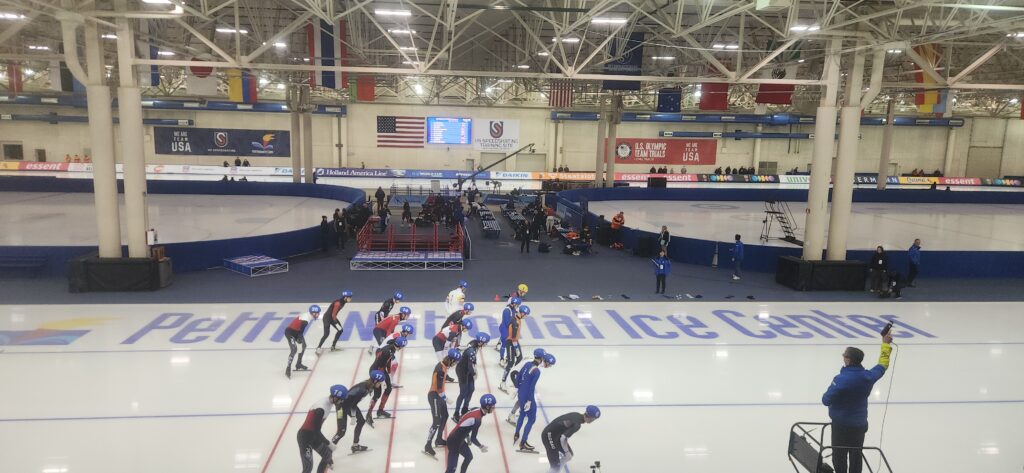
In front of a boisterous home ice crowd that packed the Pettit National Ice Center to capacity, Kewaskum speedskater Jordan Stolz put on a show to remember over the weekend while competing in the International Skating Union World Cup.
Top skaters from around the globe competed in the three-day event, which drew an estimated 1,500 spectators per day, and no one’s star shone brighter than that of the 20-year-old Stolz, who captured gold medals in three races (500-, 1,000- and 1,500-meter competitions) and silver in another, while setting multiple records in the process.


If someone has inspired you through their service, leadership or dedication, the Unity Awards are your opportunity to recognize them!
It was a remarkable homecoming for Stolz, a generational talent who raced on the Pettit Center’s 400-meter oval as family members, friends and speedskating fans alike cheered wildly, some ringing cowbells, as he blitzed past the bleachers in the blink of an eye.
The turnout pleased Stolz, who said he hopes his performance on the speedskating oval where he’s trained since a youngster will inspire a new generation of skaters.
“I’m glad they were able to see me competing well on my home track, where they can train, also,” he said. “It draws more attention and brings more people in. We haven’t had something this big here in a while.”
Stolz’s stellar skating came with Wisconsin and U.S. speedskating royalty looking on, including Eric Heiden, Dan Jansen, Bonnie Blair-Cruikshank, Shani Davis, Casey FitzRandolph and others from the tight-knit skating community.

The fans and legendary speedskaters, especially Davis, a two-time Olympic gold medalist who stepped in to coach Stolz at one point following the death of coach Bobby Fenn, generated a bit of pressure for him.
“I don’t want to disappoint them, especially Shani,” Stolz said.
Davis, a Chicago native who trained at the Pettit Center for many years, had a message for Stolz after his winning 1,500-meter performance.
“He thought it was a perfect race, which he usually doesn’t say,” Stolz said.
It was a near-perfect weekend all-around for Stolz, who came within .05 seconds of winning four gold medals. In Sunday’s 500-meter race, Stolz finished second to champion Tatsuya Shinhama of Japan, who clocked a winning time of 34.14.
The event marked the first major international speedskating competition at the Pettit Center since 2005, leaving fans scrambling for hard to come by tickets. Those who made it inside got their money’s worth, with track records set in every race over the first two days and skaters praising the condition and speed of the ice, prepared under the direction of Paul Golomski, general manager at the Pettit Center.
“The ice is always great at the Pettit. Paul does a really good job here,” said Erin Jackson, who won silver medals in 500-meter races on Saturday and Sunday. “This is my favorite place to race and it definitely delivered. I was really excited that we had a World Cup here so the rest of the world could come in and see what a great job they do here.”
Stolz smiled when comparing the Pettit Center track to the oval at Heerenveen, in the Northern Netherlands, a regular stop on the ISU World Cup renowned for turning out top times.
“Heerenveen is supposed to be the fastest ice, right?” Stolz said. “And now they’re in Milwaukee and everyone is going faster.”
Setting new standards on the Pettit Center track was especially gratifying, said Stolz, while holding a certificate commemorating one of his record-breaking accomplishments.
Stolz had been undefeated across the 500, 1,000 and 1,500 meters on the World Cup circuit for more than a year until his second-place finish in the 500-meter race on Sunday.
“I just didn’t have the snap today, just fatigued,” Stolz said shortly after completing his last race of the weekend. “It’s hard to skate a perfect race every time.”
Arguably, Stolz was perfect for all intents and purposes over the first two days of the World Cup competition.
He powered his way to a world sea-level record Friday night in capturing the title in the men’s 1,000-meter race. His time of 1 minute 6.16 seconds, which included a lap of 24.2 seconds, the fastest-ever sea level lap, topped the track record he set on the Pettit Center oval two years ago by a full second.
On Saturday, it was gold for Stolz in the 500-meters and 1,500-meters and two more track records. In that first 500-meter race, Stolz turned in a time of 33.91, the first 500-meter time of less than 34 seconds ever recorded at sea level.
There’s meaning behind the competition oddity of having two 500-meter races. In World Cup speedskating, the 500 meters is raced twice in each event to mitigate the advantage of skaters starting in the inner lane, since there is a slight but statistically significant difference in speed between the two lanes. Having two races ensures that each skater gets a chance to race with both starting spots.
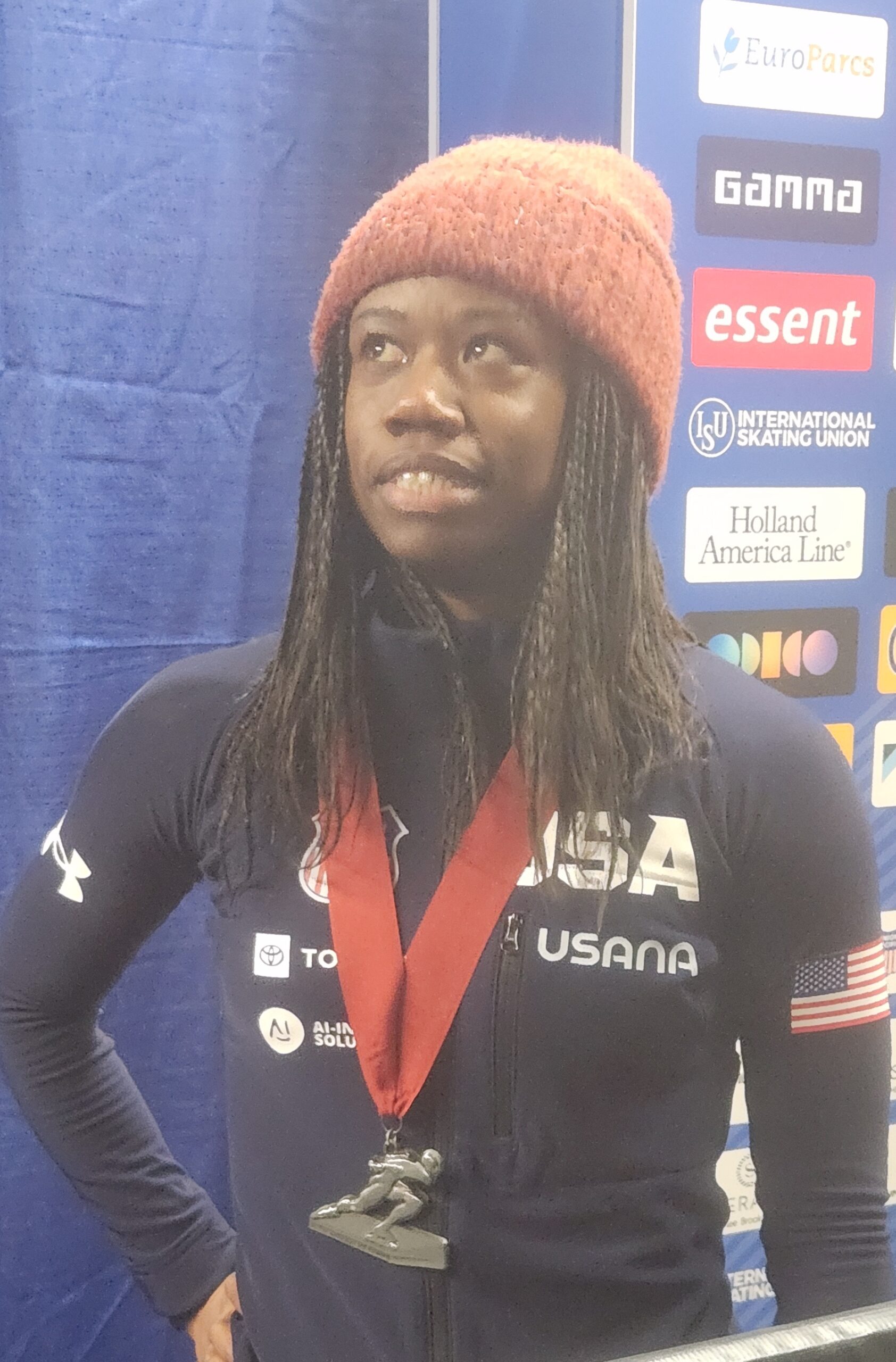
Jackson had high praise for Stolz’s dominance on the ice.
“It’s amazing being Jordan’s teammate and to see what he’s doing for the sport. He’s just phenomenal,” she said. “It’s really impressive to see him keep pulling out these wins time and time again. He’s pretty much smashing the competition. It’s really encouraging for the team, because when one of us wins, we all win. It’s really awesome to be living in the same generation as Jordan.”
Veteran Canadian skater Laurent Dubreuil, who won bronze in both 500-meter races, said competing against Stolz is often an effort in futility.
“The hope is to catch (Stolz) on a bad race and then you have your best race,” the 32-year-old Dubreuil said. “My goal is to do the best I can. Hopefully, I get to beat him at some point but if it never happens again and I have good races, I’ll be fine with that. I’ve still had a very good career but I’m lucky I was born 10 years before him.”
Kurumi Inagawa of Japan, who won a bronze medal in the 500-meters on Saturday, revealed that she has been training with Stolz. When asked what she has learned while working out alongside the burgeoning superstar, Inagawa said with a smile: “A lot.”
Much of their work together has focused on training, technique and the mental aspects of speedskating, she said.
“Keep it simple. I was thinking too much,” she said of the advice she’s received from Stolz.
Although Stolz garnered much of the attention, several other skaters turned in notable performances. In Friday night’s women’s 3,000-meter race, Italian Francesca Lollobrigida, who will turn 34 this week, kicked off the World Cup weekend by setting a Pettit Center track record in 3:54.73 to take the gold medal and set the tone for what would be a record-shattering weekend.
Miho Takagi then claimed the women’s 1,000-meter victory in 1:13.56, with previous track record holder Brittany Bowe of the United States finishing second. Norwegian Sander Eitrem set both a track record and a personal best of 6:04.74 to clinch the men’s 5,000-meter gold.
On Saturday, Joy Beune won the women’s 1,500 and Femke Kok took gold in the 500. Both are from The Netherlands. Jackson took home the silver medal in Saturday’s 500-meters.
On Sunday, the U.S. men’s squad – consisting of Ethan Cepuran, Emery Lehman and Casey Dawson – won gold in the team pursuit, while the women’s team of Bowe, Greta Myers and Mia Manganello captured bronze with a national record time.
Manganello also won bronze in the mass start. Kok and Jackson again captured gold and silver, respectively, in the second 500-meter race.
Winning medals on the Pettit Center ice had special meaning for Jackson, a Florida native who had two cousins and some friends in the stands cheering her on.
“It definitely means a lot, especially being here with the community around the Pettit Center,” she said. “Milwaukee has an amazing history with speedskating and to put on a good show in front of the next generation of speedskaters and fans is really special.”
The Pettit Center made a compelling case to make Milwaukee a future and perhaps regular World Cup stop with many of the skaters joining Jackson in their praise for the venue, the city and the fans’ enthusiasm.
“They are really cheering up for the skaters, so I really enjoyed the last three days,” Shinhama said through a translator.
When asked about what she enjoyed about her experience in Milwaukee, Inagawa lifted up a foam cheesehead, given out to all the medalists.
“I like everything,” she said with a smile.
A large contingent of exuberant bright orange-clad Dutch fans attracted attention, but it was the flag-waving U.S. fans, decked out in red, white and blue, that cheered the loudest, especially any time Stolz raced or took a well-deserved victory lap. They even cheered for him during warm-ups.
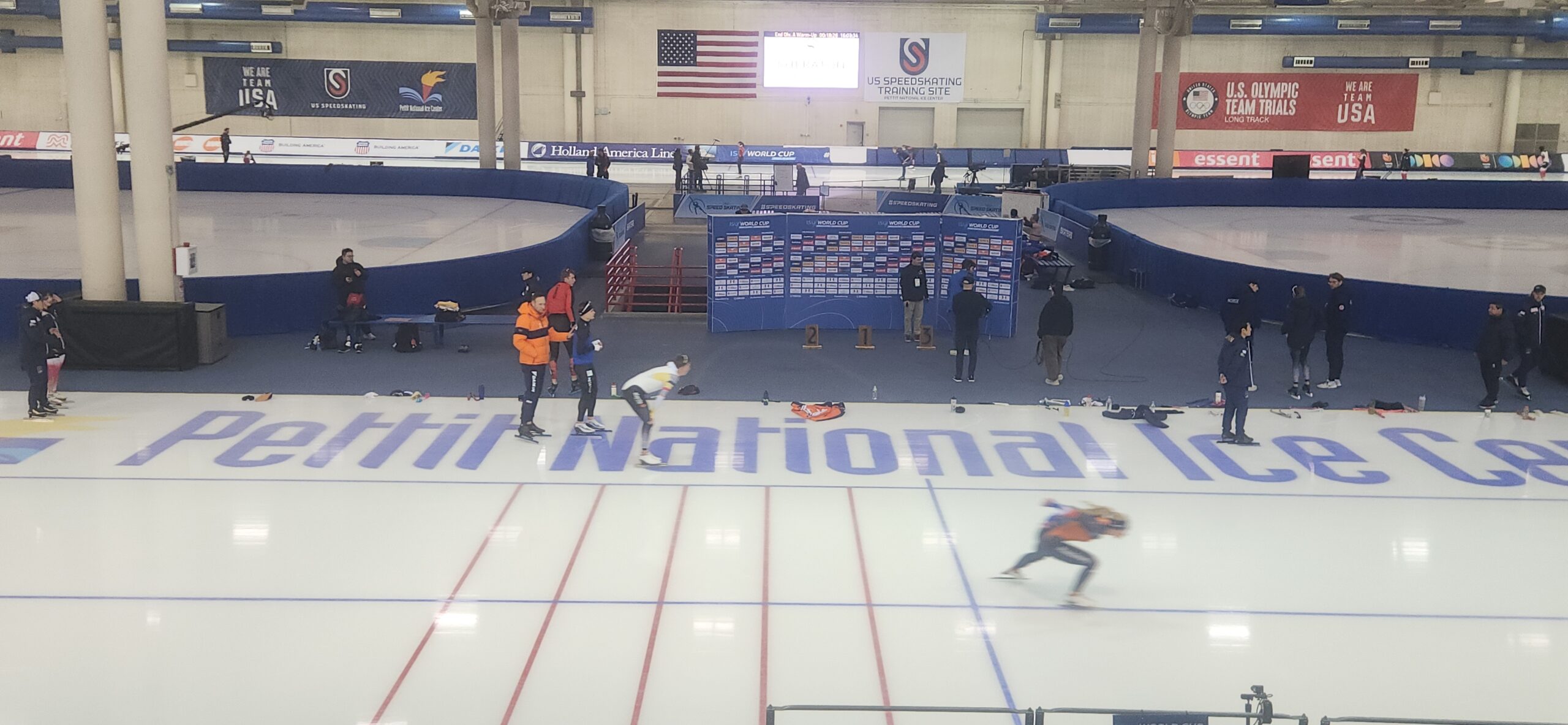
In an interview as the final skaters of the World Cup competition took to the ice, Blair-Cruikshank said the Pettit Center earned an opportunity to host another World Cup event after the triumph of the past weekend.
“With the success we had with this competition and with Jordan being so young, we’re bound to get some more competitions here,” she said. “I think the ISU is happy, the public is happy, US Speedskating is happy and I’m sure the Pettit Center is happy.”
Hosting a World Cup event goes a long way toward restoring Milwaukee as a hotbed and center for speedskating, said Blair-Cruikshank, a legend in the sport as a five-time Olympic gold medalist who lived and trained in the Milwaukee area for many years.
“One of the things that was so important about having this competition here is that Jordan is from here and everybody who’s affiliated with US Speedskating is going to come through these doors,” she said. “They are going to be racing here at some point during the season even if maybe they’re not training here all the time. So, it’s so important to showcase our sport and Jordan and continue to generate excitement about speedskating.”
The Milwaukee area has a rich and deep history tied to speedskating. The former West Allis Speed Skating Club earned a reputation for developing Olympic speedskaters. The Pettit Center opened its doors in 1992, further cementing the area as the nexus of U.S. speedskating. That changed with the construction of the speedskating oval in Salt Lake City, which opened in time for the 2002 Winter Olympics.
“That’s why it was important to bring this competition here,” Blair-Cruikshank said. “And now that it happened, we’ll be able to do it again. We had success with it, and that’s what is most important.”
Dubreuil, the Canadian speedskater, said he’s all in favor of Milwaukee getting another World Cup event. Most notable, he said, was how engaged and supportive the crowds were over the course of the three days.
“You could feel the vibe with the crowd,” he said. “I sure hope we get to come again (for World Cup) in my career. I enjoyed my week and it was a fun time being here.”