
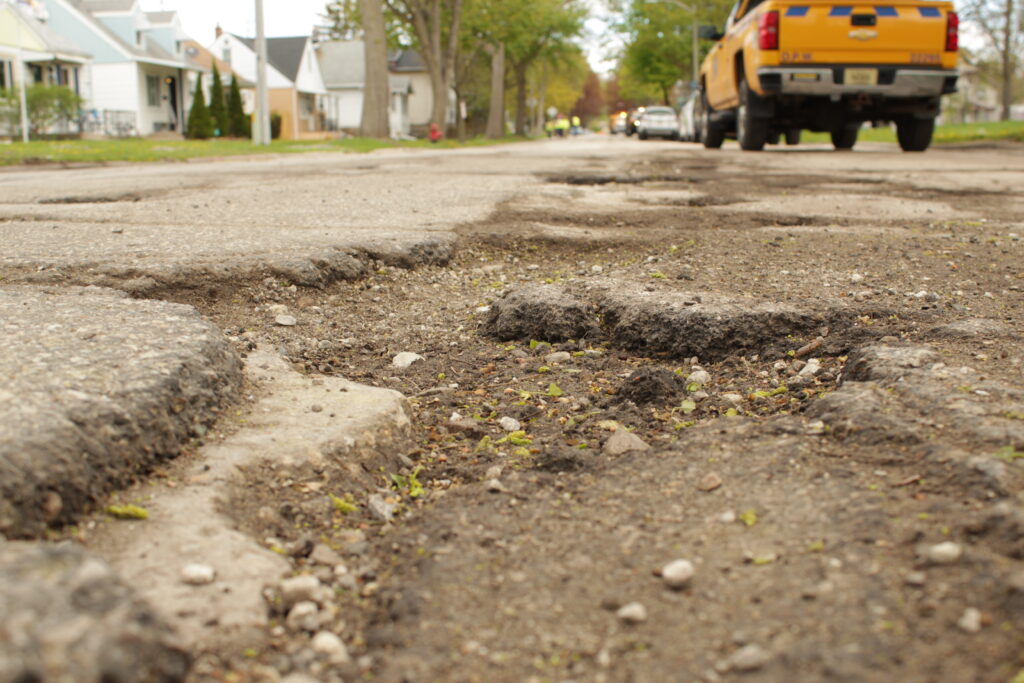
The city of Milwaukee has a new tool in the war against potholes – one more about knowing the enemy than defeating it.
Funded by the Daniel Hoan Foundation, the “Route Reports” system will use high-definition dash cameras mounted to two Department of Public Works supervisor cars that are among the highest-mileage vehicles in the city fleet after police squads. That video feed is processed by an artificial intelligence program in real-time to detect and assess potholes.
Whenever the AI thinks it has registered a pothole, a DPW staff member will review the video to ensure the AI labeled the image correctly, and then a pothole-filling crew can be dispatched to the scene.
The system would augment the current database of potholes, which is built from complaints filed with the city. As of May 19, DPW was still working on getting Route Reports up and running.

Celebrate this year’s winners of the Betty Awards!
DPW has an internal system to identify how dangerous a pothole is, based on size, depth and location – such as if it is in the middle of the roadway and if it is on a high-traffic thoroughfare or low-traffic alley.
Even without the AI system, Milwaukeeans had made more than 14,700 pothole reports from Jan. 1 through mid-May, up nearly half from all of last year, after a rough winter and spring. DPW says it has filled nearly 7,000 potholes in that period – with the help of a new asphalt hot box paid for by the Milwaukee Brewers – but City Engineer Kevin Muhs pleaded for patience from the public. “The requests do not fill themselves,” he says. “There’s actual humans who do this work.”
Before the pilot program was approved in March, the city attorney’s office raised concerns. If the city learned about a significant pothole and didn’t address it fast enough, could there be liability if someone gets hurt or a personal vehicle is damaged? City officials shrugged off the concerns, deciding that the benefits of knowing about potholes – and thus being able to address them ASAP – outweigh the financial and legal risks.
“We can play the cat-and-mouse game, but I think we prefer not to run from our own shadow here at the city,” Jim Bohl of the Department of Administration told the Public Works Committee in February. Mayor Cavalier Johnson signed the resolution approving Route Reports on March 6.