

State transportation officials are privately signaling that hopes for replacing a Downtown Milwaukee freeway spur with a boulevard are likely dead, according to a key alderman.
A Wisconsin Department of Transportation spokesman said Tuesday that the agency’s I-794 study remains in its early stages and officials are still preparing options for public comment.
Nonetheless, the signals that Downtown Ald. Bob Bauman says he received, together with state legislation that seeks to block streetcar expansion, have thrown Milwaukee’s ambitious long-term plan for Downtown development into uncertainty. Bauman says he will delay action on the draft plan as long as it recommends removing the east-west segment of I-794 and adding lines to The Hop.
Bauman isn’t objecting to those recommendations because he opposes them. On the contrary, he fully supports both ideas. But he argues that it’s misleading to include those concepts in the plan if the state won’t let them happen.
The alderman says he was briefed by WisDOT staff last week on the state agency’s study of renovating the oldest components of the east-west segment of I-794. Bauman says transportation officials presented “two removal options” that have not yet been publicly released, but they told him that “most stakeholders” didn’t support either option.
“It was suggested politely that I was crazy to think this was realistic,” Bauman wrote in an email last week to City Development Commissioner Lafayette Crump and others. “Why then is this option in the (Downtown) plan? It is disingenuous. Same for streetcar expansion … legislation will preclude expansion. What is the point of advocating for action that state law will preclude?

If someone has inspired you through their service, leadership or dedication, the Unity Awards are your opportunity to recognize them!
“I will seek to hold the further consideration of this plan until it offers realistic goals and does not (patronize) the hundreds of citizens who voiced support for (I-794) removal and (streetcar) expansion,” Bauman wrote, adding parenthetically, “Apparently there are a lot of crazy, unrealistic people out there.”
Dan Sellers, southeast regional spokesman for WisDOT, said: “The study is in its early stages, currently evaluating a range of conceptual alternatives,” including “a potential freeway removal alternative.” Details of those alternatives “are still being finalized before being presented to the public” at meetings expected to start in late July or early August, Sellers adds.
Sellers did not respond to Bauman’s specific claims about his briefing.
Bauman tells Milwaukee Magazine that he doesn’t know who else received similar private briefings, but he believes WisDOT is in contact primarily with nearby business improvement districts “whose boards are mostly business/corporate/property-owning folks who mostly live outside the city and are part of car-centric generations. Not many Gen Z folks without driver’s licenses on BID boards.”
Sellers says his department is “working closely with … various business leaders, organizations, local officials, and community representatives, among others … to provide them an opportunity to share feedback on initial design concepts.”

Highway Under Scrutiny
Connecting I-43 and I-94 to the Hoan Bridge, the I-794 spur occupies valuable land and forms a barrier between Downtown and the Third Ward. It’s also a truck route to Port Milwaukee.
The Downtown plan calls for eventually removing this spur. But the plan hedges its bets by saying that if that’s not feasible in the current state effort, officials should at least modify ramps and continue to improve spaces under I-794 to increase pedestrian safety.
Full removal could free space for new high-rises that would transform the skyline, says Robert Schneider, UW-Milwaukee professor of urban planning.
City officials, UWM scholars and environmentalists have been advocating for razing I-794 since the 1990s. But those views didn’t stop WisDOT from partly rebuilding the spur a decade ago, during then-Gov. Scott Walker’s administration, although that project reconfigured Lake Interchange ramps to free some space for development and a plaza that hasn’t taken shape yet.
Meanwhile, robust redevelopment in the former Park East Freeway corridor on the northwest edge of Downtown has helped win support from the Metropolitan Milwaukee Association of Commerce for at least studying alternatives to I-794’s current form.
WisDOT had previously indicated it would study a surface option as it considers finishing reconstruction. Critics remain wary of whether that option would be a highway that creates a new barrier, rather than a more pedestrian-friendly boulevard, say Schneider and Gregg May, former transportation policy director of 1,000 Friends of Wisconsin.
Conversely, south suburban officials want to keep the freeway link.
But WisDOT figures show less than one-third of rush-hour traffic travels the full distance between the Lake and Marquette interchanges, indicating most drivers would benefit from a surface road with more access to Downtown streets, Schneider says.

Hobbling The Hop
Meanwhile, the city’s fledgling streetcar network, like a previously proposed light rail system, has been a lightning rod for years, under relentless attack from conservative forces led by Walker, Assembly Speaker Robin Vos and talk radio.
The Hop’s initial M Line runs from Downtown’s northeastern corner to the Intermodal Station. The L line to the lakefront is mostly finished but has been delayed by the long-running construction of its terminus at The Couture.
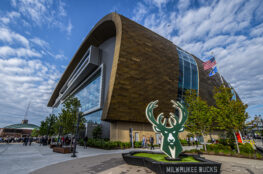
Under the Downtown plan, the city would add lines north to the planned Vel Phillips Plaza, Fiserv Forum and Bronzeville; south to Walker’s Point; and northeast to Brady Street.
All of these extensions were proposed years ago; those to Westown and the Lower East Side were part of the original streetcar planning; and the segment to Vel Phillips Plaza is shovel-ready. But the federal government has rejected four city grant applications for variations of the northern line, and disputes over route details and gentrification sidelined Common Council action on the Bronzeville and Walker’s Point lines.
Most significantly, Republican legislators hope to block further expansion with a new ban on using the tax-incremental financing that has provided all of The Hop’s local capital dollars.
That prohibition was included in a bill signed Tuesday by Gov. Tony Evers, as part of a larger financial aid deal for the city, county and other local governments across Wisconsin. In exchange for boosting shared revenue, allowing the Common Council to impose a 2% city sales tax and letting the County Board raise the county sales tax from 0.5% to 0.9%, Republicans added a broad range of restrictions on local officials, from disempowering the Fire and Police Commission to mandating police officers in schools to scaling back diversity initiatives.
In addition to blocking TIF dollars for The Hop, the bill also prohibits spending property tax funds on the streetcar. However, all of the streetcar’s operating expenses to date have been covered by grants, sponsorships and parking revenue.
Despite the legislation, Crump and Schneider stopped short of saying that streetcar expansion would be impossible without TIF cash. Instead, both say it would be more difficult.
And in a written statement shortly after Evers signed the bill, Common Council President Jose Perez made it clear that the city will continue to fight the restrictions. At the same meetings where aldermen will decide whether to impose the sales tax, Perez said, they will discuss a campaign of lobbying and lawsuits to overturn those limitations.
As part of that campaign, Perez said, the council could order public works officials to apply for a federal transit grant “to extend the streetcar consistent with the Downtown land use plan,” starting with the segment to Fiserv Forum.
Mapping the Future
Like the city’s other area plans, the Downtown plan will guide future city land use and transportation decisions. Although Bauman had previously hailed the draft plan as “outstanding,” the state transportation developments apparently soured his outlook.
“All this work and money for a plan that is dead on arrival,” Bauman wrote to Crump. “Let’s condense the plan: Advocate for some wider sidewalks, more trees and landscaping, a few bike lanes and plazas, and new development and call it a day. We could have done that in-house for a few thousand dollars.”
In response to Bauman’s concerns, Crump spokesman Jonathan Fera said only: “The Department of City Development will continue working toward formal adoption of the Downtown Plan.”
But Ald. Michael Murphy, chair of the Common Council’s Zoning, Neighborhoods and Development Committee, said: “It appears the plan is in flux right now due to concerns raised by the Downtown alderman.” Crump’s department had previously laid out a timeline that called for consideration by Murphy’s committee and the full council this summer.
Bauman expressed similar concerns about streetcar expansion in relation to the city’s climate action plan at last week’s meeting of the same committee. But he is a co-sponsor of the legislation to advance the climate plan, he joined all other committee members in supporting it, and he did not seek to delay it when it was approved, 13-0, by the full council on Tuesday .
Unlike the Downtown plan, the climate plan doesn’t recommend specific projects, Bauman says. Instead, he explains, “The climate plan is aspirational, with broad goals which I support” and it will help the city apply for federal grants.