

When this photo was taken in the early 1940s, Downtown Milwaukee had no freeways, no skyscrapers and just a handful of parking lots. The lakefront was largely undeveloped, and there were still old houses tucked among the warehouses and factories a block or two south of Wisconsin Avenue.

If someone has inspired you through their service, leadership or dedication, the Unity Awards are your opportunity to recognize them!
Known today as East Town, the east side of the Milwaukee River was both denser and dingier than its modern incarnation. This was, remember, the Age of Coal, and buildings steeped in acrid smoke for decades had a distinctly gray cast, particularly those faced with porous Cream City brick. The automobile was just beginning its relentless assault on America’s cities. With development slowed to a standstill by the Depression and then World War II, Milwaukee was a comfortably low-rise city whose residents took the streetcar to work.
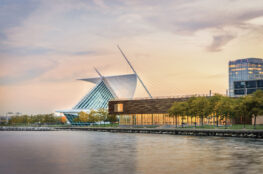
What’s remarkable about this view is how many buildings are still standing, including the Cudahy Tower (a), Northwestern Mutual (b), the Wisconsin Gas Co. (c), the old Federal Building (d), St. John’s Cathedral (e), the Wisconsin Telephone Company (f) and dozens of others. For Milwaukeeans of the 1940s, several of these landmarks felt as new as the Art Museum’s Calatrava addition does to today’s city-dwellers.
Whether by design, benign neglect or both, Milwaukee has one of the most architecturally intact downtowns in the Midwest. “Intact,” however, is a relative term. Hundreds of acres have been cleared for parking lots, parking structures and, most visibly, Interstate 794. Today, as Milwaukee considers taking I-794 out of the picture to make way for redevelopment, perhaps the city’s future will look something like its past.
TAKE A CLOSER LOOK:
- After decades of debate and delay, East Kilbourn Avenue was widened to a boulevard in 1941.
- Most of today’s Veterans Park was still under water in the ’40s.
- The North Western depot and the Pabst Building are two major landmarks that have been erased from this scene.
- Anchored by the Grain Exchange, the intersection of Broadway and Michigan is one of the best-preserved architectural ensembles in the state.
- This block-wide swath was cleared in the 1960s for construction of Interstate 794.
IN COLLABORATION WITH MILWAUKEE COUNTY HISTORICAL SOCIETY