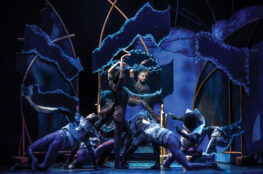


Choreographer Dawn Springer grew up in Lake Geneva and, after what she labels a “pretty circuitous path,” ended up back in Wisconsin. Her contemporary ballet Sylph premiered last October at Milwaukee’s Jan Serr Studio, and now it will now play in Springer’s hometown on Aug. 27 and 28. Notably, Sylph will be the final performance at Geneva Lake’s beloved Ferro Pavilion before it’s torn down.
Sylph examines the weight and internal experience of gendered expectations in ballet. With music by composer and percussionist Jon Mueller, Sylph explores extreme ranges of physical movement, asking the audience to consider how we both define and consume femininity as viewers.
Milwaukee Magazine spoke with Dawn Springer ahead of her Geneva Lake engagement to discuss the journey of Sylph, the significance of Ferro Pavilion, the connection she hopes audiences find in live performance, and more.

Celebrate this year’s winners of the Betty Awards!
Can you give us an overview of the journey that led you to this moment with Sylph?
The piece started two summers ago, in 2023. We worked on it over the course of the next year. With independent projects, it starts and stops a lot in the construction process. Part of the construction of the piece was a residency we did last summer in Lake Geneva, exactly a year ago. We tested some material, and the time we spent there was really an incubator time. I’m from [Lake Geneva], and being there in the summertime feels both restful and inspiring to me.
Sylph premiered last October in Milwaukee … The week after, I was recovering from doing the show and went on a walk around Lake Geneva with my husband. We were near the Ferro Pavilion, and I always thought the seats were fixed in that theater. I said, “Oh man, I wish those seats weren’t fixed, because it would be the perfect outdoor venue for Sylph.” My husband said I should just walk up the hill and look at it, and ta-da! Turns out, the seats can be moved anywhere – perfect, because Sylph is performed in the round.
That started us trying to see if we could even use the pavilion because it was in the process of being purchased. It took a while, but we found out in April that it was possible, and we’ve been working at it ever since.
So knowing Sylph will be the final performance before the Ferro Pavilion is torn down, what’s the significance of that for you and the Lake Geneva community?
I don’t know when they’re planning to tear it down, but I hear we’re the last performance. I know the history of the pavilion is very important to the Lake Geneva community, and it’s beautiful. It’s right on the lake. The Music by the Lake series that was there was instrumental and foundational to bringing artists to Lake Geneva. I have a vintage Music by the Lake poster in my house that I bought at a garage sale.
I feel really fortunate that we asked the question when we did. If I had said, “Oh, maybe I’ll wait six months and pick it back up,” we wouldn’t have been able to do this performance in this space at this moment.
How has Sylph evolved since its debut last year?
We have four new cast members, and the piece is so much about the individuals in the room and their experiences as ballet dancers. A lot of my process has been to encourage the dancers and give them space to find movement in their bodies – to consider ways of thinking about what the movement means to them. I told them the choreography is a map, but they’re driving the car. So they’re deciding how they get to certain places. They have to bring their own voice into the room, or the piece doesn’t work.
That room for variation is so fascinating. Can you tell us more about that process and what choreography is fixed versus left up to the dancer’s interpretation?
In the rehearsal process, a lot of what I’m doing is making space for the dancers to talk to each other and to me. I try to keep rehearsals really light and open so that it doesn’t feel too pressured – so that the artists feel that they can make those decisions. My job has been to create an environment where they feel trusted and respected and safe – that their opinions and experiences really matter.
A lot of Sylph is set choreography – but how the dancers do it, their timing, their nuance, their relationship to each other might change a little bit. There are other moments in which I have a general idea of what’s going to happen, but there’s certainly some room for them to make decisions.

And how did you get inspired to create this piece – and what’s the meaning behind that inspiration?
[Composer] John Mueller sent me his all-percussion album in 2019 and said he thought I might be interested in doing something with it. I was already entrenched in other projects, and then the pandemic happened, so I didn’t pick it back up until about 2023. But I kept coming back to that album because it’s really intense and rich – but it also has so much precision to it.
[The music] always felt like ballet – the virtuosity and exactitude of it. It’s like the internal experience of being the dancer. While we see these very romantic and soft things happening on stage, the meaning of what it takes to get there is very intense. Dance is live, so it’s so ephemeral, and that’s what makes it so special. But also the pressure internally for the dancer is like, “Okay, I’ve got this one shot.” So the music really captures that same feeling of intensity and pressure, but also the excitement.
Then, two dancers that I’ve worked with in the past were transitioning out of full-time company life with the Milwaukee Ballet, so they were able to freelance with me and be in the studio a couple days a week. There, we talked a lot about what it means to be a dancer, going through the different stages of our careers and sharing those experiences. So with that, alongside the music, we realized, “Oh, we’re making a ballet about ballet.”
What do you hope people experience during or take away from Sylph?
You know, I’m so sick of my screen. I’m so compelled to my phone – and I love a situation where I’m forced off of it. I’ve been noticing this sense of disconnection from each other. Even the difference between my kids watching a show on an iPad versus looking at the same thing together on TV – there’s a certain knowledge that they’re sharing something together.
That’s why I still do live performance, because it’s irreplaceable. We’ve all decided to go look at the same thing, listen to the same music, or be in the same space for a given amount of time … I feel like it’s really essential. Yes, it can be hard to get up and go do the thing. But [for Sylph], I can say that this particular venue… when the sun is setting at 7:30, it’s curtain time, and the pavilion is glowing – it’s worth it. It’s really special.
Once your Lake Geneva run is over, where can we look for your work next?
There’s a gallery that just opened [in Milwaukee] called One-Off Exhibitions. Tina Schinabeck is the curator, and she asked me to take over the gallery for the month of January 2026. So we’re installing a piece I made called Something Familiar, inspired by my family history in the Ozarks. It will be the exact opposite of an open-air pavilion. It’s a small room, and what we’re planning to do is set it up like you’re in someone’s living room. It will be a very intimate engagement.