

HEAR THE AUTHOR TALK ABOUT THIS STORY ON WUWM’S LAKE EFFECT
When Jacki Pederson moved from her native Seattle to Milwaukee – the hometown of her wife, developer Melony Pederson – she couldn’t believe how many duplexes there were here.
Instead of the single-family homes, two-flats and triplexes that make up much of Milwaukee’s neighborhoods, medium-density housing along Jacki’s West Coast looks more like little houses in the backyards of homes or flats above garages in which family members or a renter can reside.
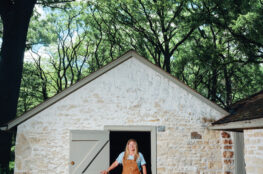
These households are known by many names depending on the region – carriage houses, secondary suites, granny flats, Polish flats, casitas – but planners call them accessory dwelling units. ADUs essentially achieve the same effect as duplexes, albeit in a form relatively uncommon here.

Know somebody making an impact in Milwaukee?
It’s why Southeastern Wisconsin planners, urbanists and developers like Pederson are now asking: Why can’t we have both? Traditional duplexes will remain, of course, but ADUs are widely seen as an attractive way to tackle the nationwide housing crisis in a way that addresses the much-sought-after “missing middle” of housing.
The National League of Cities defines the “missing middle” as diverse – and often scarce – moderately affordable housing options, including two- to four-unit buildings, clustered single-family homes and ADUs. The missing middle is notable for what it’s not: standalone homes and larger apartment buildings. Middle housing also is usually not eligible for tax credits or other subsidies.
“We see the ADUs as adding some density to our neighborhoods without actually changing the overall fabric of our neighborhoods,” says Mark Hammond, development director in Wauwatosa, which is offering $25,000 to homeowners who add an occupied ADU.
Until action by the Common Council in July, building new external ADUs (those detached from the primary residence) had been forbidden in Milwaukee since 2002. As part of a much wider housing effort, the city this year went through a painstaking process to reverse that and find the right rules for granny flats.
“I wouldn’t say ADUs are the solution to Milwaukee’s overall housing needs, but they are a piece of the puzzle,” says Sam Leichtling, Milwaukee’s deputy commissioner of city development.
PICTURE A SLIGHTLY OVERSIZED Bay View lot with two houses on it. Back along the alley, there are two detached garages with a separate flat above each. That’s four residences on a quarter-acre, the very definition of middle-density housing for the working class the city wants so badly. But the city also has been making it almost impossible to build.
It’s the vision the aforementioned Melony Pederson, a developer with an urbanist streak, is trying to bring to life on an empty lot on Logan Avenue through her firm, Hadari Development. As much as it is an investment, Pederson’s plan is a proof of concept that secondary suites have a place in Milwaukee. That proof hasn’t been easy.
Pederson and Hadari had to get special approval from the Zoning Board for their ADU plan before the current legalization effort began.
But the fight with the city continues: Hadari wants to have only two water lines going out to the street instead of four. City code – which Pederson describes as “very complex and unnecessary” – demands there be one water hookup for each separate building. She says the requirement is archaic. Instead, Pederson wants to have one hookup for each of the main houses. Auxiliary lines from the primary houses will then feed the ADUs.
The requirements for utility connections were among the many details bogging down passage of updated housing codes this summer. Mayor Cavalier Johnson’s Housing Element, comprehensive plan approved in July includes overturning the citywide prohibition on new detached ADUs (in some instances, it had remained legal to add an internal ADU by converting a single-family home into a duplex). The proposal enacted this summer requires the primary residence on a property to be owner-occupied before breaking ground on a new ADU.
Tech-forward prefab construction companies are aiming to make purchasing an ADU nearly as easy as ordering groceries online. Visit boxabl.com and you can begin the process of purchasing a 361-square-foot “casita” for as little as $60,000 in just a couple of minutes.
The catch: Boxabl and its peers mostly serve higher-density coastal communities where new ADU construction is normalized. Plus, once installation fees are included, the total cost of even the cheapest Boxabl casita still ends up north of six figures.
“Once we have some more robust options … for high-quality prefab ADUs, I could see that certainly driving down the cost,” says Mark Hammond, development director for the city of Wauwatosa.
In Wauwatosa, there are similar headaches. Desperate to create more housing (and to spend the last of its federal COVID-19 grants), the city in January announced that it was offering a $25,000 loan to the first four homeowners to add a new ADU to their property – to be forgiven when an occupant moves in.
But city ordinance requires detached auxiliary units to be 10 feet from the primary residence and 20 feet from the property line. This precludes ADUs on many of Tosa’s tight residential lots.
Tosa staff have met with more than 70 interested homeowners but, as of late June, hadn’t yet received a single application to build an ADU. Hammond thinks sticker shock is a factor: It’s practically impossible to complete such a project for less than $100,000, and $25,000 really only covers the costs of utility hookups.
Therese Hanson could be the first to take advantage of Tosa’s sweetener. The home she and her husband, Dan, bought in 2017 has an apartment that’s part of the detached garage. It hasn’t been lived in since the ’70s; the Hansons use the ramshackle space for storage. She hopes to get it back up to code and invite her father-in-law to move in, qualifying it for the city’s incentive.
The project would cost at least $100,000 – an investment Hanson, an architect by trade, wouldn’t expect to recoup anyway even if it were to be rented out in the future.
“I don’t see this as a moneymaker for us,” says Hanson. “This is not a payoff for Dan and Therese. This is giving to the future, for building in the kind of density we need to keep Tosa viable.”
WHILE METRO MILWAUKEE’S population has been more or less flat in recent years, growing cities where the housing crisis has been more severe have liberalized their housing codes, including smoothing the process for ADUs. In Los Angeles, ADUs have accounted for as much as 20% of planned new housing in recent years.
Here, there just isn’t that kind of demand or culture – yet, Pederson hopes. In addition to loosening restrictions on ADUs, she wants to see Milwaukee publish some kind of “playbook” that homeowners and contractors can use as a guide for building them.
If communities can make things easy, she reasons, development will be more likely to surge. “We have to spell out the process,” she says. “We need to have a website you can go to and click it and it gets delivered. That’s the world we live in.”
Amy Bliss, executive director of the Wisconsin Housing Alliance, sees prefabricated homes, including ADUs, as “the only way” to affordably create enough housing to fill the missing middle.
The median housing unit in Milwaukee cost $414,000 to build, the Marquette University’s Lubar Center reported earlier this year – prefab homes could bring that cost down significantly.
Pederson agrees that prefab is the future, noting that there are few local builders who have experience with ADUs. Jack Golatke, a co-founder of Wauwatosa’s Story Hill Renovations, says his firm fields far more calls from people seeking to convert duplexes back into single-family residences than the reverse. “Here,” he says, “I’m not seeing it.”
Hammond hopes for some ADU trailblazers to come forward and become a positive example to their Tosa neighbors. For many Milwaukeeans, the best practical example they have of an ADU is from decades ago, and fictional: the flat above the Cunninghams’ garage where Fonzie lived in season 3 of “Happy Days.”
Perhaps a few granny flats in Bay View, Sherman Park or Clarke Square could make the concept less foreign. “We don’t think hundreds of ADUs will pop up overnight,” says Milwaukee’s Leichtling. “Here, you will see ADUs be implemented much more gradually.”