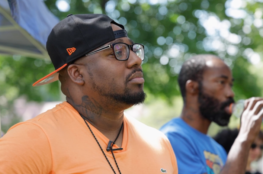


Cycle, directed by Racine natives Laura Dyan Kezman and William Howell, landed the Best Feature Documentary Award at this month’s Brooklyn Film Festival, its first major out-of-state screening.
The honor follows Cycle’s world premiere in May at the Milwaukee Film Festival, where it received the prestigious Cream City Cinema Jury Award, honored for its raw storytelling and relentless investigative reporting.
“It’s validation that these last six years have been building to something larger than ourselves,” Kezman said in an interview with Milwaukee Magazine. “It’s not about the awards, per se, but what it does is unlock more doors and provide more opportunities for us to get this film into spaces and connect with people who are in a lot of ways stakeholders and can bring this film to a larger audience.”

If someone has inspired you through their service, leadership or dedication, the Unity Awards are your opportunity to recognize them!
Kezman said the awards provide credibility and momentum for the film, which is centered on the killing of Ty’rese West, a Black 18-year-old from Racine who was fatally shot by a Mount Pleasant police officer. The officer attempted to stop West for riding his bicycle without a light in the early morning hours of June 15, 2019. West was shot three times after being pursued by the officer.
Investigators said West was armed with a gun, but the family argued that there was no evidence that a gun found at the scene was ever in West’s hands. There was no body camera footage from the pursuit. The Racine County District Attorney’s office declined to press charges against the officer, determining that he acted in self-defense.
“I really did put my life completely on pause. I sacrificed a lot to make this film,” Kezman said. “The awards are validation that we did what we came to do.”
Watch the official trailer here.
Kezman and Howell teamed up to tell the story of the shooting and the subsequent lawsuit filed by West’s family against the village. A settlement of the lawsuit was reached through mediation in 2023 that, according to reports, included a payout to West’s estate and a recommendation that the village create a dignified memorial to West.
Cycle was created in close collaboration with the West family, particularly Ty’Rese West’s mother, Monique West, who has fought for years to share her son’s story.
“This isn’t just a movie, it’s a call to action for my hometown and America,” Kezman said. “We want audiences to understand how our justice system operates, to see the stark contrast between official investigations and our own independent findings and to feel the weight of what’s at stake. Our goal is to save lives by making this film. Period.”
Featuring interviews with national legal scholars and rare access to the officer’s sworn deposition, Cycle reveals the raw, often unseen struggle for accountability when there’s no video, no headlines and no public pressure. “This is a problem baked into American society,” Howell said.
Kezman hopes Cycle motivates audiences to respond.
“The way that people are moved to respond to the film is not one dimensional. Everyone brings their own perspective and history,” she said. “When you watch Cycle, the thing that will be triggered naturally for people is that they will be inclined to do something. Whether that is organizing in their local community or motivating somebody to run against an incumbent official in the next election cycle.”
Kezman and Howell insist that Cycle is a film ultimately rooted in love, not rage, one that invites the energy it stirs to be transformed into something generative.
“The film started with rage and that carried on throughout many years of the process. It’s an enraging truth to confront,” Kezman said. “This process was dark and isolated and you wondered if the world was even going to care anymore because the silence sets in and no one is talking about it. There’s a sense of defeat. But in the end, the way to break cycles is to break cycles within ourselves. Rage is not an ingredient for sustaining change, but love is. We reframed the conversation to be about love and this broader understanding. We just need to understand each other better on a fundamental level. That is the thing that can foster better policy and better structures within our systems. It sounds very pollyannish, but you have to strip it all down and focus on the connection between people.”
What’s next for Cycle? Kezman, Howell, and the West family are actively building the Cycle Impact Campaign, forging partnerships with social justice leaders, legal experts, activists and policymakers with a goal of using the film as a tool for justice, healing and real policy change.
There will be local encore screenings of the film coming soon, including a private event in Milwaukee to raise funds for the film’s impact campaign.
“The other, which will be really big and important, is a premiere of the film in Racine, a public screening literally in the heart of where the story takes place,” Kezman said.
The filmmakers also plan to conduct several community screenings in partnership with local organizations, law firms and educational institutions, she added.
Screenings at other film festivals are also a possibility.
“We’re still waiting to hear back from a few festivals in the fall. Nothing confirmed yet but we’re optimistic,” Kezman said. “It’s worth noting that we submitted to two festivals and were accepted into both and won jury prizes in both.”
There’ll also be efforts to secure streaming options for the film.
“It’s an interesting time for our industry. The landscape has shifted so dramatically,” Kezman said. “We’re trying to connect with people who are looking for meaningful, rich content, like this film. I believe it deserves a home on a large platform. It’s just a matter of finding the right partner.”