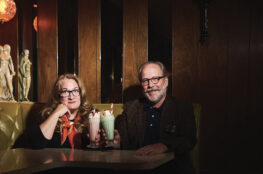

Publishing is often the realm of singular personalities who shape the titles they run, and for nearly 30 years, Milwaukee had its own magazine maven in Betty Quadracci. The voice and attitude of the uncompromising publisher of this magazine became ours – telling it as it is (or at least as she saw it) and having the best interests of this city at heart. Betty was determined from the start, overcoming severe polio as a child. She was a teacher, mother, philanthropist and entrepreneur, helping her husband, Harry, found Quad.
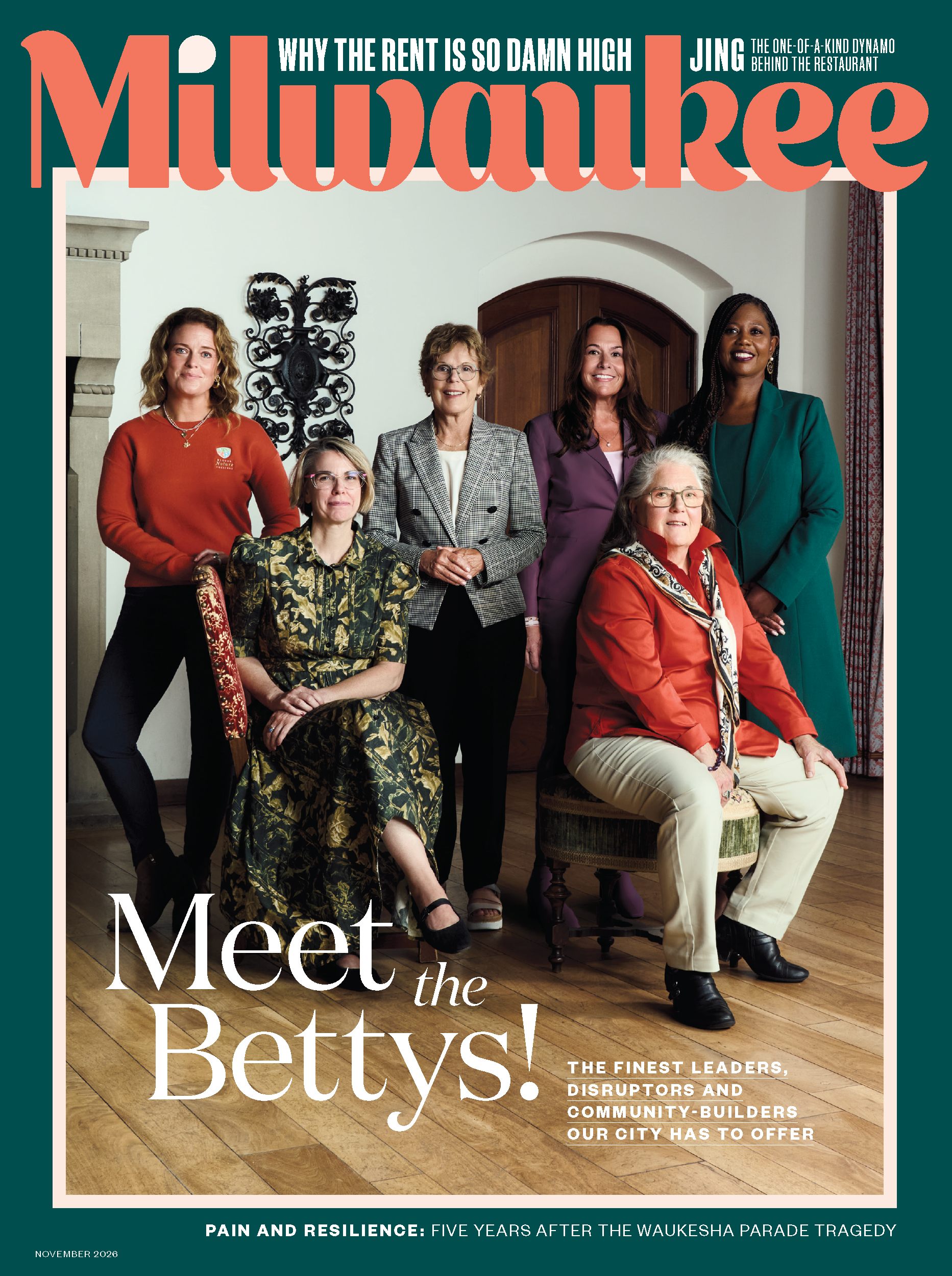
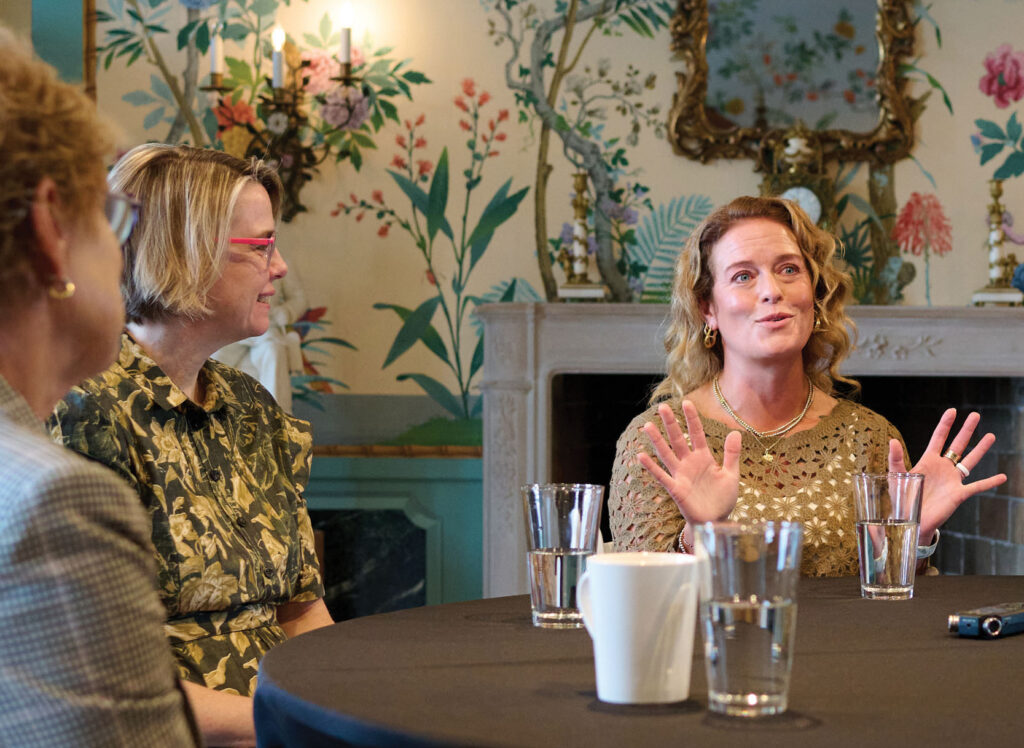
Betty’s spirit still resonates across Milwaukee, and this is the eighth year we’ve celebrated remarkable women who honor her legacy in their own way. We brought this year’s cohort together for a roundtable at Villa Terrace. Our editor-in-chief and Betty’s successor as publisher, Carole Nicksin, led a discussion about what drives them and what it’s like to be a female leader in Milwaukee today.

Celebrate this year’s winners of the Betty Awards!
The 2026 Bettys Are:
Carmen Pitre, Standout Sister, CEO of Sojourner Family Peace Center
Peggy Troy, Quadracci Family Award, Former President & CEO of Children’s Wisconsin
Chantell Jewell, Bridge Builder, Superintendent of Milwaukee County House of Corrections
Kristin Thiel, Groundbreaker, Executive Director at Mequon Nature Preserve
Susan Kerns, Arts Advocate, CEO of Milwaukee Film
Anne Zizzo, Tenacious B, Founder & CEO of Zizzo Group
Celebrate The Bettys
CAROLE NICKSIN: Welcome, everyone, and congratulations on being named a Betty! I like to start out with reminiscences about Betty Quadracci from those of you who knew her.
CARMEN PITRE: Years ago, the former founder of the Task Force on Family Violence [which eventually formed the Sojourner Family Peace Center] got into some trouble, and the organization almost folded. Marty and Barb Stein brought together a group to help, and Betty was one of them. She lent us her name, and she reminds me of what’s possible when we say yes – far beyond our lifetime.
PEGGY TROY: I met Betty socially. We had something in common, in that she was treated at Children’s, when she had polio as a child. What really inspired me about Betty is that she was a force. She inspired me to keep going, to reach for the stars, be brave and do great things for people.
NICKSIN: Turning the conversation to all of you, we selected each of you because you’ve gone above and beyond in your work. What motivated that? What did you see that you thought wasn’t being addressed?
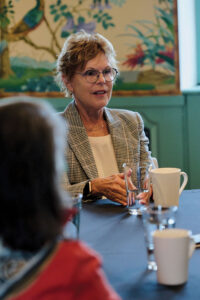
TROY: I grew up in a healthcare family, and so healthcare was second nature for me. I had an inspirational professor who taught me how to fall in love with taking care of kids – and inspired me to think of kids holistically. So much of healthcare is just about coming in and fixing the problem, but when you look at people, and kids in particular, you’ve got social issues, mental health issues, physical issues and dental issues. And, if you start to really look at the whole child and all those influences that determine the pathway for that individual, you start to knit services and programs together to holistically address how kids can grow up healthy. One of the reasons I came to Children’s is because so much of what they did there went beyond just the physical.
NICKSIN: Can you tell us just bit of what that teacher imparted to you?
TROY: She interacted with the kids and families in a way that was personal, professional and fun. And she was not afraid to call out people if they weren’t doing the right thing. That taught me, early on, to be the advocate that you need to be. Kids can’t always speak up for themselves, so it’s important that you become that advocate and make sure that you’re looking out for their best interest.
NICKSIN: That’s a great segue to you, Chantell. There is a parallel in your work, right?
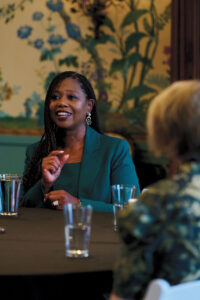
CHANTELL JEWELL: I’ve always had the mindset to look at everything comprehensively. We know family distress is a driver of criminal behavior. We know this, but as a system, we definitely don’t do enough to address it. I used to say, “When I get to a place where I have influence and I can make some of those changes and those additions, I will.” I’ve gotten to that place, and that’s how I see corrections differently. It extends far beyond the individual who is incarcerated. People want to say, “These people have done something bad. We shouldn’t provide them with resources. We shouldn’t invest in them.” But I don’t see reintegration and public safety as mutually exclusive. Reintegration is public safety because when we’re preparing people to return home successfully, we’re building stronger families and stronger communities. That’s the message that I’ve been trying to convey in this role – that we have to do something different.
PITRE: What motivates me is the people. People deserve better than what they’re getting in their lives. We should have doors open to safety and security long before we need public safety. People should find it around their kitchen table, and our families should be equipped to help us. We have to invest in change sooner.
KRISTIN THIEL: At the Mequon Nature Preserve, we feel the same way about a holistic approach. We are free and open for all so there are no financial barriers. We care so much about the trail systems being ADA compliant and inclusive, so everybody can be a part of it. In the beginning days of the nature preserve, I had a group of kids come from Fletcher Elementary. We had so much fun with these kids on the land, but they were freezing cold. We learned very quickly that we need to do way more than just give them an experience outdoors. We started a program to have coats and hats and mittens and boots, so that kids come now and they’re totally equipped, whether rain or shine. If the child does not have that item, then they go home with it – because otherwise they’ll continue to have that barrier to the great outdoors.
SUSAN KERNS: It’s interesting listening to all of you because I also feel like Milwaukee Film is very much a part of the community. To your question about what I saw that maybe my predecessors didn’t – it is that community piece. What I was seeing for so long was so many people thinking about movie theaters as spaces of isolation. But it’s always been the opposite for me. I go to movie theaters because I want to hear other people. I want to feel like I’m watching with people who are laughing or are scared or are just observing the world through this other lens, like I am. Our spaces are for the community. They’re spaces to talk and to gather and to feel good and to relax.
I’ve also been very brazen about how good the Oriental Theatre and the Downer Theatre are and what Milwaukee Film is doing. We have some of the greatest movie theaters in the world, and we’re bringing opportunities to Milwaukee that punch above our weight in every way possible.
ANNE ZIZZO: Like any entrepreneur or founder, you look back and realize there were these milestone moments. There was an iterative building process that happened alongside your professional growth as a leader, along with opportunities that came to you. Nobody taught me how you could create a portfolio of businesses. Nobody taught me how to buy companies to grow a business. That aspect is what really gives me the energy to keep going and not quit.
NICKSIN: How do you approach leadership? What resonates as the essential aspect of being a leader for each of you?
THIEL: I’m not a micromanager. I just trust. Do your job. We know our goals. Hit them, and we’ll be good. And I care deeply about my team. When you hire an individual, you also, in a sense, hire their family. You hire what their needs are.
ZIZZO: I try to make decisions around my moral compass. When it comes to leadership, I always treat people the way I would want to be treated, whether I’m leading in my personal life or in business. Maybe it comes from operating a marketing company, but I just always try to put myself in other people’s shoes. That’s a learned trait, to some degree. I’m definitely better at doing that now than I was when I was 30.
TROY: One of the attributes, I think, of a great leader is humility. Too many times, especially for women, you come into the job, and you think you have to be tough. I think being humble is more inspiring, and it doesn’t show signs of weakness.
And I agree with you, Kristin. Care about your people. To be the leader, you have to understand the mission and vision, and develop a culture where people are inspired to do great work, to do great things, and are allowed to make mistakes.
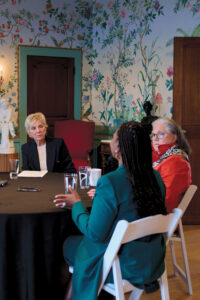
THIEL: Teach them the sentence, “I don’t know.”It’s a solid, important sentence in any conversation. And then teach them the follow-up: “I don’t know, but I will find the answer and get back to you.”
JEWELL: It’s scary, as a leader, saying “I don’t know.” Especially when you’re the first in that role. It’s a very vulnerable place to be, but I’ve learned to be OK with it. For me, being a leader is about being courageous and not afraid to challenge the status quo. To make those necessary corrections when you see them instead of trying to hide them, and understanding that everything doesn’t have to be perfect.
TROY: That was one of my big things: Fail fast. Don’t keep doing the same thing and hoping for a different result.
PITRE: I think leadership is a calling and an assignment, and it can be a daily endeavor. I feel like I stand in front of a mountain every day. You have to become comfortable with unfinished business. I can’t solve all the harm in people’s lives. The issue becomes: What can I do right now with what’s in front of me, and how can I do it with love and dignity and respect? And every day you get up and you do it again.
KERNS: My relationship to leadership is evolving right now because I’m fairly new to my role. When I started my position [in February 2025] , I wanted to make sure I wasn’t talking to everyone like a student because I’d been a teacher for so long. I didn’t want people to think I was infantilizing them. But, as I started to have conversations, I realized I need to lean more into the teacher part because it’s so much like mentoring. It’s interesting that my first instinct was kind of wrong, so now I’m trying to go back to the teacher instincts and pull those into what I’m doing.
NICKSIN: You’ve all teased out commonalities and ways your work overlaps and differs. If you could combine your influence and solve one problem in Milwaukee, what would it be?
JEWELL: The fragmentation. If we have one family with multiple needs, how do we treat that entire family and wrap our arms around them so they can get consistent, intentional care? We’re guilty of treating just the individual, but we have to treat the entire family and support systems. The resources are there, but we just have to be more coordinated.
KERNS: I see people getting very locked into neighborhoods. It’s something that I’m very surprised by. I’m from Iowa originally, and my family lived in all parts of the city growing up. It’s something I’ve never quite understood about Milwaukee. If we could chip away at that and figure out how more of us can live in more parts of the city, it would help everybody.
PITRE: I would try to solve isolation. There’s so much suffering that happens because we’re separated from each other and we’re living in these narratives that are usually fear-based. I would try to break them down. When I worked for the mayor, we understood that what holds this city together is neighborhood by neighborhood. A ton of good people and resources, but they’re not connected.
ZIZZO: And also, what can leadership in Milwaukee do to create a structure for convening and collaborating across these many organizations that have the shared mission to help people in need? Is there a way these organizations could think of themselves as collaborators? How could there be more of a synchronized effort around what the community’s needs are?
PITRE: We live in so many conditions that don’t instill dignity or love or respect to us as people, and then we expect people to transcend that. If you’re living in poverty or in generational chaos or conflict, it’s hard to break out, no matter how many resources are around. And yet, in spite of that, there’s something in people that’s resilient. Just think, if we made connections and improved and invested in the environment around ourselves, what might happen in the world?
Jen Kent is a lifestyle writer based in Milwaukee who has covered travel, home and design, and other topics for Milwaukee Magazine.