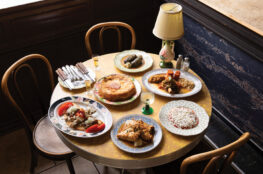

The mussel has left the safety of its brother mollusks in a deep, white bowl rich with stewed kale, cured sausage, white beans and a crisp toast to absorb all that luscious broth. It meets the tines of my fork. And then its maker. Ahhh.
Placed on a solid table made of reclaimed elm, this dish speaks of solid cuisine. Of substance. But with enough flourishes that it “makes this gray time feel a little less gray,” quoting Thomas Schultz, executive chef of the new restaurant Smyth (rhymes with myth). He’s referring to these not-exactly-fruitful economic times, and not expressly to the mussels dish but to Smyth’s home, the Iron Horse Hotel, a 100-room, Walker’s Point boutique hotel with the most exclusive dining and imbibing address in town.
Crafting the Iron Horse was no small expense, and it shows. The 100-year-old former bedding factory retains the feel of the warehouse it once was. The exposed beams and posts are 300-year-old heart-pine timbers. What isn’t wood is leather, and what isn’t leather is probably metal. (The motorcycle-friendly hotel even has an on-site bike wash.) The restaurant, whose name comes from an old spelling for blacksmith, has a hodgepodgey interior design, like a country shop in Cedarburg, complete with rooster art and vintage-looking scales and bottles. Servers pair casual uniforms (jeans, black shirts) with a “broken-in” style – confident, enthusiastic and knowledgeable.
Schultz, whose talents were on full display at the Third Ward’s short-lived Holiday House, seems in command here. And he has to be – he’s in charge of food for the lounge, private parties, in-room dining, the bar Branded and The Library (which serves breakfast). The Smyth menu is nostalgic (beef tartare, green bean casserole), comforting (buttermilk pan-fried chicken) and accessible (filet mignon with béarnaise sauce). It’s also local (Usinger’s meats, Wisconsin cheeses) and modern (foie gras du jour). The menu gets smart with its portion sizes. Some items are available for one or up to six diners – great if you want to sample various things on the menu without committing to a lot of food. Although experience has shown me that the single-portion size is big enough for two. As such, the prices seem fair.
The wonderful West Coast mussels ($10 for one serving – about a half-dozen) will make you want to lean your face in for a therapeutic, ale-infused steam bath. A bowl for one makes a meal, along with a meat or cheese board. The boards come with the typical accoutrements – coarse-grain mustard and cornichons with the Usinger’s sausages; fruit and honey to complement the mellow Carr Valley cheeses ($12-$24). Schultz’s caprese, offered long before we see any good home-grown produce, has all the right stuff – creamy, rich, thick-sliced buffalo mozzarella layered between fresh basil and slices of red tomato, whose juiciness and sweetness smack of late-summer days. Just a slightly thick balsamic reduction and a few pine nuts to garnish and voilà, a thing of simple splendor ($8).
The foie gras du jour, offered at market price, has the ability to both change a fear of liver and challenge the liver lover who yearns for something new. The unexpectedly sweet incarnation I devour features a piece of seared duck liver in a tower of brandy-soaked and grilled apples, a shortbread biscuit and blueberry sauce ($17). The rock shrimp and avocado salad – the soft avocado meeting the tautness of the shellfish in a creamy citrus vinaigrette ($12) – is almost pedestrian by comparison. But here is a perfect example of the way this menu wears different hats.
There are dazzling moments with the entrées. For a variation on osso buco (typically, braised veal shank), Schultz uses the much leaner venison shank. The slow cooking keeps the meat tender, while the delicate Madeira-gremolata sauce enhances the mild flavor of the meat, served, as tradition dictates, with saffron risotto ($24). Smyth’s sea scallops are lighter than the osso buco, but just as good. They benefit from the deft hand of the chef during pan-searing and the subtle reduction of grapefruit and Domaine de Canton ginger liqueur in the sauce ($26).
Another seafood with staying power, the pan-seared red snapper with steamed clams is again all about the fine cooking of a quality piece of fish ($26). There isn’t much more to the flavoring than the juices of the shellfish and roasted red peppers. And I like the Wisconsin unpretentiousness of the walleye. The cornmeal-crusted Lake Superior fish is not deep-fried. It’s pan-roasted, and the crumb topping is a light shell ($20). So what I’m tasting is the mild, delicate fish, with all the freshness of its lake source.
The menu isn’t without a good steak. While the filet isn’t the most interesting cut of beef (it’s devoid of marbling), this 6-ounce filet has the qualities I hope for – tender, pink meat encased in a seasoned crust ($24). A classic béarnaise, with its fresh tarragon flavor, is a fine complement to the grilled flavor.
In the last half-year, many diners have cut back on dining. It’s encouraging to see Smyth make us feel excited about a high-end restaurant again. Already, these times are feeling just a little less gray.
Smyth restaurant, Iron Horse Hotel, 500 W. Florida St., 414-831-4615.
Hours: Tues-Thurs 5-10 p.m.; Fri-Sat 5-11 p.m. Prices: appetizers $8-$32; soups/salads $5-$12; pasta/fish $16-$26; entrées $14-$34; desserts $6. Service: well-trained, educated about the cuisine. Dress: up or down. Handicap access: Ask for assistance. Smoke-free. Credit cards: M V A DS. Reservations: recommended.