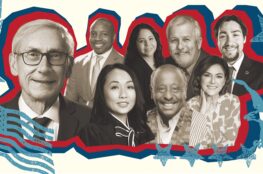


They’re called “down-ballot” races, but they’re the biggest contests in Milwaukee’s April 2 election.
Three of the most important jobs in local government are at stake. Scandal-drenched City Attorney Tearman Spencer is seeking a second term as chief legal counsel for the city and Milwaukee Public Schools, against a challenge from Democratic State Rep. Evan Goyke.
Neither County Comptroller Scott Manske nor City Comptroller Aycha Sawa are seeking re-election, the first simultaneous openings for both chief financial officers since 2012. Supervisor Liz Sumner and former County Pension Board chair Michael Harper are seeking the county post, while Deputy City Comptroller Bill Christianson and former firefighters union leader Greg Gracz are vying for the city position.

Experience an unforgettable evening celebrating great design!
But with little competition at the top of the ticket, public attention has focused largely on the MPS referendum to raise property taxes by $252 million.
Both Democratic President Joe Biden and former Republican President Donald Trump have already won enough convention delegates to secure their respective parties’ nominations for a second term, rendering Wisconsin’s presidential primary almost meaningless. No statewide races for Supreme Court justice or superintendent of public instruction are on the nonpartisan general election ballot. And Mayor Cavalier Johnson and County Executive David Crowley face only token opposition from proven losers in their re-election bids.
That leaves the remaining citywide and countywide candidates vying for attention with the MPS referendum; a variety of aldermanic, supervisory, suburban and judicial contests; and two proposed state constitutional amendments that the League of Women Voters has branded as “rooted in disinformation,” because they’re based on debunked Republican conspiracy theories about grants that helped fund the 2020 election.
Turnout predictions are difficult because of the COVID-19 pandemic that hampered the spring 2020 election, say County Clerk George Christenson and Claire Woodall-Vogg, executive director of the city’s Election Commission. Also, both parties held contested presidential primaries in 2016, the county exec’s office was open in 2020, and Supreme Court seats were at stake in both 2016 and 2020.
Those big races typically spur get-out-the-vote drives and heavy advertising. None of the campaigns for the three local offices is mounting that kind of effort.
Law and Disorder
While all three positions are usually low-profile, the city attorney’s office has been in the news a lot, and not in a good way.
Numerous deputy and assistant city attorneys have fled the office since Spencer was elected, accusing him of sexual harassment and creating a toxic work environment. City Inspector General Ronda Kohlheim urged the Common Council to oust him and Deputy City Attorney Odalu Ohiku after finding that they covered up Ohiku’s private legal work on city time, leading to a criminal probe and Ohiku’s resignation. The Milwaukee Journal Sentinel reported that Spencer intervened in a code enforcement dispute at a property where his cars are stored.
Spencer has denied all of the allegations and blamed his problems on prejudice against him as Milwaukee’s first Black city attorney; on sabotage from staffers loyal to his predecessor, Grant Langley; and on the news outlets that cover him. Spencer didn’t respond to requests for comment for this article, although his campaign website says he “fearlessly confronts opposition” while “safeguarding the rights of Milwaukee’s citizens” and “demonstrating a strong stance against corruption.”
Yet another line on Spencer’s website encapsulates how he ended Langley’s 36-year tenure. Spencer writes, “As your city attorney, my commitment is not to shield the police but to defend the very essence of Milwaukee and the individuals who shape its soul.” Because the city attorney’s office represents the Police Department, Spencer attacked Langley in 2020 for defending officers accused of misconduct. But once Spencer took office, the police became his clients and the officers’ union filed an ethics complaint against him. That union has endorsed Goyke.
“Tearman’s flaw … was a failure to communicate with his client,” Goyke says, pledging that he would comply with the ethical requirement for an attorney “to be a zealous advocate for the client.” At the same time, Goyke says he will communicate with the public about the city attorney’s role and listen to their concerns.
While Goyke responds to questions about Spencer — and accuses the incumbent of leaving his full first name off the ballot to sow voter confusion with popular City Treasurer Spencer Coggs — the challenger says he’s running a positive campaign. As the top prosecutor for city ordinance violations, Goyke says he would try to help fight reckless driving by improving prosecution of traffic tickets, and reduce boarded-up houses by strictly enforcing city codes.
All of Goyke’s legal experience is in criminal law, as a public defender and as an intern in the district attorney’s office. Langley had criticized Spencer’s lack of background in municipal law. But Langley and 11 former deputy and assistant city attorneys have endorsed Goyke, who says they’re schooling him in municipal law. Goyke also says he might rehire some ex-staffers to bring more experience back to the office.
Almost all of Wisconsin’s other 2,300-plus local governments and school districts appoint or contract for legal counsel. Goyke says he wouldn’t oppose converting the city attorney to an appointed office if citizens support the change after a full debate on its pros and cons. Besides Milwaukee, only Waukesha, Appleton, Sheboygan, Stevens Point, Wisconsin Rapids, Kaukauna and Lake Geneva elect city attorneys, and none of the others represent school districts. Of the 12 largest Midwestern cities, only Milwaukee and Columbus, Ohio, elect their chief lawyers.
Dollars and Votes
If the city attorney’s office is misunderstood, the city and county comptrollers’ offices are nearly invisible. In addition to handling day-to-day accounting and payroll, they manage borrowing, provide independent fiscal analysis to other elected leaders and oversee audits.
City comptroller: Sawa, the city’s first female comptroller, is finishing her only term after winning an unexpectedly wild 2020 race against Democratic State Rep. Jason Fields.
Now Christianson is hoping to follow her and former Comptroller Wally Morics in moving up from the office’s No. 2 job. Christianson previously worked as a city budget analyst and is endorsed by Johnson, Sawa, Morics, former Comptroller Marty Matson and budget director Nik Kovac.
Gracz was president of the conservative-leaning firefighters union when he lost a 1992 race against then-Mayor John Norquist. He has served as county director of labor relations and state director of employment relations, both as an appointee of Republican Scott Walker, the former county executive who became governor. Another GOP governor, Tommy Thompson, named Gracz to the University of Wisconsin Board of Regents.
Thompson has donated to Gracz’s campaign, as have former Democratic Acting Gov. Marty Schreiber; former Assembly Speakers Wally Kunicki, a Democrat, and Scott Jensen, a Republican; and three other losing mayoral candidates: State Rep. Bob Donovan (R-Greenfield), former Ald. Tony Zielinski and former Municipal Judge Vince Bobot.
Gracz’s former union apparently isn’t backing anyone in this race. But Fire Chief Aaron Lipski and the Fire Department’s chief officers’ association have endorsed Christianson.
State law requires the county comptroller to be a certified public accountant or hold a graduate degree in accounting or finance — requirements that don’t exist for the city comptroller. Sawa, Morics and former City Comptroller Jim McCann were all CPAs. But Matson wouldn’t have met the county job’s qualifications and neither would Gracz or Christianson.
Both candidates say they don’t need to be accountants. They contend their experience and education — a UW-Milwaukee master’s degree in public administration for Christianson and a Marquette University bachelor’s degree in business administration for Gracz — qualify them to run the office and supervise the accountants on its staff.
County comptroller: Manske has served three four-year terms as the county’s first elected comptroller, after 17 years as controller, an appointed position with a slightly different spelling and many of the same responsibilities, except for auditing.
Sumner, who chairs the County Board’s Finance Committee, is finishing her second two-year term as a supervisor and her third three-year term on the Fox Point Village Board. She ran as a Democrat in a losing 2018 challenge to then-State Rep. Jim Ott (R-Mequon). Sumner owns a women’s clothing store in Shorewood and holds a master’s degree in business administration, with concentrations in finance and strategy, from the University of Chicago.
Harper, of Glendale, served on the Pension Board from 2015 to 2020. After working in a variety of jobs, he co-founded a clean energy business. Harper holds a master’s degree in business administration, with a concentration in financial markets trading, from the Illinois Institute of Technology.
Sumner would be the county’s first female comptroller, while Harper would be the first Black comptroller.
Crowley, Johnson and the county Democratic Party have endorsed Sumner for the nonpartisan post. Harper says he has other endorsements but chose not to publicize them.
Try, Try Again
Perhaps the most notable aspect of the races for mayor and county executive is that this is the first time that every candidate for both offices is Black. But like the first all-Black contest for a citywide administrative office four years ago, these races pit popular and well-funded incumbents against long-shot challengers. Coggs, who defeated developer Brandon Methu in 2020, is unopposed for a fourth term this spring.
County executive: Crowley, who is seeking his second term, is opposed by community activist Ieshuh Griffin, who is also running for an east side Common Council seat after being eliminated in the February mayoral primary. She lost previous bids for mayor, county executive, state representative, supervisor and alder.
Although Griffin attracted national attention for her failed attempt to run under the banner of “Not The White Man’s Bitch” as an independent Assembly candidate in 2010, she’s lost every race — including that one time in 2011 when she finished ahead of Johnson, but behind Spencer, both first-time candidates, in a five-way County Board primary. Now, as the incumbent’s lone challenger in a countywide general election, Griffin is almost guaranteed to capture somewhere between 10% and 20% of the vote, meaning she could win more than the combined total of 6,325 votes she garnered in her eight previous contests and still lose by a landslide.
Mayor: While Griffin is challenging the progressive Crowley from his left, the equally progressive Johnson faces opposition from his right in conservative pastor David King, an anti-abortion crusader. Johnson is seeking his first full four-year term after winning a 2022 special election to succeed former Mayor Tom Barrett, now U.S. ambassador to Luxembourg.
In 2010, King won the Republican nomination for Wisconsin secretary of state unopposed and received more than 1 million votes in the general election, finishing with 48% to longtime Democratic incumbent Doug La Follette’s 52%. But King’s performance was more lackluster in races for lieutenant governor, U.S. representative, mayor, state senator, state representative and alder. February marked the first time he advanced out of a contested primary, as well as the first time he faced fellow perennial candidate Griffin, edging her out 10% to 4% as Johnson took 86% of the vote.
The outcome of the races for mayor and county executive isn’t in doubt. But what happens in the other three contests will depend on who turns out to vote — and how much they know about these little-known offices and the candidates who hope to fill them.