
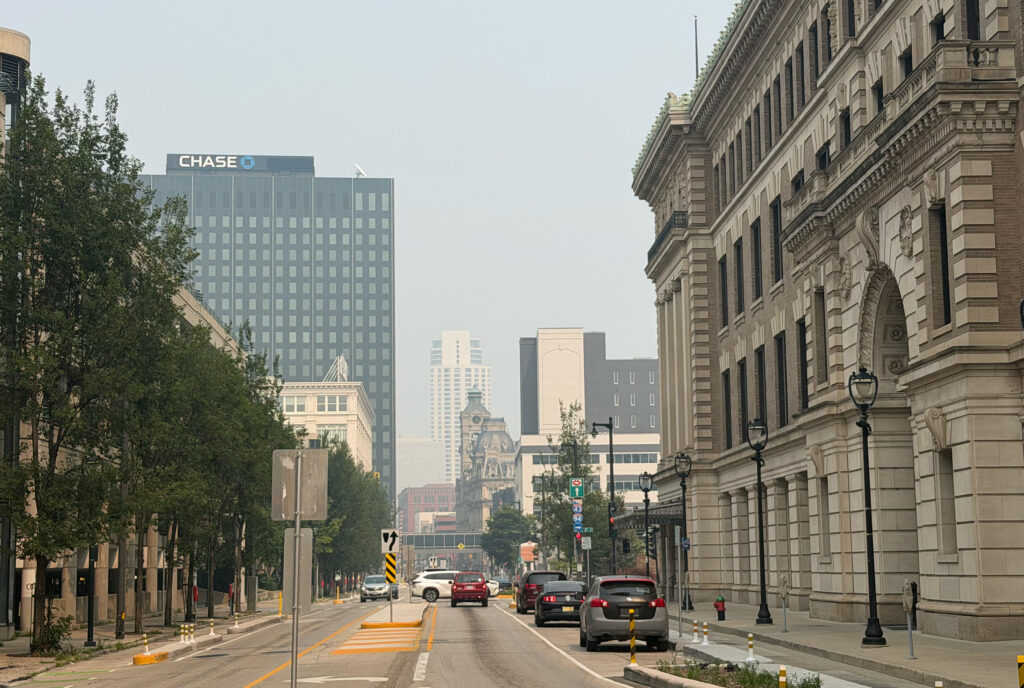
The orange haze and overwhelming campfire smell engulfing the Milwaukee area is extremely serious.
Milwaukee is experiencing its worst air quality in at least 46 years, with Air Quality Index values well into the “hazardous” category, driven by smoke from wildfires in Minnesota and Ontario. Across the city, events were canceled and outdoor work was halted to protect people from the dangerous air.
“This is incredible. And scary. Our air quality continues to be off the charts bad,” Mark Baden, chief meteorologist at WISN-TV (Ch. 12) posted on social media on Thursday.
View on Threads
The hazardous category is the most severe rating and means everyone and everything that breathes air is in danger.
“This is not one of those situations where it’s unhealthy for sensitive groups or just for some,” Lindsey Slater, meteorologist at WTMJ-TV (Ch. 4), tells Milwaukee Magazine. “This is hazardous for everyone – dogs, cats, humans. It is very unhealthy. Take it seriously. We did some data digging and at its peak today, if you were outside for 40 minutes to an hour, it was the equivalent of smoking a whole cigarette. So, just think about what that could do to you all day.”

Celebrate this year’s winners of the Betty Awards!
The situation is worse than three years ago, when the area was blanketed with smoke from wildfires in Alberta, Canada, Slater says. Air quality numbers in the Milwaukee area then hit record levels, from 250 to about 280.
“It’s actually much worse this time,” she says, noting that Thursday’s index reached 644, a potentially life-threatening level of particle pollution.
“The AQI here has never been that high before in recorded history when measuring air quality,” Slater says, noting that air quality measurements began in the late 1970s.
City and state officials urged residents to stay inside or limit exertion outdoors; the statewide air quality advisory was extended until noon on Friday. Sensitive groups such as children, older adults and people with asthma or other respiratory conditions were urged to stay indoors and keep handy quick-relief medicine like inhalers.
City officials advised keeping windows and doors closed; running air conditioning on recirculate, if available, using a portable air cleaner and considering wearing a well-fitting N95 respirator if spending time outdoors is necessary. They also urged residents to check on neighbors, family members and others who may be especially vulnerable to poor air quality.
A Host of Cancellations, Closures
The smoke incursion, which followed a period of extreme heat that plagued the area this week, led to the cancellation of several outdoor events Thursday.
A ceremony reopening the Holton Street Bridge was called off. The Marcus Performing Arts Center canceled a Boy Band Review concert at Peck Pavilion, part of its Rainbow Summer program. The Boerner Botanical Gardens closed early and a concert was canceled. The Milwaukee County Zoo remained open but brought some of its animals inside and canceled many outdoor experiences. Milwaukee County Parks closed all of its beer gardens, splash pads and pools.
The Milwaukee Department of Public Works halted all non-emergency outdoor work, including garbage and recycling collection, until conditions improve. Milwaukee County suspended non-emergency work for its highway crews, too. Buses remained running, with unspecified precautions.

The Smoke Outlook
The smoke is expected to clear out throughout the day on Friday, from west to east across Wisconsin, according to the DNR. The DNR warned that the air quality advisory may be extended again for eastern areas, especially those near Lake Michigan.
But Slater says the smoke could return over the weekend following the warm front coming through the area on Friday.
“What that front’s going to do is change the wind direction and push everything to the northeast of us, so it’s going to push its way towards Door County and go toward Michigan,” she says. “That’s good. The bad news is that the wildfires are ongoing, so once that front clears, we have other weather systems that could likely bring it back as early as Saturday afternoon or evening. Will it be as bad? I don’t know. It depends on how those fires are going and a lot of other factors.”