
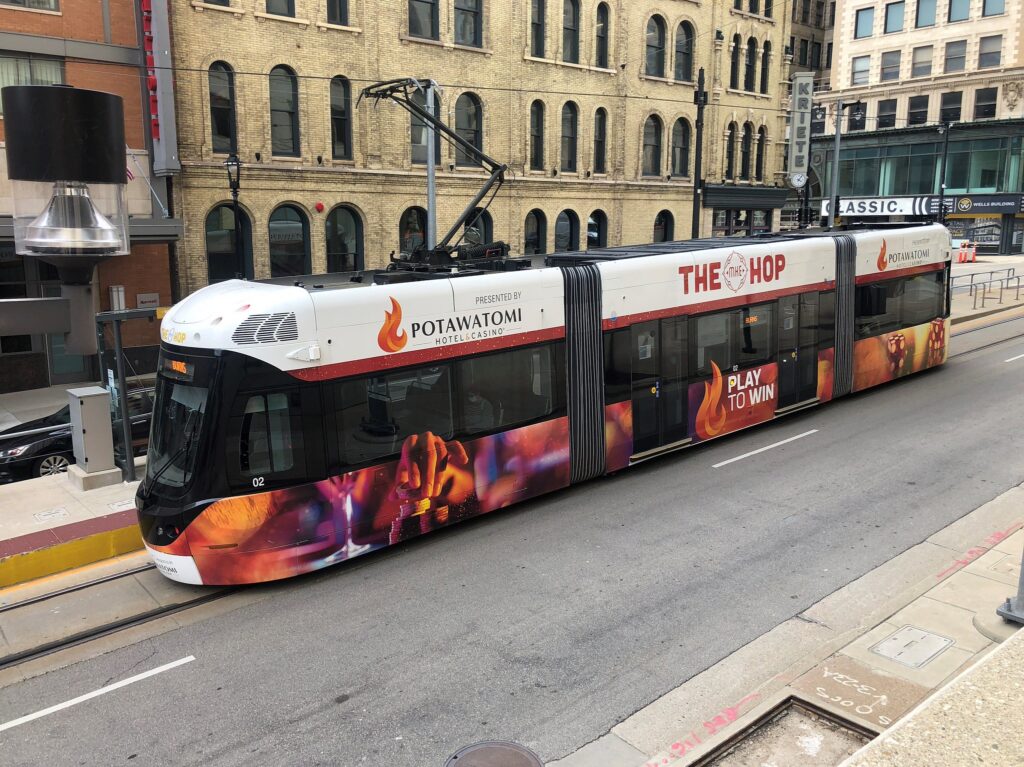
For more than seven years, passengers have been hopping on and hopping off The Hop without reaching for their wallets.
But those days of free hopping may not last. The Milwaukee Common Council has asked the city’s Department of Public Works to come up with a plan to start charging fares for the first time since the modern streetcar debuted in November 2018.
That directive is driven partly by concern over how much city parking revenue is being used to subsidize streetcar operations. However, the seven-figure annual subsidy is actually lower than it appears, as a result of city and federal fiscal practices.

Celebrate this year’s winners of the Betty Awards!
Council members authorized the city’s fare study as part of the 2026 budget, after refusing to support south side Ald. Scott Spiker’s attempt to derail the streetcar instead.
During last fall’s council budget action, Spiker argued that ending The Hop could allow the city to reduce or avoid increases in its wheel tax and in parking fees and fines. Before 2024, the city was using at least $10 million a year in parking revenue to help reduce reliance on property taxes.
But it’s not that simple. Revenue from the city vehicle registration fee goes to street projects, not The Hop. Parking revenue has slumped because the pandemic boosted telecommuting, which reduced the number of workers driving and parking Downtown, city public works spokeswoman Tiffany Shepherd says. And a complex accounting formula governs transfers from the city’s transportation fund (which covers parking operations and scooter fees as well as the streetcar) to the general fund, Spiker says.
Streetcar systems are sometimes seen as more valuable for economic development than for transportation, because they increase the convenience of living and working downtown, instead of carrying commuters from outlying neighborhoods and suburbs. Downtown Ald. Bob Bauman, The Hop’s biggest supporter, says the streetcar more than pays for itself by attracting development that boosts the city’s property tax base. Spiker calls that claim “a bit of a leap of faith,” contending that most Downtown development would have happened without The Hop.
Public Works Commissioner Jerrel Kruschke warned alders that discontinuing streetcar service would lead the federal government to demand repayment of about $48 million of the $69.1 million it contributed to build the system. Spiker insisted that wouldn’t happen. Backed by state Rep. Bob Donovan (R-Greenfield) and State Sen. Van Wanggaard (R-Racine), Spiker asked U.S. Transportation Secretary Sean Duffy to assure the city it wouldn’t have to pay anything back. However, Federal Transit Administration chief Marcus Molinaro replied that the city would indeed have to repay at least some of the federal cash.
With that response and zero support from colleagues, Spiker withdrew his budget amendment to kill The Hop. His separate amendment to require the fare study passed, 10-4, with Bauman among those opposed.
Bauman says fares would cost more to collect than the revenue they would raise. He pointed to the expense of installing fareboxes on streetcars or payment terminals at stations. And because streetcar operators are not positioned to check whether passengers are paying, other workers would have to be hired to monitor compliance, Bauman says.
A previous plan called for a private company to install electronic kiosks that could collect fares and provide transit and visitor information at stations, funded by advertising at no cost to the city. But that idea collapsed during the COVID-19 pandemic, Bauman and Shepherd say.
Spiker says he wants the council’s Legislative Reference Bureau to research how other cities charge for transit, which he hopes would “prod (public works officials) to think outside the farebox, so to speak.” He pointed to systems like Salt Lake City’s TRAX light rail, where riders can pay by credit card or smartphone before boarding. However, the Utah Transit Authority’s website advises TRAX riders that police or fare checkers may ask for proof of payment.
How Much Does the Hop Actually Cost Milwaukee?
The Hop was never meant to be permanently free. Potawatomi Bingo Casino sponsors the city-owned streetcar and paid for the first year of fares as a promotion to encourage ridership.
Yet as the streetcar neared its first anniversary, then-Mayor Tom Barrett’s administration extended the free rides for a second year, delaying plans to charge $1 fares. A few months later, the pandemic sent ridership spiraling downward on all forms of public transit across the country. With The Hop’s 2025 ridership of 494,557 still 35% below its pre-pandemic high of 760,321 in 2019, fare plans have remained on the shelf.
Potawatomi’s $10 million sponsorship provides $833,333 a year through 2029, supplemented by federal aid, advertising and other grants. The city doesn’t spend any property tax dollars on the streetcar, instead using parking revenue to cover the rest of its annual operating costs.
Those costs ranged between $4 million and $5 million through 2022, then jumped to $5.6 million in 2023 and $7.2 million in 2024. The increases partly reflected repair costs after a dump truck collided with a streetcar in 2023, Shepherd says. Also contributing to higher costs for 2024 and beyond were costs for maintenance overhauls on streetcars; replacing track switches that have contributed to derailments and shutdowns; and a new contract with TransDev, the French-owned company that operates The Hop.
In its annual budget presentations to the council, the Legislative Reference Bureau subtracts operating costs from streetcar revenue to show the shortfall that is covered by parking revenue. That amount averaged about $2 million a year from 2019 through 2023, then shot up to $6.3 million in 2024.
However, the bureau’s calculations for prior years are based on the “actual revenue” and “actual expenditures” columns of the city budget. And hundreds of thousands of dollars of federal aid never appear in those “actual revenue” columns.
That’s a timing issue. City officials prepare each year’s budget during the summer and fall of the preceding year, and each budget includes actual revenue and expenses for the last full year. For example, the 2026 budget compares 2024 actual figures with 2025 and 2026 budgeted figures.
But federal aid frequently arrives after the year is over, partly because the federal fiscal year ends Sept. 30, Shepherd says. As a result, $460,908 in 2024 federal aid earmarked for the streetcar didn’t show up in time to be included as 2024 “actual revenue” in the 2026 budget, say Shepherd and city budget director Nik Kovac. Similar issues resulted in other federal aid being excluded in other years, Shepherd says.
The same thing happened with a $1.15 million insurance settlement stemming from the 2023 collision, Shepherd and Kovac say. That settlement was intended to cover repair costs that were mostly reflected as 2024 expenditures, but it didn’t arrive in time to be reported as 2024 revenue, they say.
If the insurance settlement and 2024 federal aid had been counted as 2024 revenue, the shortfall for that year would have narrowed from $6.3 million to $4.7 million. That would be more consistent with projections of $4 million for 2025 and $4.3 million for 2026.
Kovac confirms that interpretation is “generally correct.” He says the late-arriving revenue eventually will show up in the annual financial report from the city comptroller’s office, but even then may not be obviously linked to the streetcar.
Spiker says the information about late revenue doesn’t change his position, which was based on the 2026 projected subsidy. He says he still considers a gap of more than $4 million “a big annual shortfall that we need to work to close further.”
The Feds Are Done With Free Rides
Meanwhile, Republicans in the federal government are pressing for tighter fare-collection policies on public transit, a move that is aimed mainly at Milwaukee County buses but might affect The Hop as well.
Last summer, county transit officials blindsided supervisors and County Comptroller Liz Sumner with news of a looming multimillion-dollar deficit. Among the contributing factors cited for the shortfall was lost revenue from unpaid fares, with about one-third of passengers not paying — a figure that transit officials say is comparable to Seattle and Washington, D.C. In response to sometimes-violent disputes over payment, the Milwaukee County Transit System started easing up on fare enforcement in 2022, leading to a 42% drop in assaults against bus drivers.
Fare evasion isn’t the main driver of the deficit, which stems more from rising expenses for overtime, vehicle repairs and paratransit service. Nonetheless, Republican U.S. Rep. Bryan Steil focused on fare evasion in calling for federal intervention. Steil, whose district includes most of the southern Milwaukee County suburbs, urged Duffy and Molinaro to step up oversight of local transit agencies and retract guidance from former President Biden’s administration that allowed bus drivers to stop asking for fares.
Molinaro then sent letters to both the transit system and The Hop, asking for information about their fare-evasion policies and security measures and threatening to withhold federal aid if they didn’t cooperate. Since the streetcar doesn’t charge fares, Bauman called the FTA letter “silly” and Spiker agreed it was “curious.”
“The Milwaukee streetcar has been free to ride since its inception, so there is no fare evasion,” Kruschke wrote in his response to Molinaro. The rest of Kruschke’s letter explained The Hop’s safety precautions, noting that streetcar staff reported only two security incidents in 2024 and one in 2025. Shepherd said she believed all those incidents were minor.
Steil and Rep. Scott Perry (R-Pa.) also introduced a bill to cut off federal aid to transit systems that either let everyone ride free or that don’t enforce posted fares. Free or reduced fares still would be allowed for older adults, children and other specific groups. President Trump’s administration is seeking similar legislation, but only for major transit systems with at least 100 vehicles in an urbanized area of 200,000 or more people.
Both proposals could apply to the county bus system, but The Hop would not meet the minimum vehicle requirement in the administration’s version.
New York City Mayor Zohran Mamdani campaigned on a promise of free bus rides on the nation’s largest transit system. However, he doesn’t have the power to enact his plan for the state-controlled Metropolitan Transit Authority. The idea faces substantial opposition from New York Gov. Kathy Hochul and MTA managers, who consider it financially unsustainable.
Through 2019, only a few dozen of the nation’s 2,200 transit agencies offered free rides systemwide, all in smaller communities. The administration’s proposal wouldn’t affect those small-town and rural systems, which are more heavily dependent on federal aid — and more likely to be located in areas that voted for Trump.
Kansas City, Mo., and Olympia, Wash., eliminated fares for all buses in early 2020. Many other transit agencies followed suit after the pandemic hit. Most went back to collecting fares after the COVID crisis eased, although a few continued to let passengers ride free. Raleigh, N.C., ended free rides in 2024 and Kansas City buses will start charging fares June 1. Among the largest bus systems still free are those in Tucson, Ariz.; Richmond, Va.; Albuquerque, N.M.; and Olympia.
However, as Bauman notes, it’s not unusual for cities to offer some form of free transit in and around their downtowns, particularly on downtown-only systems like The Hop. That includes streetcars in Kansas City (which were free before buses and will remain free), Tucson and Tampa, Fla., as well as elevated rail lines in Detroit, Miami and Jacksonville, Fla.
Washington’s streetcar — which operates in a neighborhood rather than downtown — is also free, but will end operations March 31, to be eventually replaced by electric buses. Unlike The Hop, the DC Streetcar was not built with federal aid that would need to be repaid.
All that means free rides are becoming even less common nationwide. But it’s still too early to tell whether Milwaukee’s streetcar will hop on that trend.