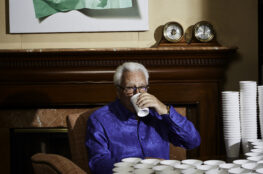


Manty Ellis, the beloved guitarist dubbed the godfather of Milwaukee jazz, has gone silent, but those who he played alongside and mentored vow to ensure that his musical legacy lives on.
Ellis died on July 9 at the Clement J. Zablocki VA hospital at the age of 93. He continued to play music until his death, and in 2025 the Jazz Foundation of America named him one of 20 inaugural fellows for the Jazz Legacies Fellowship. A funeral for Ellis will be held on July 25, from 10 A.M.-1 P.M., at Krause Funeral Home.
Grover Edwin “Manty” Ellis was born on Jan. 16, 1933, in Milwaukee’s Bronzeville neighborhood. Ellis was inspired by his father, Grover Edwin Ellis Sr., to start playing piano as a young child before learning guitar. Which quickly became his primary instrument while performing throughout Milwaukee for decades, according to a biography of Ellis posted on the Milwaukee Jazz Institute website.
Some of the notable artists Ellis worked with during his long performance career included Sonny Stitt, Eddie Harris, Stanley Turrentine, Melvin Rhyne, Buddy Montgomery and Charlene Gibson. In the early 1980s, he was part of the Wisconsin Connection, a group that included Berkeley Fudge, Jessie Hauck and Carl Allen. In 1999, he recorded a trio album entitled In Your Own Sweet Way, which featured his original compositions “Trane Stop” and “Marlene,” according to the Jazz Institute. Ellis also co-founded an accredited jazz program at the Wisconsin Conservatory of Music, ran a North Side music store and served on the Milwaukee Jazz Institute’s board of directors.

Celebrate this year’s winners of the Betty Awards!
“Ellis was our teacher, mentor and friend,” Milwaukee Jazz Institute Artistic Director Mark Davis told Milwaukee Magazine. “I was lucky to study with him as a teenager over 40 years ago and then work with him as a pianist in his groups, his passion inspired me as a musician and a teacher, and has been a key motivating factor in the programs I’ve led, including those at the Milwaukee Jazz Institute.”
Davis is seen here on piano, playing with Ellis as he performs “Time After Time,” in Milwaukee in March 2019.
In 1971, Ellis and pianist Tony King founded an accredited jazz program at the Wisconsin Conservatory of Music in Milwaukee. Unlike other college jazz programs in the country at the time, it focused on small ensemble playing. Ellis taught student groups that included young players such as Brian Lynch, Jeff Chambers, Sam Belton and Charles Small, winning first place at collegiate jazz festivals several years in a row, according to the Milwaukee Jazz Institute. The program lasted until 1984 when it was discontinued. Not long after, Ellis left the conservatory.
“Jazz scenes don’t appear out of nowhere; they are created by people like Manty,” Davis said. “I hope that we can all continue his legacy.”
Racine trumpeter and composer Jamie Breiwick, a notable figure in Wisconsin’s jazz scene, often shared the stage with Ellis.
“I am so grateful to have had many opportunities to work with, listen to and learn from Manty,” Breiwick said. “He mentored many of the greatest musicians of this generation right here in Wisconsin and was a direct link to a now bygone era.”
Ellis opened his music store, Manty Ellis Music Center, in the early 1970s on West Hampton Avenue.
“One of the many important lessons I garnered from Manty was to grow where you’re planted,” said Breiwick. “He could have chosen to settle in any one of this country’s larger and more active music scenes, but he chose to stay here.”
Many artists who came through town to perform at Milwaukee’s Jazz Gallery or elsewhere would stop by the store to hang out and jam, including major figures such as Freddie Hubbard, George Benson and Lou Donaldson. Ellis closed the store in the early 1990s.
“Always swinging, sophisticated and sharp, he spoke truth through his music,” said Breiwick. “Manty left a mark that will stand for generations to come.”