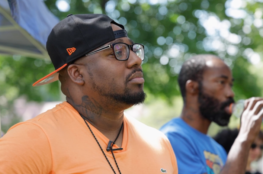
Growing up in Milwaukee, Paulina Lule didn’t see a path to Hollywood and the film industry. It took them years after graduating college to realize they could go to film school, and after studying in California, they directed a number of short films and acted in various TV shows like General Hospital and Agents of S.H.I.E.L.D. Lule returned to Milwaukee in 2022 to share what they learned and play a part in growing Cream City’s film scene.
Part of that means working for Action! Wisconsin, a coalition to establish a film office in the state to entice more film and TV productions. It also means producing their own films, such as their zombie social horror film called Sherman Park, set in the titular Milwaukee neighborhood. The proof-of-concept short film received a 2023 Forward Fund Award, and Lule is crowdfunding the rest of the budget on IndieGoGo.
MilMag talked with Lule about the concept behind Sherman Park, acting with the Zoological Society of Milwaukee and starring alongside Forest Whitaker and Grantham Coleman in the MGM+ series Emperor of Ocean Park.

If someone has inspired you through their service, leadership or dedication, the Unity Awards are your opportunity to recognize them!
Tell us about the short film you’re developing, Sherman Park.
It’s a story about Miles, who is a Black man from Milwaukee returning to his home in Sherman Park after a six-year prison sentence. And he’s returning home to start his life over, but finds that it’s a little more difficult than he imagined it would be, because “society” has turned on him – and I’m using air quotes because it is a social horror film. This is a film about reentry into society by folks who have been incarcerated, told through the context of a zombie horror film, and it’s set in Milwaukee.
I wrote it around 2016 when my own brother was being released from prison, and I was very anxious about what he was going to do. There was a lot of things happening in 2016. There was a very tumultuous presidential campaign happening that year; there was also a lot of things happening in Milwaukee. It was right around the time when Syville Smith was killed, and there was some unrest in Sherman Park. And then on top of that, [my brother] was formerly incarcerated and being released into society and expected to do right, live right – with everything stacked against him.
If someone has inspired you through their service, leadership or dedication, the Unity Awards are your opportunity to recognize them!
How do you plan to use the horror genre and its conventions to tackle these broader themes about reentry, race and violence?
I use, loosely, zombie horror lore, right? So, zombie horror is like a person is infected or undead – unkillable, nonempathetic, just a shell of a human. And the only thing they want to do is eat flesh of other humans. That’s kind of how we all know zombies. In my film, it’s never explicitly stated, but I read this article [that said] “white supremacy is a virus.” That’s always stuck with me.
And then I was like, OK, I want to set it in Milwaukee. How can I make it very Milwaukee specific? Again, alluded to but never explicitly spoken of is the segregation in Milwaukee. I would always kind of joke with people that you could literally see the segregation if you start on North Avenue on the East Side and drive straight all the way through. You can see the lines of demarcation where class, race – everything changes, and then it changes again.
So, this idea that the people in the surrounding areas are infected with this virus, and it’s kind of descending on – for the lack of a better word – inner city of Milwaukee, that this poisonous way of thinking eventually infects Black people as well. I mean, Black people have internalized white supremacy in so many ways.
The cold open of the film, and what our proof of concept is going to be, is a sickly white man finds himself in Sherman Park, and these kids are just hanging out there. They think he’s an addict that’s looking to score and soon realize that he’s not. Once he attacks one of them, they kind of change and attack each other. That’s another theme – that Black-on-Black violence is a symptom of white supremacy.
This isn’t your first short film about reentry after prison, nor your first set in Milwaukee. Could you tell us about Homecoming (2016)?
At that moment, there was a lot of disconnect between people in my family about how we felt about my brother and his situation and where he was at that moment. And I was off in film school in California. I didn’t have to put up with a lot of the drama that went with having someone in your family go to prison. I got it secondhand over the phone. There’s guilt I felt about that – the desire to fix the situation from afar as best I could.
I felt like, “Oh, if I could just get home, I could fix this situation.” So that’s what the film is about. It’s about a woman named Andy who goes home to plan a welcome home party for her brother who’s getting out of prison, but the rest of family wants nothing to do with him. So, she spends the entire short film with each family member trying to convince them in whatever way she can. … It was just a film that came from the genuine desire for me to have my family just all come back together and have everything be alright.
What made you want to return to these ideas with your new film?
My brother and I were very, very close, so his incarceration is a huge part of my life, even though I wasn’t the one incarcerated. Honestly, a lot of my films are less about incarceration and are sibling stories. They’re always stories about a brother and a sister.
I don’t know how I’m going to move forward because he’s no longer here. (Editor’s note: Lule’s brother died from gun violence in 2022). I don’t know what that’s going to be. He was killed before I could tell him I’m nonbinary, and that’s something that I think about a lot, like: Would he have accepted me? Would it have been a problem? But I don’t think I’m ready to write that film yet.
What do you hope people take away from Sherman Park?
On the one hand, yes, my films have these deeper meanings, but I also love movies. There’s lots of comedy in it. There’s lots of things that do make you think. Hopefully, it’s going be scary. I like making horror films.
I hope people think about when people are forced into a situation where everything is hostile toward you, that they can be a little bit more sensitive to those who have to make decisions that don’t always fall on the “right side of the law.” And I think in general, our society is becoming more aware of how heavily skewed a lot of our systems are. I hope that I make a film that people will see the main character and show him a little more empathy than I think my own brother got when he was alive.
Along with being a writer and filmmaker, you’re also an actor. Do you prefer one role over the others?
Do you know The Legend of Zelda and the Triforce? I believe there’s a Triforce of filmmaking, and the three triangles are acting, writing and directing, and each one of those triangles feeds a different part of me creatively.
Writing to me is super intellectual – you’re sitting in a room on your own, clack, clack, clacking in a computer. And it’s just you and your imagination, right? Directing is super collaborative. You’re not alone at all. Acting is super intimate and personal, allowing myself to feel and act and react to the imaginary circumstances that the character is going through.
I don’t really think there’s a preference for me because it’s all storytelling to me. I think of it in the reverse way, in the sense that like I get spent if I’m writing something. When I finish the project, my brain can do no more. I want to get out and be in my body and be in an acting project, or I want to go out and collaborate with people and do a directing thing.
This year, you acted in a new MGM+ show called Emperor of Ocean Park. What was that like?
It was my first major role. First off, working with that cast, I was very nervous because everyone in that cast is incredible, has so much experience between all of them and are just incredibly talented. But as I was there, because they’re such wonderful, giving people and giving actors, I felt supported – not necessarily not challenged, though. Forest (Whitaker) is, you know, a true professional. It’s wild to be watching the show now and seeing what he was doing on set and how it translated when the show was actually cut together. I learned a lot just from that.
Most of my scenes are with Grantham Coleman, and he is just a delight. He’s a star; he is a thespian – trademark, underline, circle.
He showed up every time and kept me on my toes and challenged me and did it in such a kind way. … I feel so fortunate to have been on that show for my first show. Our industry is very not diverse at times, so to be on a show with an all Black cast and a very largely Black crew is rare.
I know you’ve also done acting work with the Zoological Society of Milwaukee. How did that start?
When I first moved back here and I was looking for a job, I’ve always been kind of an outdoorsy person, but I wasn’t really a conservationist. I came across this thing on LinkedIn or something, and it was an actor, educator with the Zoological Society of Milwaukee. And I’m like, what is this? It ended up being their Kohl’s Wild Theater program, which is part of the Zoological Society of Milwaukee’s arts education department. It’s essentially children’s conservation theater, so all of the plays are musicals with puppets and singing and light choreography about various conservation issues, specifically wildlife conservation. The very first play I did was Leona Lionheart Saves the World, and then I did another season with them.
(Then) I took a management job there, and I became the program manager of the arts education program and became even more immersed in their mission, learning more about conservation outside of just the theater. That’s when I really started to grasp onto it, the people who run the conservation and programming there. There are so many cool activities. There’s bat monitoring. They keep bees in the zoo. We would do birding and bird counts, and it was just like so much fun, and it opened up a part of me that I guess has always been there but didn’t have structure. And then from there, I’ve been really starting to get into intersectional environmentalism. … Maybe I’ll make a movie about that.
You’re taking a friend to Milwaukee for the first time. Where’s the first place you take them?
Leon’s. 100%. Every person I’ve taken there, they’re like, “this is the best thing I’ve ever eaten.” Leon’s is the best one, and I will die by that statement.