
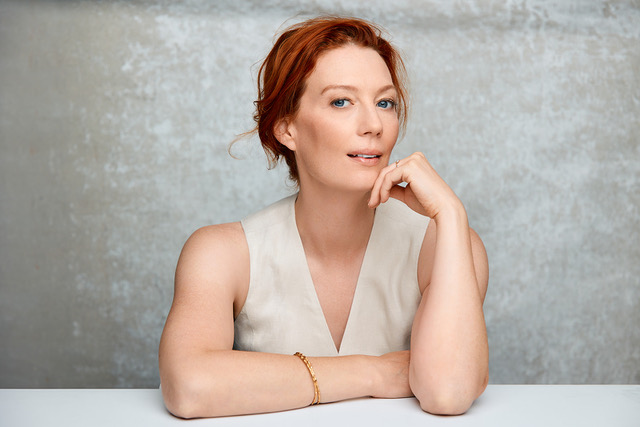
What happens if our artistic gifts stay stuck inside us? It’s a question playwright Monica West endeavors to answer in the operatic “Nina/Violetta,” her first full-length play, featuring arias from Verdi’s “La Traviata.”
At the center are two women: Nina (West), a mother and would-be opera star, and Verdi’s iconic soprano, Violetta (Emily Rohm). Catch them at Milwaukee Opera Theatre’s staged reading, taking place at the Florentine’s Lueders Opera Center (926 E. Burleigh St.) from Sept. 17-20.

Check It Out!
What’s your connection to Milwaukee? Are you originally from around here?
I was born in Western New York – but when I was growing up, my dad was often transferred for work, so my family moved around quite a bit. When I was 17, we moved to Illinois. Our family is Catholic, so I applied to a Jesuit school: Marquette. I was originally going for a business degree, but when the syllabus came, my parents were like, “You love theater. Why don’t you do theater?”
What was your experience like with the Marquette theater program?
I was so lucky because at the time I started at Marquette, there was a new head of the department, Phylis Ravel. She came in with some really exciting ideas, and a bunch of people from my class ended up taking big leaps after school. Four days after I graduated, I moved to New York City. “Oklahoma!” was going to be on Broadway, and I asked a friend to have their manager submit me for an audition. I was not equity, and they didn’t want to let me in. But I insisted: “I have an audition.” I ended up getting called back for the lead. I didn’t get it, but Phylis taught me to make bold moves. It set me on a good path.
How did you arrive at this moment in the Midwest with “Nina/Violetta?”
I was working off-Broadway when I booked Baby in “Dirty Dancing” in the North American premiere in Toronto for a year. That’s where I met my husband. He was based in the Bay Area, so I left New York and started writing. I wrote and produced a short digital series that ended up on the festival circuit, and I started producing other women’s short films. “Nina/Violetta” started during our journey back to the Midwest for me to attend the Art Institute of Chicago for an MFA in writing. This was during the pandemic.
The pandemic has influenced so many creatives – how did it influence you and this piece?
Before the pandemic, I was set to play Viola in “Twelfth Night” at Santa Cruz Shakespeare Festival – outside in the mountains, just gorgeous. Then everything shut down. My husband’s work got busy, and we had a toddler. So, I went from preparing to play Viola to: “Empty the dishwasher, reload the dishwasher, empty it, reload it.” I remember I was sitting in front of a huge pile of laundry while my son was napping, and I wondered: Am I ever going to sing again? If theaters do open, will I work again?
So, I started writing this play about a woman who has created a life for herself that she loves. She loves her family, but she also wonders what happens to the gifts we’re given if we don’t use them. Around that time, “lean in” was the message. The idea that women can do it all, you just can’t do it all at the same time. But, I think, no one was having a real conversation about how it feels to try to decide what to do.
So “Nina/Violetta” explores themes of motherhood vs. artist and career, trying to have it all – how do you find the play resonating with people so far?
I thought “Nina/Violetta” was really going to appeal to Gen X and millennial women. But what’s surprised me is that baby boomers are also excited about it – because they did this quietly. There was no one to talk to about the choices they were making, so they have a lot to say about their experience. Gen X are a lot of latchkey kids whose moms were trying to do it all, or sometimes had to do it all, because divorce became more acceptable. Millennials were left in the balance with no real answer, and now Gen Z is wondering, “How will I do this?” But it’s a bit of an unanswerable question.
For non-mothers, what will draw them into “Nina/Violetta“
While the mother vs. artist question is in there, it’s wrapped in absurdity and magic. “Nina/Violetta” is a dark fairy tale. It conjures something from our childhood. I wanted it to feel compelling and wildly entertaining, whether you have children or not. Also, the opera singing – it’s like an Olympic sport. To be able to see people perform these arias up close in this intimate space in Milwaukee is thrilling.
How did the collaboration with Milwaukee Opera Theatre come to be?
Whenever a project is ready to take flight, it needs people to see it. Last summer, I did a small presentation of the play at my house, and I invited Jill Anna [Ponasik] from Milwaukee Opera Theatre. She sat in the front row, and I could see her quietly nodding the whole time. It made my heart full to see – this is real, people are feeling this, an artistic director is feeling this.
Have Jill Anna and the creative team helped push the show in any unexpected ways?
Originally, all the music was from Verdi’s “La Traviata.” But Jill Anna proposed we write a new aria for the character of Violetta in the second act. Our composer, Sheila Ramesh, is also a mom and has to travel a lot for her work, so she immediately connected with the piece. In January, we did a music workshop – we wrote the underscoring for the show and the new aria, then shared it with Jill Anna.
Are all the arias in Italian? What would you say to people who don’t speak the language?
The new aria is in French, the others in Italian. There is enough context within the play, but my hope is that people will have the experience of letting the arias wash over them. The magic of opera is that it’s transporting. The vibrations and sounds reach something really primal within people.
You play Nina in the show. Have you always sung opera?
I sang in an opera when I was 21 at the Florentine Opera in Milwaukee, but that was my only experience with opera music before now. Two years ago, I asked Alicia Berneche – she’s a vocal coach, opera singer and mom who lives in Evanston – if she would teach me to sing opera. Some people might laugh in your face, but she was like, “Absolutely!” So, I’ve been training for two years.
Playing Nina seems like a quintessential moment of art imitating life. During the pandemic, you wondered if you would ever sing again – then you wrote this play that allows you to do just that. How does it feel?
Well, it just feels joyful now. It’s so fun to do it. I’ve been producing the project and pushing it forward – so now it feels like a real gift to do it.