

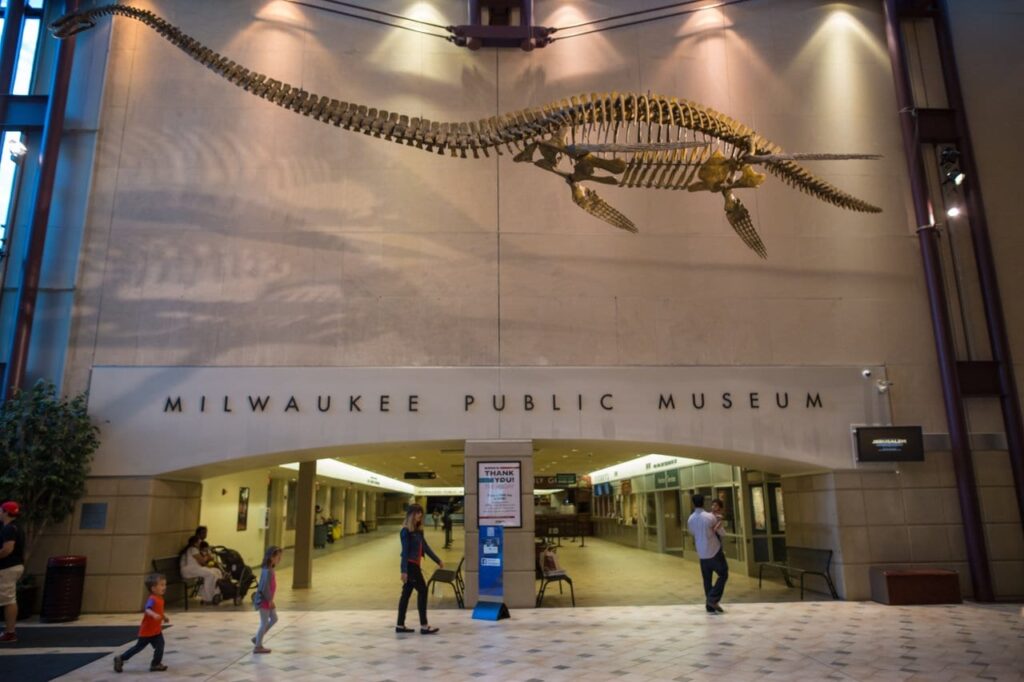
A state legislator is launching a long shot bid to preserve the current Milwaukee Public Museum after its replacement opens next year.
Rep. Russell Goodwin (D-Milwaukee) tells Milwaukee Magazine that he is exploring whether the state could purchase the county-owned building and use part of it as a scaled-back museum while turning the rest into offices for justice-related state agencies and possibly other uses.
It’s an idea that would cheer fans of some iconic exhibits that aren’t moving to the new Nature & Culture Museum of Wisconsin, including the Streets of Old Milwaukee and the current museum’s historic dioramas.
But as Goodwin concedes, the cost of his plan could be a major obstacle. County consultants estimate that reusing the existing building as a mixed-use complex would cost $208.6 million, not including design costs and whatever price the county might ask for the property.

Celebrate this year’s winners of the Betty Awards!
That renovation expense would be more than the projected costs that sank two earlier plans to construct a new state office building on the near west side. After previously saying a third west side office plan was on hold, a state Department of Administration spokeswoman now says her agency is turning its focus to renovating the existing State Office Building, which is across Lovell Street from the current museum. Renovation costs were previously estimated at $95.7 million.
Keeping the old museum building intact also would clash with the city’s downtown plan, which calls for razing the structure and replacing it with a mixed-use complex.
Goodwin says he plans to introduce legislation to authorize a study, either later this year if the Legislature comes back for a lame-duck session or after the next regular session starts in January. He was unopposed for re-election Nov. 3.
Museum officials have long portrayed their existing building as deteriorating, particularly in the basement and upper-level spaces that house the vast county-owned collection of specimens and artifacts that are often not on public display. As concerns grew that the American Alliance of Museums would pull its accreditation over the safety of the collection, the nonprofit museum prepared to move to a new home.
Construction is now nearing completion on the new museum, a 200,000-square-foot building with a unique design in the Haymarket neighborhood just north of Fiserv Forum. The “Wisconsin” in its new name acknowledges its statewide focus and a $40 million state contribution to the $255 million project cost. Its entire 2.4 acre campus, including the parking garage and outdoor areas, will be known as the Milwaukee Museum Center.
However, an unexpected controversy arose when Museum Director Ellen Censky said in a 2023 MilMag Interview that “entire exhibits will not move over, but elements will.” At the time, Censky said she was certain only that the butterfly vivarium and the planetarium would be part of the new museum.
Social media swiftly erupted with outrage that Censky had not mentioned either the Streets of Old Milwaukee or the European Village. Museum representatives explained that most elements of those exhibits and many of the museum’s first-of-their-kind dioramas physically can’t move because they are built into the walls of the old building, although some of the Streets’ beloved features and the popular “snake button” will be incorporated into the new museum’s exhibits.
Nonetheless, at least two organizations, PreserveMKE and SaveMPM, sprang up to advocate for preserving the old exhibits, while a change.org petition to save the Streets has attracted more than 11,000 signatures.
Goodwin, a former county supervisor who represents a northwest side Assembly district, is apparently the first elected official to take up their cause. Like many Milwaukeeans, he says he recalls visiting the current museum as an elementary school student.
In 2022, Goodwin was one of four County Board members who voted against contributing $45 million of county tax money to the new museum. He says he was concerned about whether museum leaders could reach their private fundraising target. Preserving exhibits wasn’t part of the debate back then.
“I didn’t realize the magnitude of what we could be losing,” Goodwin says. “We could be losing some unique assets.”
In Goodwin’s vision, the exhibits that aren’t moving could remain open under the management of the Wisconsin Historical Society. However, he notes he hasn’t discussed that idea with them. A society spokeswoman said she couldn’t comment without seeing a proposal.
Beyond the exhibits, Goodwin would like the state to study moving some agency offices into the old museum building, particularly agencies with missions related to the justice facilities that ring the rest of MacArthur Square: the county’s Courthouse, Safety Building and Criminal Justice Facility (home of the County Jail), as well as the city’s Police Administration Building and Municipal Court. The state’s Milwaukee Secure Detention Facility also is nearby.
Agencies that Goodwin suggests for the site include:
- The state public defender’s Milwaukee trial division and the downtown parole and probation office, both now in the State Office Building.
- Regional offices for the Corrections Department’s, Division of Community Corrections and the Justice Department’s, Division of Criminal Investigation, now in separate leased spaces nearby.
- The District 1 Court of Appeals and the public defender’s Milwaukee appellate division, now in separate leased spaces on the east side of downtown.
Goodwin says he hasn’t talked to any of those agencies, either. He emphasizes that his ideas would need to undergo a feasibility study and that any arrangements would have to be consistent with the agencies’ “independence, confidentiality, security and public access requirements.”
Here are some questions and answers about Goodwin’s plan:
What’s In The Museum Complex?
The 3.7-acre Public Museum site is home to four connected buildings with nearly 500,000 square feet of space, including:
- The 417,449-square-foot main building, completed in 1962. Less than 150,000 square feet of the seven-story structure is open to the public for exhibits and other common areas. The rest is used for offices, research facilities and storage.
- The four-story addition that Discovery World occupied from 1995 to 2006. That 44,440-square-foot space is now used for storage.
- The 18,080-square-foot Soref Theater and Planetarium, a six-story addition built in 1996.
- The city-owned Wizard Wing, which connects the main building to the MacArthur Square parking garage and also has lunchroom space for school groups.
According to county consultants, the Discovery World and planetarium spaces are in fairly good condition, but all three county-owned buildings would be difficult to adapt to housing or offices. Consultants say the Wizard Wing presents additional challenges for either demolition or renovation, because it’s sandwiched below the main building’s upper floors and above the Kilbourn Tunnel freeway off-ramp.
What’s The Current Plan For The Site?
The city’s downtown plan recommends “high-density mixed-use development” on the site, preferably housing for a range of income levels, with neighborhood retail on the ground floors. Converting the public space into privately owned housing, shops and restaurants would bring in new property tax revenue and fit with Mayor Cavalier Johnson’s long-term vision for the city to grow to 1 million residents.
City planners also want to extend North 8th Street through the site to connect West Wells Street to MacArthur Square. They hope the combination of housing, street access and new programming would revitalize the vast plaza, which was planned as a grand civic space but has become something of an urban dead zone.
County consultants backed the city plan. They estimated that reusing the entire complex as a new museum would cost $350.9 million. However, that estimate includes $154.3 million to bring the building up to accreditation standards, presumably for the collection storage space. Using only part of the building for a museum that’s all exhibits and no collection, as Goodwin envisions, might be closer to the $208.6 million mixed-use renovation estimate.
Demolishing the current buildings would cost between $12.6 million and $13.6 million, depending on what happens to the Wizard Wing, consultants said.
In its request for proposals, the county cited the city plan and consultants’ recommendation, but said it would be open to a range of ideas for reuse or replacement. However, it discouraged tax-exempt concepts, which would include a state building.
Proposals were due Oct. 12. Celia Benton, county director of economic development and real estate services, says she won’t disclose how many proposals she received or any other information about them until the county finishes evaluating them in December. Emily Tau, spokeswoman for County Executive David Crowley, says she doesn’t expect the county to consider a state plan that missed the deadline. However, Benton left open the possibility that she could reopen the process if none of the proposals are accepted.
In comments to the Milwaukee Business Journal, real estate experts expressed skepticism about whether the county would receive the kind of proposals it wants. They cast doubt on how the property was marketed. The site is also on a slight hill, further complicating development and nearly all of its neighbors are public buildings, except for the Library Hill Apartments across Wells Street.
Using extraordinary power granted by the Legislature, Crowley — or more likely his successor, after he steps down to become governor on Nov. 3 — can sell or lease the site without County Board approval. The exec only needs the support of either County Comptroller Liz Sumner or a city representative.
How Much Space Does The State Need?
Following up on former Gov. Scott Walker’s call to replace the State Office Building, Gov. Tony Evers’ administration spent $4 million to buy an entire block at North 27th Street and West Wisconsin Avenue. However, lawmakers rejected both a $98.5 million plan for a 200,000-square-foot building and a $163.6 million plan for a 283,000-square-foot building.
Joel Brennan, then secretary of administration, said in 2021 that the latter concept would have included all the state agencies in leased space as well as those in the State Office Building. A total of 12 agencies lease space within three miles of downtown, DOA spokeswoman Tatyana Warrick said in a recent email.
Next, DOA requested proposals for a privately developed building that would include 72,000 square feet of space for most of the agencies now housed in the State Office Building, including the governor’s Milwaukee office but not the public defender or parole and probation office.
However, all of those proposals came in “substantially higher than maintaining and operating the existing Milwaukee State Office Building,” Warrick wrote. Instead of pursuing the new building, she added, “DOA is currently working to evaluate the existing building’s capital improvement needs and potential requests for future state capital budgets.”
Told that the museum complex has more space than the state needs for downtown offices, Goodwin responded that some of the remaining space could be used for Historical Society storage and the rest might be leased to businesses. He added that his concept “deserves consideration alongside renovating the existing State Office Building and continuing to lease space elsewhere.”
When Will The Building Be Vacant?
The current museum will remain open through Jan. 3, including the food service, gift shop and planetarium, museum spokeswoman Madeline Anderson says. Visitors will be able to see all exhibits, although some items already have been moved to the new building, Anderson says.
By the time the old building closes, construction should be mostly done on the new building, Anderson says. Exhibit installation and landscaping will continue through early 2027, ahead of an opening “sometime in the second quarter of 2027,” she says.
Museum staff have been moving the county collection into the new building and a separate 50,000-square-foot storage facility at an undisclosed location. That process will continue throughout the next year, Anderson says.
Meanwhile, under guidelines approved by the County Board, the museum has been offering tours to county agencies, other museums and other nonprofit organizations. Through December, those organizations can express interest in any items that aren’t moving to the new building, but they won’t be able to take anything until sometime next year, said Anderson. Anything they don’t take would be auctioned off to the public.
The museum expects to have everything out of the old building by the end of 2027, according to Anderson. After that, maintaining the vacant building would cost the county $1.9 million a year, consultants estimate.
All that means is Goodwin’s plan would have to move relatively quickly next year, if it has a chance at all.
“I’m not even sure if it’s possible,” Goodwin says. Still, he adds, “I’m going to do my best to see if there’s any way we can save the museum.”