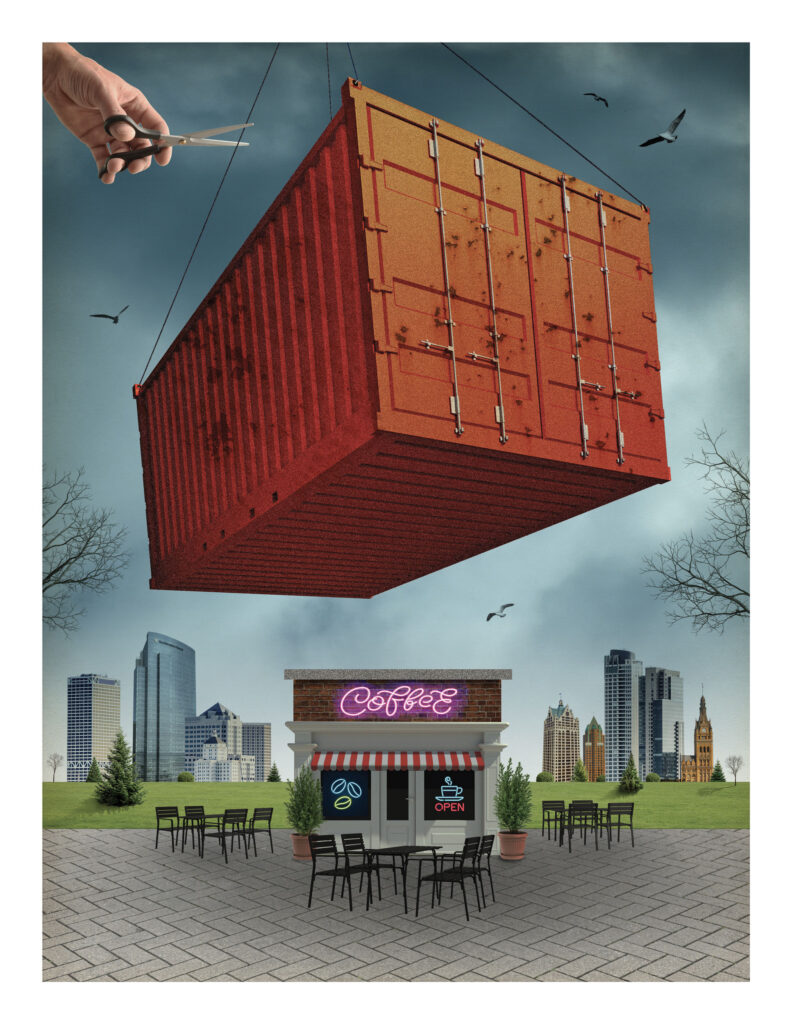
In Milwaukee’s food and drink scene, the quiet threads that tie global supply chains to neighborhood storefronts are starting to fray.
Coffee roasters, chocolatiers, wine shops and international grocers are all confronting the same uneasy reality: tariffs that shift without warning and reshape the cost of doing business overnight.
The challenges look different for each business, but the pressure is shared. There has been real or promised relief for some sectors with the easing or elimination of certain food tariffs late last year. But as policies continue to whiplash, these small businesses are left calculating not just rising costs, but how long customers can shoulder them, too.

If someone has inspired you through their service, leadership or dedication, the Unity Awards are your opportunity to recognize them!
Stone Creek Coffee
FOUR LOCATIONS IN THE MILWAUKEE AREA
No matter how “local” the coffee, beans have to be imported from all over the globe. Specifically, from tropical climates of what’s called the Coffee Belt spanning South and Central America, Africa and Asia.
When sweeping tariffs went into place, the impact hit roasters fast and hard. Milwaukee-based Stone Creek Coffee roasted around 600,000 pounds of coffee beans in 2025, primarily from Colombia (which had a 10% tariff), Guatemala (10%) and Costa Rica (15%).
Stone Creek estimates it paid an additional $270,000 on just tariffs in 2025. Include additional tariff-related costs tied to getting coffee and the total ballooned to nearly $1 million. This came on top of steep year-over-year increases in non-tariff product costs – 5% to 35%, depending on supplier.
Between tariffs and other cost increases, coffee prices are up 250% compared to 10 years ago, according to Eric Resch, founder and co-owner of Stone Creek Coffee. “We’re a high-end specialty coffee roaster; we do not, and cannot, compromise on quality,” he says. “The only outlet is to ask our customers to participate in that vision and support a Milwaukee-based business. And, luckily, they have.”
“The tariff change in November helps nominally, but how do you make long-term decisions when the short term constantly changes?”
The company also refuses to compromise on employee pay so it has raised prices to offset some of the product cost increases. Resch emphasizes that nobody at Stone Creek is profiting from these adjustments. Instead, the company is bracing for more uncertainty as tariff policy continues to shift – as it did late last year when tariffs on coffee were lifted. Had those levels of tariffs remained in place for 2026, Stone Creek expected to face costs of nearly $1 a pound on the 650,000 pounds of coffee it plans to roast this year.
Even with that relief, the future is still murky. Resch is uncertain what the impact will be for prices. “The tariff change in November helps nominally, but how do you make long-term decisions when the short term constantly changes?” he says. “We think prices are high but stable. It just depends on where the coffee market goes and broader tariffs beyond the coffee market. We did one increase in June, and we may do another step. We just don’t know.”
The Chocolate Sommelier
829 E. BRADY ST.
When the holiday rush hit The Chocolate Sommelier, owner Karen Duffy felt fortunate to have a stockpile of chocolate tucked away – a strategic buffer she’d been building since early 2025.
Duffy curates and sells the highest-end truffles from around the world; importing is central to her business. So that January, with talk of tariffs looming, she contacted her suppliers in Canada, Austria, France and Italy. She ordered extra cases of customer favorites, hoping they’d help shield her shop from the financial blow she feared was coming. With a decent shelf life, she figured she could stretch her inventory if needed.
It was a dramatic shift from how she’d always operated. Before, she could place an order and trust it would arrive within weeks. But now, even well-planned shipments can stall, sometimes indefinitely.
“No longer can authorized importers ship to me with any kind of security or confidence,” Duffy says. Confusion has reigned. “There are stories of chocolate sitting places because no one seems to know procedures anymore. Who collects the tariffs? Who pays who? The shipper? The end user? Because it’s perishable, they can just end up throwing it out.”
Even with her stockpile, Duffy hasn’t escaped rising costs. Distributors have tacked on increased fees of 10%, 15% and even 20%, roughly matching the tariffs imposed on chocolate-exporting countries like Austria, France and Italy. She’s absorbed as much as possible to keep prices stable, but her usual $10-$12 items have risen by $1-$1.50.
For customers seeking high-quality chocolate, those increases may feel manageable. But grocery store brands that use cheaper cocoa have raised prices, too. As with coffee, tariffs pile onto existing cost pressures. Poor growing seasons have tightened supply, pushing cocoa prices from about $2,500 a metric ton two years ago to as high as nearly $13,000 in December of 2024 and about $6,000 a year later.
As 2025 wrapped, Duffy remained unsure just how deeply tariffs would cut into sales. November’s announcement that cocoa tariffs would be lifted could provide price relief from domestic makers, but wouldn’t effect her costs for the finished chocolates she imports. “There’s definitely going to be price increases in 2026,” Duffy says. “If tariffs don’t stop and harvests don’t get better, the importers are raising their fees. It will have an effect on pricing for smaller operations like mine or bean-to-bar makers. Let’s just hope there’s a good cocoa harvest.”
Pan-Asia Supermarket
6910 W. GREENFIELD AVE., WEST ALLIS
Opening any store is a feat. Opening a 36,000-square-foot grocery operation that relies almost entirely on imported goods – all while sweeping tariffs reshape global supply chains – is something else entirely.
That was the reality for Pan-Asia Supermarket, a growing national chain that opened in West Allis last July. Instead of a smooth debut, store manager Siew Tran says, the business spent much of its first year navigating higher costs, unpredictable supply and constant budget-cutting adjustments on an already tight margin.
Taxes on imported products and services, aka tariffs, have been a cornerstone of President Donald Trump’s trade and foreign policy. He says they’ll boost the domestic economy and investment in the U.S. by encouraging consumers to buy American while providing billions for the federal government. Many mainstream economists are skeptical of those assertions, even with the economy remaining more resilient in 2025 than many expected. A November analysis by the nonpartisan Tax Foundation estimated Trump’s threatened and imposed tariffs cost the U.S. 0.5% in GDP and increased the tax burden on the average U.S. household by $1,100.
The original plan was straightforward: lean on fewer distributors and source heavily from China. But tightened supply chains and rising import expenses quickly upended that model. To keep shelves full, Tran says, the team had to widen its sourcing network across multiple countries.
“We shifted our focus to Thailand, Japan, Korea, but even they have had higher wholesale and logistics costs,” she says. “Suppliers only pass costs on to us if it hits a threshold, but it means we have to be very cautious about certain items, and that limits our stock availability.”
As a new business, Pan-Asia has shouldered most of the added tariff-driven costs, especially for shelf-stable staples such as sauces, noodles and rice. For a 20% tariff on a good, a distributor might absorb a quarter to half of that, but the rest landed squarely on Pan-Asia. With suppliers emailing about price changes, the store has had to rethink sourcing and find new partners for key items.
Some adaptations have been unexpectedly positive. Pan-Asia began working with local farms to meet its produce needs, reducing lead times and offering fresher goods at lower prices. While customer habits remain mostly steady, aside from a dip in seafood purchases, she expects challenges to continue and anticipates “more creative solutions” ahead, especially with “many challenges [from tariffs,] from higher costs to low supply,” Tran says.
2A Wine Merchants
577 E. ERIE ST.
At 2A Wine Merchants, co-owner Tony Bisciglia has watched a clear pattern emerge: Customers are “trading down.” Instead of reaching for their usual bottle, many now choose something a little cheaper. The high-end collectors still splurge, but the shop’s core consumers – the middle of the market – are spending about 10%-15% less than they did just a few years ago. It’s not a direct impact of tariffs, but Bisciglia believes people are tightening their belts because essentials are costing more.
That shift comes as prices across the wine world continue to rise. In an industry shaped by ever-changing regional trends and stylistic waves, costs are rarely static. But tariffs have added a new layer of unpredictability.
For years, wine distributors were well stocked with imports, so the initial, direct impact of tariffs wasn’t dramatic. But as those reserves have dwindled, the effects are becoming harder to ignore. Costs inched upward not just for the wine itself, but for everything around it.
“I know suppliers that are now sourcing glass all over the world, looking for the lightest glass out there because of freight costs associated with tariffs,” Bisciglia says. “It’s a complex matrix that is ultimately driving costs up for everything and causing people to spend less on wine as prices go up.”
With 60% of 2A’s inventory coming from overseas, the ripple effects are significant when they are selling wines from around the globe: Europe (10%-20% tariffs in 2025), Chile (an additional 10% in 2025), South Africa (30%), New Zealand (15% in 2025) and Australia (10%). Still, Bisciglia says, the shop focuses on selling an experience, and that means adapting. They’ve leaned into new grapes and regions that offer strong value: white wines from Spain, German pinot noirs, and Chianti from lesser-known regions of Italy. All bring familiar styles at friendlier prices.
But tariffs have also nudged him to expand domestically. While Napa Valley prices continue to climb, Bisciglia has recently added impressive, affordable wines from Oregon, Washington and even a Wisconsin vineyard – American Wine Project in Mineral Point. These alternatives help keep customers in the $20-$30 range they now gravitate toward, rather than the $40-plus bottles they reserve for special occasions.
It’s something they plan to continue to look into more if tariffs continue to drive prices up.
“There is a lot of exciting wine making going on in the U.S., so it was always a little bit of a conversation before tariffs were put in place,” Bisciglia said. “This just expedited the conversation and moved us forward on it. We’ll see where the grapes take us next.”